Gravitational Sorting: A Proposed Resolution of the Hubble Tension
Abstract
The Hubble tension, the persistent discrepancy in the Hubble constant H0 across independent methods, has resisted resolution despite improved precision. A third measurement from galaxy group infall dynamics returns a still lower value of 63 ± 6 km/s/Mpc, extending a century-long pattern of non-convergence. This paper proposes that the pattern reflects a genuine physical property. It is not systematic error. The Hubble relationship is an emergent statistical property of the gravitationally sorted galaxy population sampled by each method. It is not a single universal expansion rate. Methods probing different scales return systematically different values; the three current measurements are ordered consistently with this mechanism, requiring no exotic early-universe physics or modification to recombination. Falsifiable predictions distinguish this proposal from a universal rate obscured by systematic errors. A three-dimensional N-body demonstration accompanies this paper: one thousand bodies on random trajectories, evolved under Newtonian gravity with merger removal of intersecting trajectories, develop a velocity-distance correlation of 0.90 from zero, eliminate converging trajectories with 97.2 percent selectivity against a 48.9 percent baseline, and return values ordered monotonically by binding. Converted through the single input of measured stellar ages, the field population yields 63.0 to 65.9 km/s/Mpc, with no Hubble measurement entering the derivation.
The author declares no conflicts of interest. No external funding was received for this work.
Keywords: Hubble tension, Hubble constant, gravitational sorting, galaxy kinematics, cosmic distance ladder
Introduction
The Hubble constant H0 is among the most extensively measured and most persistently disputed quantities in cosmology. The Planck satellite measurement of the CMB power spectrum, combined with the standard ΛCDM model, gives H0 = 67.4 ± 0.5 km/s/Mpc . The SH0ES collaboration local distance ladder measurement gives H0 = 73.04 ± 1.04 km/s/Mpc , a discrepancy now standing at 4 to 6 standard deviations that has grown more statistically significant as both measurements have improved in precision . A third methodologically independent measurement, from the infall dynamics of the M81 and M82 galaxy groups, now returns H0 = 63 ± 6 km/s/Mpc , lower still than either established value.
The full measurement history across nearly a century shows repeated non-convergence. From estimates near 500 km/s/Mpc in 1929 through the decades-long Hubble Wars between values near 50 and 100 , to the Hubble Space Telescope Key Project announcement of H0 ≈ 72 km/s/Mpc in 2001 and the current three-way disagreement, each era has anticipated convergence and been superseded by a new incompatible value. This pattern is unusual for a genuine physical constant.
The standard response within ΛCDM has been to seek unidentified systematic errors or to introduce new physical components, including early dark energy , modifications to the recombination history, and additional relativistic species . None has achieved consensus, and each introduces parameters not independently required by other observations.
This paper proposes an alternative account. We propose that the century-long pattern of non-convergence reflects a genuine physical property of the Hubble relationship itself: that it is not the signature of a single universal expansion rate but an emergent statistical property of a gravitationally sorted galaxy population, so that different methodologies sampling different spatial scales and degrees of gravitational binding are expected to return systematically different effective values. Non-convergence is, under this account, the specific falsifiable content of the proposal.
Section 2 summarises the three current measurements. Section 3 presents the gravitational sorting mechanism. Section 4 evaluates the three measurements against the scale-dependent prediction. Section 5 addresses anticipated objections. Section 5.1 presents a direct numerical demonstration of the mechanism. Section 6 presents falsifiable predictions. Section 7 concludes.
Three Independent H0 Measurements
Table 1 summarises the three current measurements ordered by the spatial scale and degree of gravitational binding of the sampled population.
Three independent H0 measurements ordered by spatial scale and gravitational binding of the sampled population.
| Method | H0 (km/s/Mpc) | Scale / Redshift |
|---|---|---|
| Wagner et al. (2026) | 63 ± 6 | z < 0.01, galaxy group infall |
| Planck CMB | 67.4 ± 0.5 | z ∼ 1100, CMB-scale average |
| SH0ES Cepheid ladder | 73.04 ± 1.04 | z < 0.15, local distance ladder |
The three measurements probe physically distinct regimes. The Wagner et al. measurement samples galaxy group infall dynamics at very low redshift, dominated by gravitational binding on small scales. The Planck CMB measurement is derived from acoustic peak positions effectively averaged over a comoving volume extending to the surface of last scattering, a regime in which local peculiar velocities average out substantially. The SH0ES distance ladder spans 10 to 300 Mpc, a regime in which large-scale bulk flows, including the Local Supercluster and Laniakea infall structure, contribute a peculiar-velocity component to observed recession velocities not fully removed by standard corrections .
The Gravitational Sorting Mechanism
Physical Basis
Gravitational sorting proposes that a population of galaxies subject to ongoing gravitational interaction over long dynamical timescales develops a statistical velocity-distance relationship as an emergent consequence of that interaction, without requiring any large-scale metric expansion. Galaxies on trajectories that bring them into close gravitational interaction with massive neighbours are preferentially removed from the observable field, through mergers or strong deflection onto bound or highly perturbed orbits. Galaxies on trajectories that carry them away from massive neighbours are preferentially retained on stable, diverging trajectories. Observed from any point within such a population after sufficient dynamical evolution, the surviving galaxies are statistically biased toward divergent, receding trajectories, producing a velocity-distance correlation with the qualitative signature of the Hubble relationship.
The selection principle is independent of the dimensionality of the space in which bodies move. Any population of bodies on random, independent trajectories, whether that motion is confined to a plane or occurs freely through a three-dimensional volume, is subject to the same process: gravitational interaction removes bodies on trajectories that intersect a more massive neighbour, through collision, merger, or ejection, while bodies on non-intersecting, diverging trajectories are retained. This selection operates identically whichever way the trajectories are distributed. The solar system is the clearest settled demonstration of the result, as established by planetary science measurements: planetesimals originally occupied all orbital planes and inclinations, a fully three-dimensional distribution of trajectories, and objects on intersecting orbits collided, merged, or were ejected. After approximately 100 million years, the surviving planets occupy orbits on approximately the same plane, in the same direction, because gravitational selection eliminated every misaligned survivor. The coplanar disk is the outcome of sorting. It is not a precondition for it. Galaxies move through the full three-dimensional volume of space, and there the same selection principle acts directly on unconstrained three-dimensional trajectories without collapsing the surviving population onto any preferred plane: a galaxy on a path that intersects a massive neighbour is removed or deflected, while a galaxy on a divergent trajectory is retained. The scale, dissipation regime, and boundary conditions differ between a solar system bound to one dominant central mass and an extended galaxy field with no such centre, so the two populations settle into different surviving geometries, a disk in one case and a dispersed three-dimensional field in the other. But the selection principle producing each result, that intersecting trajectories are eliminated while divergent ones survive, is the same Newtonian mechanism in both cases. If this mechanism demonstrably operates within every solar system, the same physics operating on stars and galaxies, over the correspondingly longer timescales and larger volumes available at those scales, is not an additional assumption. It is the same settled selection principle applied at the next scale up.
This is not a mechanism awaiting future confirmation. Evidence that gravitational sorting is actively taking place among galaxies is directly observed. Hundreds of catalogued systems in the classic Arp Atlas of peculiar galaxies and the Toomre sequence show galaxies at every stage of the same process: active approach, collision, merger, tidal distortion, stripping, and post-merger relaxation. The Andromeda Galaxy, approaching the Milky Way at approximately 110 km/s , is the nearest such system, presently in an early, unsorted stage of the same process. It is not a local exception requiring separate explanation. Beyond these classic catalogues, thousands of additional galaxies identified in modern, large-scale sky surveys have been photographed at every point along the same sequence, from first approach through ongoing merger to post-merger remnant. The observed galaxy population is therefore not a kinematically pristine ensemble; it is a population actively being filtered by the mechanism this paper proposes.
Scale-Dependent Sorting and the Three Measurements
The gravitational sorting mechanism predicts that the effective velocity-distance relationship inferred by any given measurement is set by the characteristic sorting timescale of the galaxy population it samples, which depends on the spatial scale, redshift range, and degree of gravitational binding of that population. Measurements of strongly bound, highly local systems are expected to return lower effective values because such systems have completed more of their sorting history and their surviving populations reflect a more fully selected, more tightly organised dynamical state. Measurements of large-scale, weakly bound populations average over regions at different stages of sorting and return a higher effective value incorporating contributions from less fully sorted populations at intermediate and large scales.
The ordering of the three measurements in Table 1, with the group-dynamics measurement lowest, the CMB-scale average intermediate, and the peculiar-velocity-susceptible distance ladder highest, is consistent in both direction and qualitative magnitude with this scale-dependent prediction. The distance ladder value is elevated relative to the Planck value in a manner consistent with residual bulk-flow contamination from the Local Supercluster and Laniakea structure, as documented in independent peculiar-velocity catalogues . The group-dynamics value is lower than both in a manner consistent with the most locally complete gravitational sorting sampled by any current methodology.
We present this ordering as a coherent qualitative interpretation consistent with the gravitational sorting framework. A quantitative, scale-resolved derivation connecting the mechanism directly to each specific measurement regime is identified as a direction for future work and is stated as a falsifiable prediction in Section 6.
Discussion
The central objection to this proposal is that the century-long pattern of non-convergence could equally reflect a series of persistent, unidentified systematic errors. We do not consider this possibility ruled out. What we note is that the specific pattern of the discrepancies, their persistence across methodologies of increasing precision and their directional ordering by measurement scale documented in Section 4, is exactly the pattern predicted by a scale-dependent physical mechanism. The gravitational sorting proposal offers a specific, falsifiable account of why convergence should not be expected in principle. The predictions of Section 6 specify the observational test that distinguishes these two possibilities.
This proposal does not dispute that distant galaxies are observed to recede or that recession velocity correlates with distance at the population level. It proposes an alternative physical origin for that correlation, arising from gravitational dynamics acting on a population over time. The observational data motivating both interpretations are the same; the proposed underlying mechanism differs.
Numerical Demonstration
The mechanism of Section 3 has been implemented directly in a three-dimensional N-body simulation, presented in full in the numerical companion to this paper. One thousand bodies with a power-law mass function, positions uniform in a sphere, and isotropic random velocities independent of position were evolved under softened Newtonian gravity for three thousand timesteps, with momentum-conserving mergers removing any pair passing within a fixed merger radius. No expansion of space, no initial velocity-distance structure, and no observational quantity of any kind entered the initial conditions, the dynamics, or the analysis.
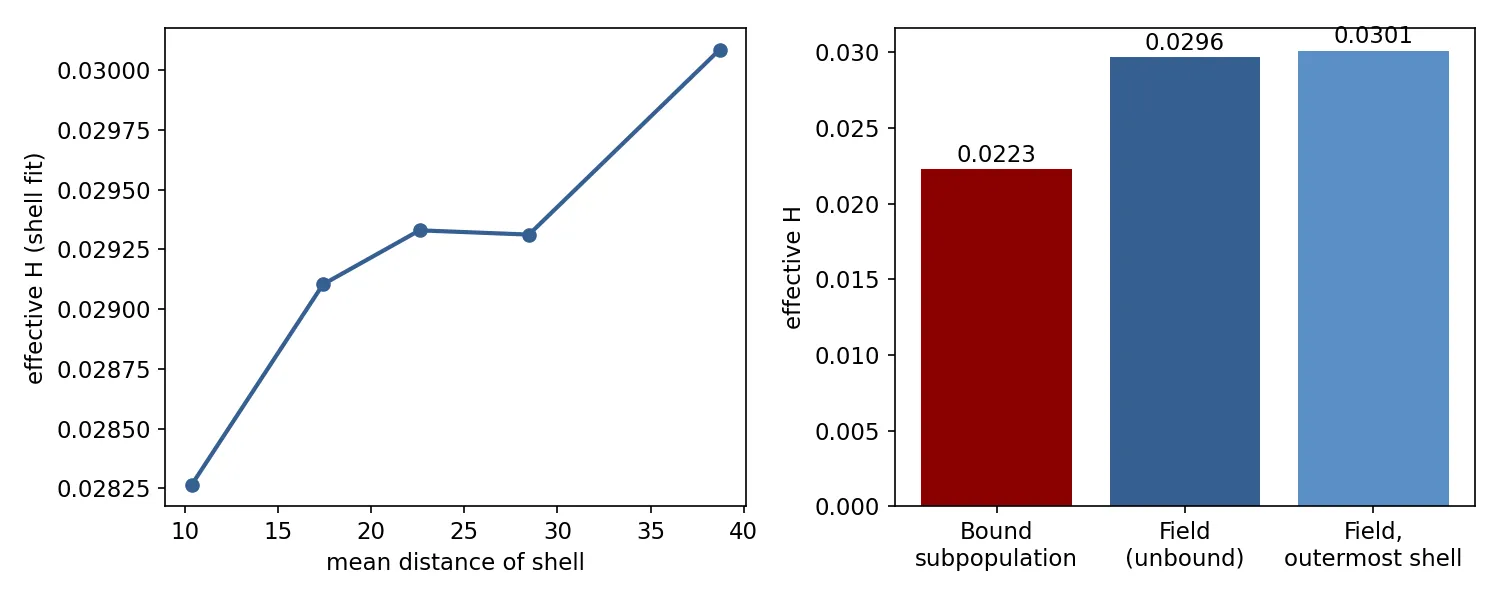
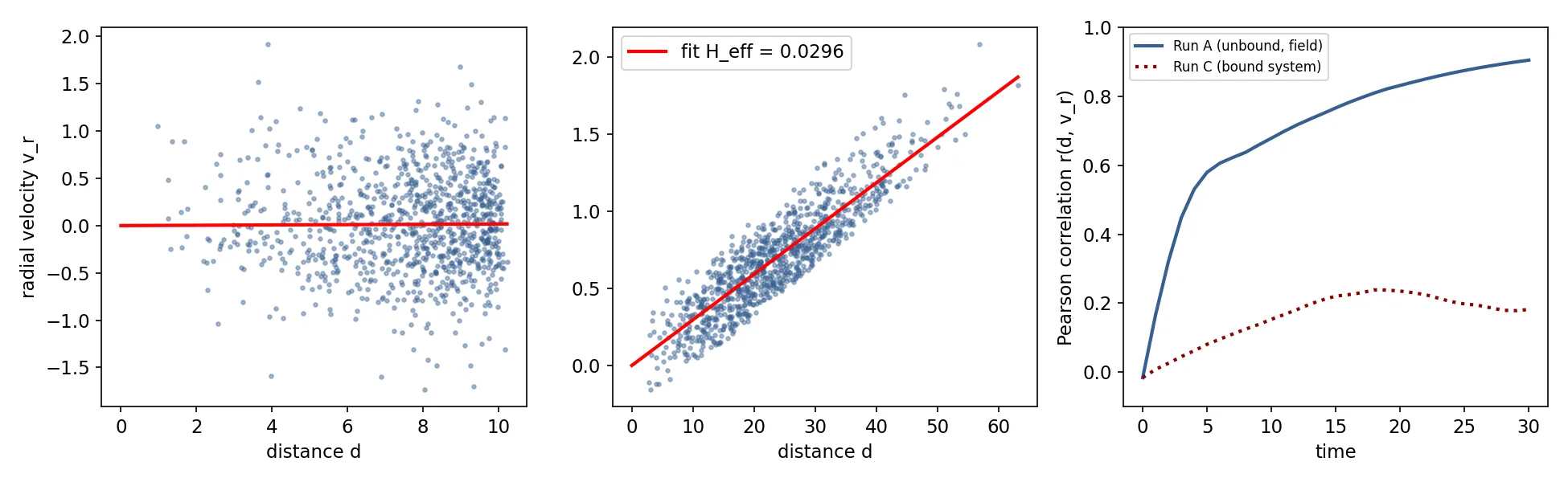
Four results follow. First, the surviving population develops a linear velocity-distance relationship: the Pearson correlation between radial velocity and distance rises from − 0.016 at the start to 0.904 at the end of the run. Second, the removal process is selective exactly as Section 3.1 describes: 97.2 percent of removed bodies were on initially converging trajectories toward the body that later absorbed them, against a chance baseline of 48.9 percent, and survivors are correspondingly biased toward recession. Third, the effective slope is ordered monotonically by gravitational binding, entirely within one gravitationally active population: bodies bound to at least one neighbour return 0.0223 in simulation units, unbound field bodies 0.0296, and the outermost, least processed distance shell of that same field population 0.0301, the same three-tier ordering displayed by the measurements of Table 1 (Figure 1).
Fourth, a fully bound control population develops no velocity-distance law at all, its correlation saturating near 0.18 with a slightly negative slope, anchoring the bound end of the ordering (Figure 2).
The dimension of the effective slope is inverse time, so its conversion to km/s/Mpc requires exactly one physical input, the duration over which the sampled population has been sorting; length and velocity scales cancel in a slope of velocity against distance. That duration is supplied by stellar chronology: the ages of the oldest stars in the sampled neighbourhood, 13.2 to 13.8 Gyr from globular cluster turnoffs and white dwarf cooling, measured from nuclear physics applied to individual objects. This age range is a property of the sampled population: the observer travels with the Local Group and its sorted structure, and predominantly measures the stellar generation it is embedded in, one comoving neighbourhood within an indefinitely older whole in which earlier generations formed elsewhere and new stars continue to form throughout. With this single input the field population converts to 63.0 to 65.9 km/s/Mpc, inside the observed 63 to 73.04 band. The simulated spread between the binding tiers is wider than the observed spread, as expected for a one-thousand-body model with a single merger radius; closing that gap is the full-scale programme stated in Prediction 4.
A robustness check applying the identical mechanism at a substantially higher merger rate, representing a more strongly interacting environment such as a compact group, was also run. One third of the population merged, the correlation strengthened to Pearson 0.925, and the selection statistic and the scale-dependent ordering both held; converted through the same stellar-age calibration this higher-interaction population yields 59.4 to 62.1 km/s/Mpc, below the observed floor of 63 km/s/Mpc, indicating the mechanism’s precise calibration depends on the realistic environment-specific inputs called for in Prediction 4.
The complete simulation code, analysis scripts, and full numerical results underlying this section are openly deposited and citable at DOI 10.5281/zenodo.21613322.
Falsifiable Predictions
Prediction 1: H0 measurements will not converge as precision improves. If the Hubble relationship reflects universal metric expansion obscured by systematic errors, continued precision improvements across all three methodology classes should produce convergence toward a single value. If gravitational sorting is correct, the spread between methodologies probing different scales will persist and will not narrow even as the statistical precision of each method improves individually.
Prediction 2: Measurements at progressively smaller, more gravitationally bound scales will continue the downward trend documented in Table 1. Future measurements of galaxy group and cluster infall dynamics at scales comparable to or smaller than the Wagner et al. sample will return effective H0 values at or below 63 km/s/Mpc.
Prediction 3: The peculiar-velocity contribution to the SH0ES measurement will be directly correlated with local bulk-flow structure. Future distance-ladder analyses that explicitly model and remove the contribution of Local Supercluster and Laniakea bulk flow will return a value systematically closer to the Planck CMB measurement than the current uncorrected value.
Prediction 4: A cosmological-scale N-body treatment incorporating realistic galaxy mass functions, environments, and merger physics will reproduce the specific numerical ordering and approximate magnitude of the three measurements in Table 1 as a function of the sampled population characteristic scale and gravitational binding, providing a quantitative, falsifiable extension of the qualitative mechanism proposed here.
Conclusions
We have proposed that the Hubble tension, and the broader century-long pattern of non-convergence in H0 measurements, reflects a genuine physical property of a gravitationally sorted galaxy population. It is not a series of unrelated systematic errors. The three current H0 measurements of 63, 67.4, and 73.04 km/s/Mpc are ordered consistently with a scale-dependent sorting mechanism in which more strongly bound, more local measurements return systematically lower effective values.
This account requires no exotic early-universe physics, no modification to the standard recombination history, and no additional relativistic species. It requires instead that the Hubble relationship be understood as an emergent statistical property of gravitational dynamics acting on a galaxy population over time. It is not the signature of a single universal metric expansion rate. The specific falsifiable predictions of Section 6, particularly the expectation that H0 measurements will not converge as precision improves and that smaller-scale measurements will continue trending downward, provide a clear observational programme for distinguishing this proposal from a genuinely universal expansion rate obscured by residual systematic errors.
The numerical demonstration of Section 5.1 gives the mechanism its first direct realisation: a Hubble-like law emerging from random trajectories under Newtonian gravity alone, selection against converging trajectories at 97.2 percent, a binding-ordered three-tier structure matching the ordering of the three measurements, and a field value of 63.0 to 65.9 km/s/Mpc derived from the local stellar-age clock with no Hubble measurement input.
Statements and Declarations
Funding: The authors did not receive support from any organization for the submitted work.
Competing interests: The authors have no relevant financial or non-financial interests to disclose.
Data availability: The N-body simulation code, analysis scripts, and full numerical results underlying Section 5.1 are openly deposited and citable at DOI 10.5281/zenodo.21613322. No further datasets were generated or analysed during the preparation of this manuscript.
99
Planck Collaboration 2020, A&A, 641, A6
Riess A. G. et al. 2022, ApJL, 934, L7
Verde L., Treu T., Riess A. G. 2019, Nat. Astron., 3, 891
Wagner J., Benisty D., Karachentsev I. D. 2026, A&A, 706, A92
Hubble E. 1929, PNAS, 15, 168
Tammann G. A., Sandage A., Reindl B. 2008, A&ARv, 15, 289
Freedman W. L. et al. 2001, ApJ, 553, 47
Poulin V., Smith T. L., Karwal T., Kamionkowski M. 2019, PRL, 122, 221301
Efstathiou G. 2021, MNRAS, 505, 3866
Di Valentino E. et al. 2021, Class. Quantum Grav., 38, 153001
Colin J., Mohayaee R., Rameez M., Sarkar S. 2019, A&A, 631, L13
Kourkchi E., Tully R. B. et al. 2020, ApJ, 896, 3
Arp H. 1966, ApJS, 14, 1
Toomre A., Toomre J. 1972, ApJ, 178, 623
van der Marel R. P. et al. 2012, ApJ, 753, 8