This paper presents three independent categories of argument that the
universe is spatially infinite and has no physical boundary. The first
is conceptual: a physical boundary of space is incoherent because a
boundary requires a physically meaningful distinction across it, whereas
absolute non-being cannot function as a physical interface. The second
is logical: the standard cosmological model's own answer to the question
of where the Big Bang singularity was located, namely that it was
everywhere, undermines any finite localised-origin premise. The third is
derivational and observational within the BFUT framework: the
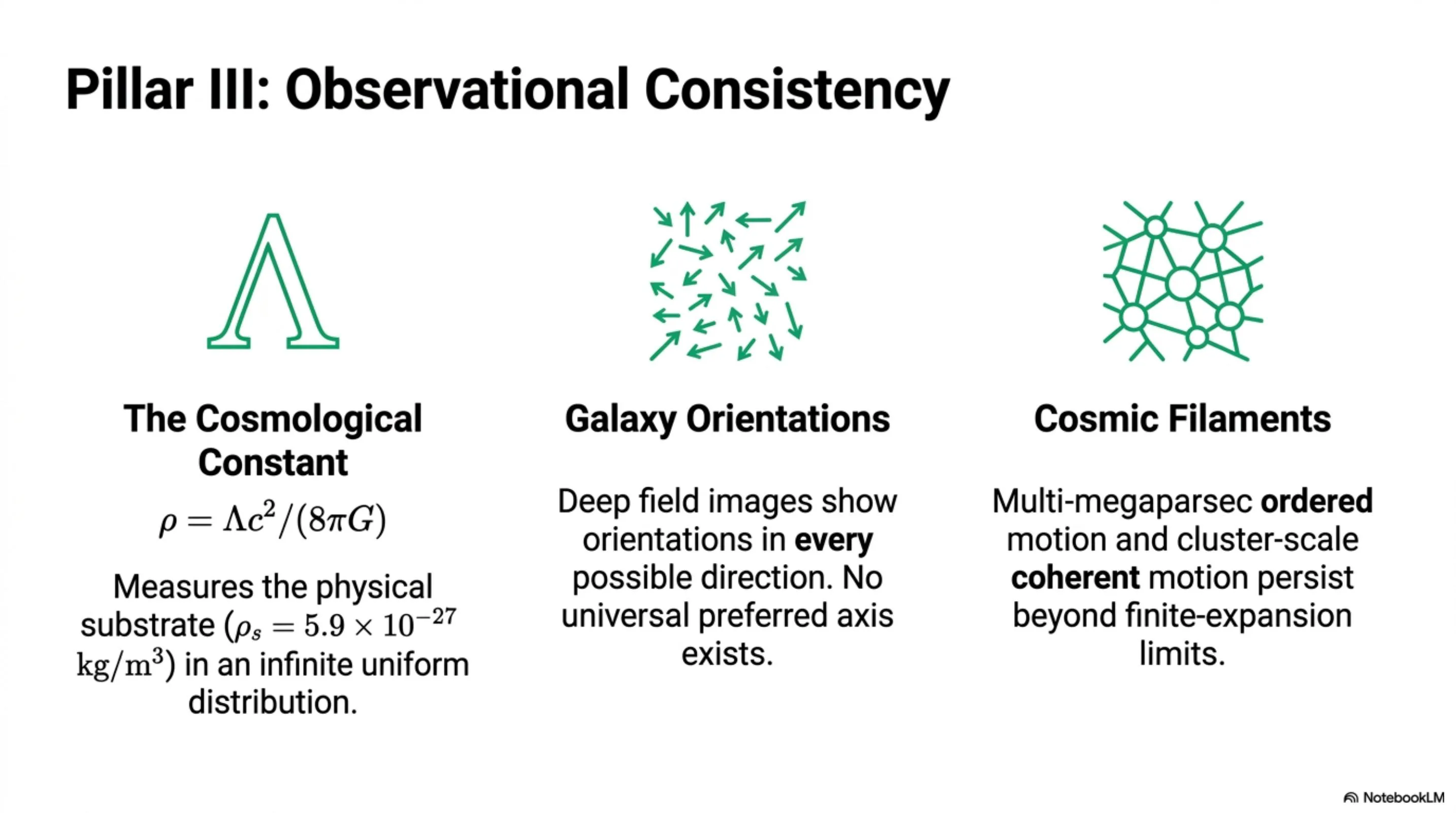
cosmological constant Λ yields the equilibrium density of the Spaticle
field ρ_s = Λ c² / (8 π G) ≈ 5.9 × 10⁻²⁷ kg/m³ from established physics
with no free parameters in an infinite uniform distribution (as
established independently across multiple sectors in BFUT Paper 14);
current large-scale orientation evidence does not establish a single
robust global preferred axis consistent with a finite-boundary
cosmology; and large-scale ordered motion persists in rotating cosmic
filaments, cluster-scale coherent motion, and multi-megaparsec
environmental coherence beyond the scale at which naive finite-expansion
reasoning would expect such coherence to be washed out. Standard
responses are then examined - finite-but-unbounded topology,
singularity-era breakdown claims, and inflationary patches - and shown
either to change the question, relocate instead of resolve the boundary
condition, or introduce additional assumptions without direct
confirmation. The paper concludes that spatial infinitude is not merely
one cosmological option but the most coherent physical interpretation
within the BFUT framework.
The paper is part of a series presenting components of the Big
Flare-Up Theory (BFUT) [2], a comprehensive alternative cosmological
framework proposing an infinite eternal universe. The spatial infinitude
argument presented here is foundational to BFUT but can be evaluated
entirely independently of the other BFUT claims.
This paper argues that the question is not merely observationally
undecided but is logically, derivationally, and observationally decided
in favour of spatial infinitude. Three independent categories of
arguments are presented, each sufficient on its own and
convergent in their conclusion.
The question of whether the universe is spatially finite or infinite
has been debated since antiquity. The standard cosmological model, based
on the Friedmann-Lemaitre-Robertson-Walker metric, is agnostic on this
question: it permits both finite and infinite spatial solutions
depending on the sign of the spatial curvature parameter. Current
observational constraints from Planck 2018 results (2020) [1] find
Ωk = 0.001 +/- 0.002, consistent with spatial flatness and
therefore with both a very large finite universe and an infinite
one.
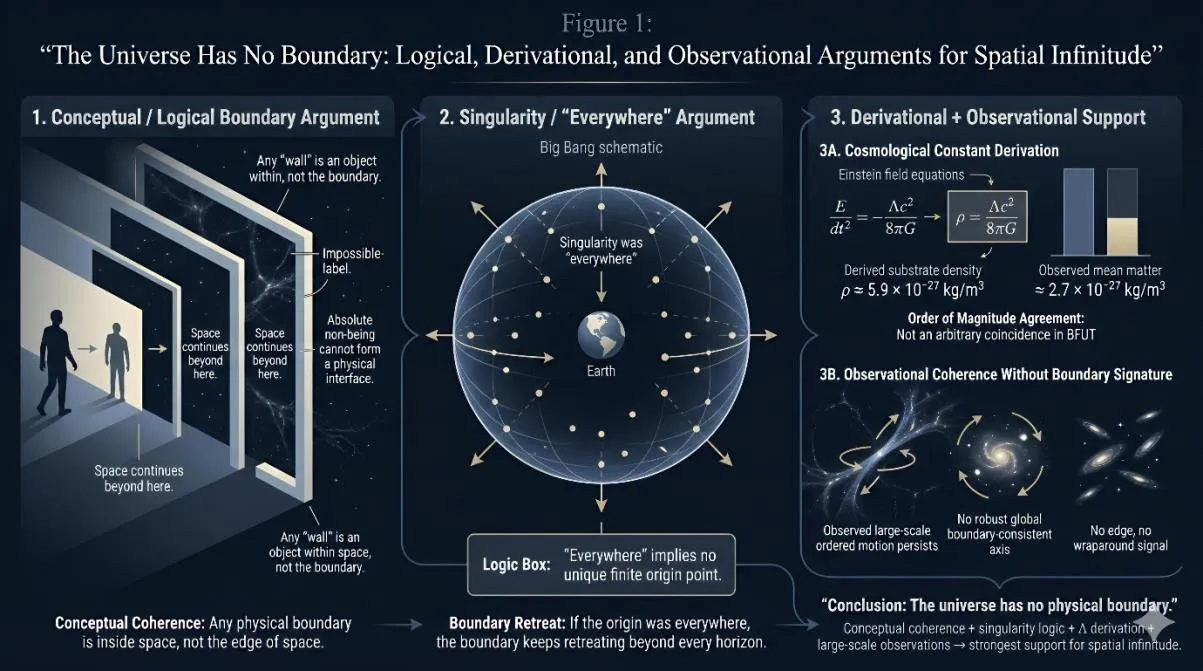
Figure 1. Representative schematic summary of the BFUT argument
for spatial infinitude. Formal arguments and citations are provided in
the main text.
The
Conceptual Proof: A Physical Boundary of Space Is Incoherent
Consider a thought experiment. You are standing in a room. The walls
are proposed to be the boundary of your accessible domain. You break
through the wall. There is more space beyond it. If that next boundary
is broken, there is more space again. Any physical barrier that can be
approached, touched, crossed, or even meaningfully described is not a
boundary of space itself. It is a structure located within space.
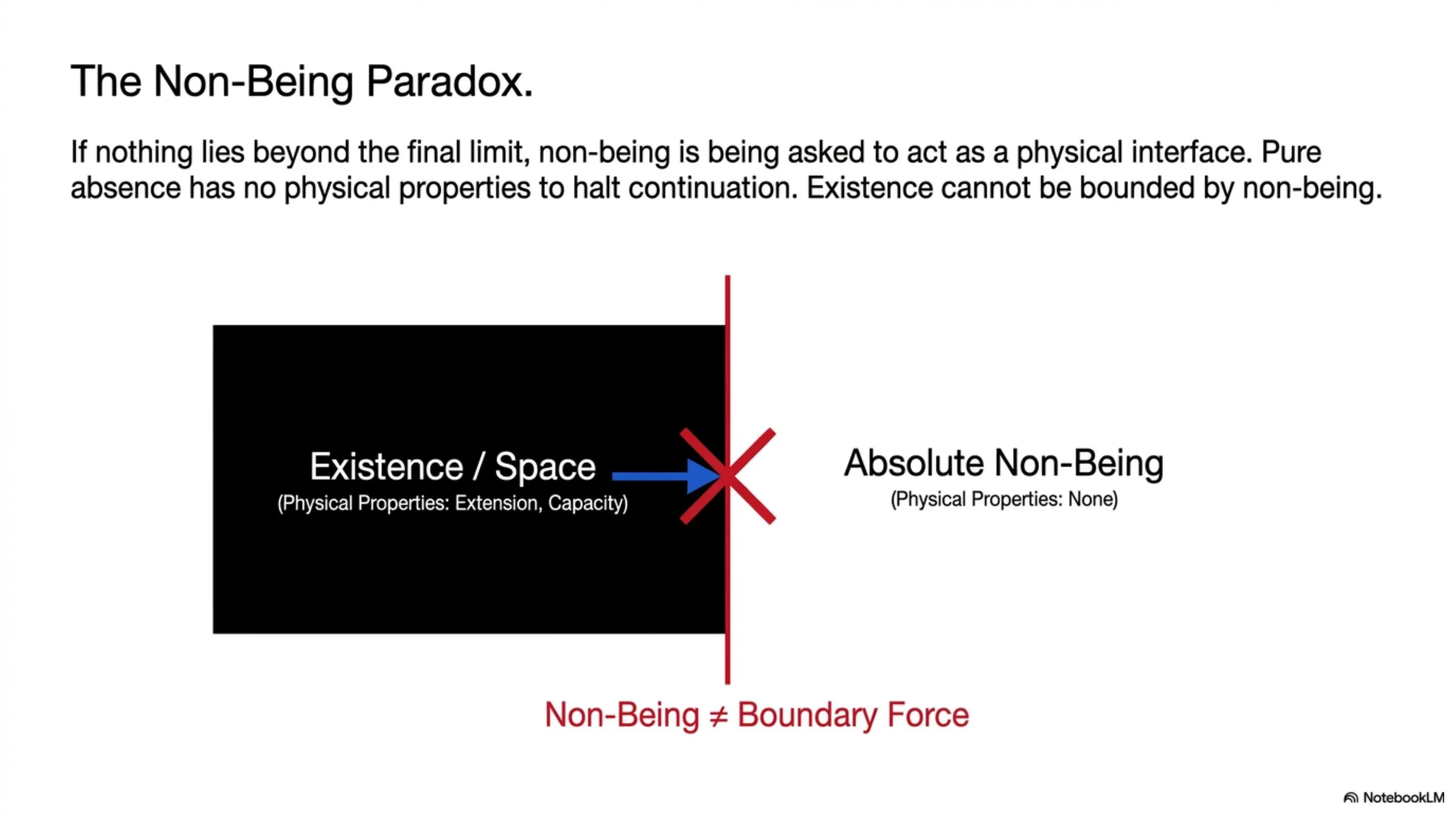
The only way to stop this regress is to say that beyond the final
limit there is not empty space but absolute non-being: no extent, no
geometry, no location, no causal capacity, no physical property of any
kind. But absolute non-being cannot function as a physical interface. A
boundary is not merely a line in a diagram. A boundary is a physically
meaningful distinction across which something changes. If one side of
the proposed boundary has no physical status whatsoever, then there is
no physically meaningful interface there to describe, locate, or
interact with.
Therefore the idea of a physical boundary of space is conceptually
incoherent. Any proposed boundary is either inside space, in which case
it is not a boundary of space but a structure within it, or it is said
to separate space from absolute nothing, in which case it ceases to be a
physical boundary at all.
Figure 1. The Boundary Regress and the Non-Being Paradox: Any proposed physical boundary of space either leads to an infinite regress or requires absolute non-being to act as a physical interface, which is incoherent.
This is why the paper retains the blunt formulation while also
defining it carefully: space, in the physically meaningful sense, is
infinite. The claim is not that every mathematical model of finite
topology is illegitimate. The claim is that purely formal topological
finitude does not by itself provide a physically meaningful ontology of
a finite totality of space. In the physically relevant sense, the
universe has no boundary.
Everything that follows in this paper should therefore be read as
reinforcement, not as the sole basis of the conclusion.
Figure 2. Three convergent BFUT arguments for spatial infinitude: a physical boundary is logically incoherent, the “everywhere” origin logic defeats a finite edge, and both the Λ-derived density scale and large-scale observations remain consistent with an unbounded universe.
The Singularity Location
Argument
Where Was the Singularity?
The standard cosmological model proposes that the universe originated
from a singularity. Before presenting the formal paradox, one prior
point must be established. The singularity, whatever it was, must be
located within the observable universe. The observable universe extends
approximately 47 billion light years in every direction from Earth. If
the singularity was the origin of everything including space, and if it
was at a specific location, that location must be somewhere within the
space that now exists. It cannot be outside the observable universe
because the observable universe is defined as everything that has had
causal contact with us. The singularity, having produced everything
including us, necessarily had causal contact with us.
Now ask: where exactly within the observable universe was the
singularity? The standard model cannot point to a specific location,
because any specific location would be a preferred centre, contradicting
the Copernican principle. The standard response is that the singularity
was everywhere: every point in the current universe traces back to the
singularity because space itself originated at the singularity.
The Formal Contradiction
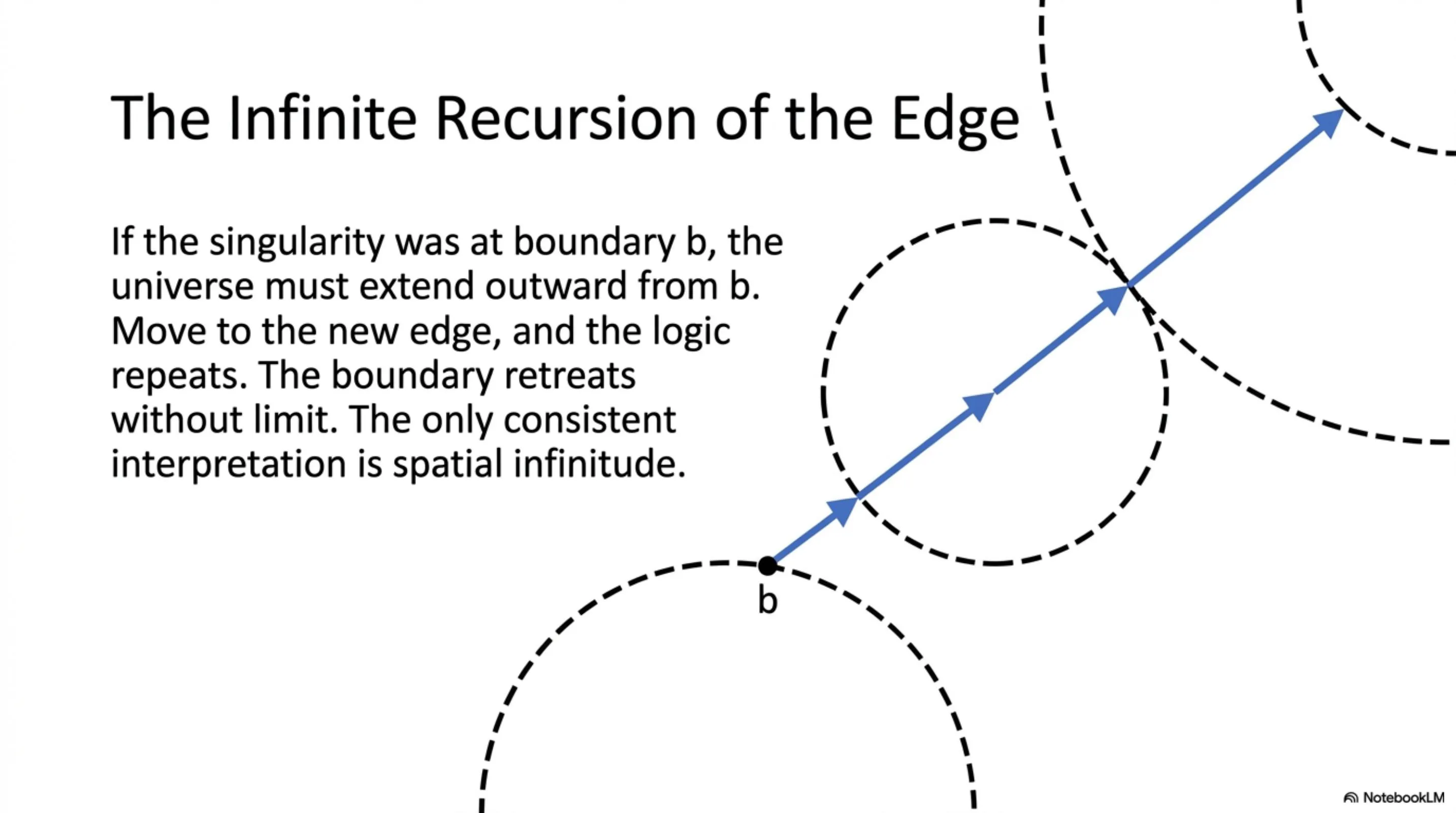
This response generates a formal contradiction. If the singularity
was at every point in the current universe, it was at every point
including those at the boundary of the observable
universe at approximately 47 billion light years from Earth. From any
point at that boundary, the same logic applies: the singularity was at
every point as seen from there, and the universe extends a further 47
billion light years beyond that boundary.
The boundary retreats without limit. The statement that the
singularity was everywhere is logically equivalent to the statement that
the universe is spatially infinite. This directly contradicts a finite
localised-origin interpretation of the Big Bang.
Figure 3. The Singularity Location Contradiction: The standard model’s claim that the singularity was “everywhere” logically requires the universe to be spatially infinite.
Formally: let U denote the universe and S the singularity. The
standard model asserts: for all p in U, S was at p. For any boundary
point b at the edge of the observable universe, S was at b. From b, the
same assertion applies recursively. There is no spatial boundary at
which the argument terminates. The only consistent interpretation is
that U is spatially infinite.
Standard Responses and
Their Evaluation
The "Finite but Unbounded" Universe
The first response proposes that the universe is spatially finite but
has no boundary, like the surface of a three-sphere. A two-dimensional
sphere has no edge: moving in any direction, one never reaches a
boundary but eventually returns to the starting point. The
three-dimensional analogue is a closed Friedmann model.
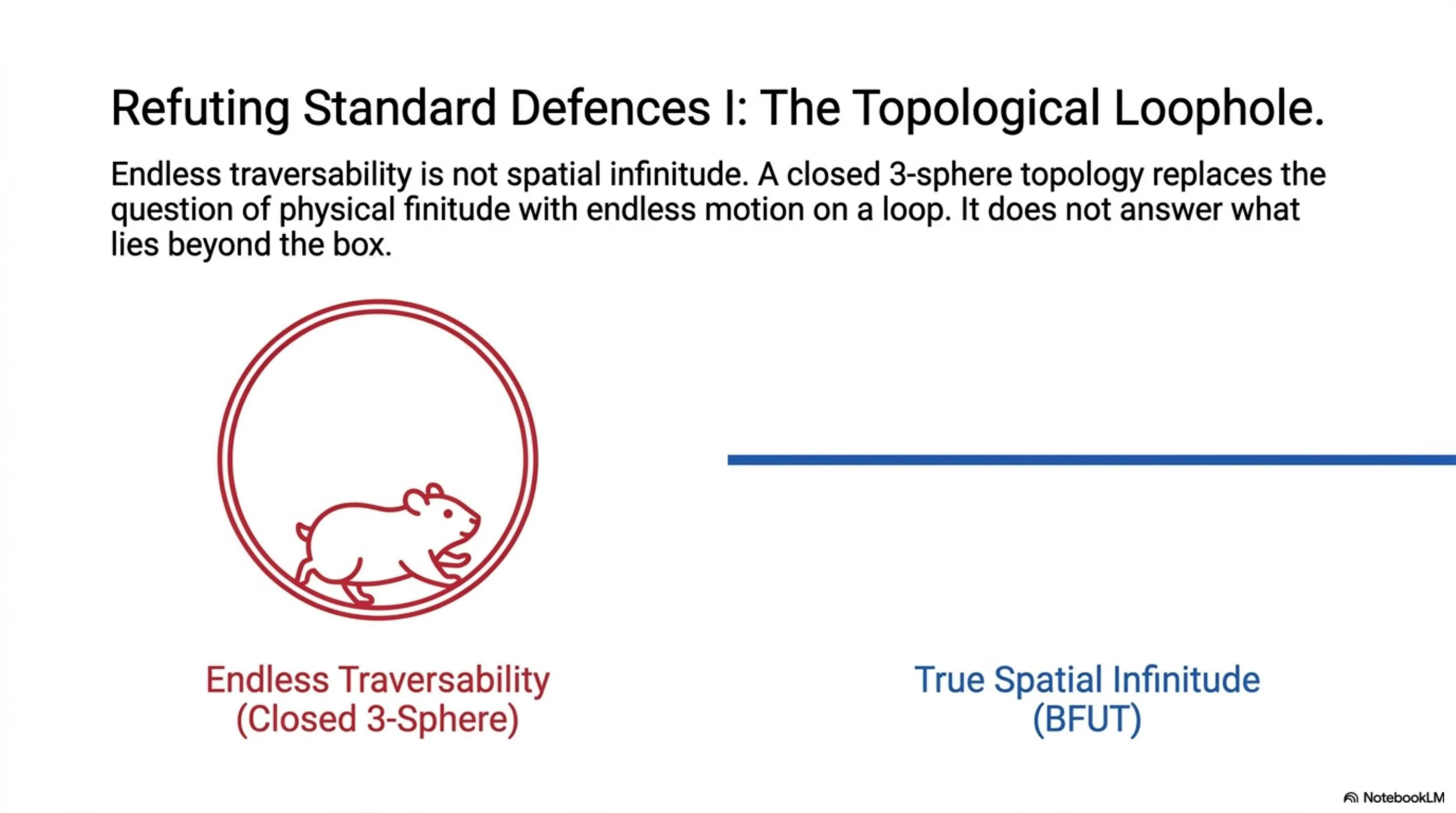
The standard ‘finite but unbounded’ reply can be illustrated more
plainly. Imagine a hamster placed inside a very large box and told,
‘This is the whole world. It is vast, but it has an end.’ If the hamster
then asks, ‘If I keep walking, will I eventually reach that end? And
what lies beyond it?’ the original question is perfectly clear. But
instead of answering it, the hamster is placed on a wheel and told, ‘You
can keep running forever and never reach an end.’ That does not make the
wheel infinite, nor does it answer what lies beyond the box. It merely
replaces the question of whether the world itself is finite with the
different claim that motion can continue indefinitely along a
constrained path. The same confusion often appears in cosmology: endless
traversability is presented as though it were equivalent to spatial
infinitude, when in fact it is only a different and weaker claim.
The three-sphere proposal does not resolve the contradiction; it
merely recasts it in the language of higher-dimensional topology. The
relevant question is whether it supplies a physically meaningful account
of finitude.
Figure 5. Refuting the Finite-but-Unbounded Defence: A closed 3-sphere topology replaces the question of physical finitude with endless traversability on a loop. It does not answer what lies beyond the boundary.
The scientific enterprise exists precisely to go beyond what appears
to an observer and find what actually is. An observer inside an enormous
finite universe cannot see its edge. An observer inside an infinite
universe also cannot see its edge. To both observers the universe
appears identical: isotropic, extending equally in all directions, with
the observer at the apparent centre. The question is not what appears to
the observer. The question is what is actually there. Physics does not
stop at the limits of human perception and say one cannot know. Physics
asks: if one could go macro, if one could step outside the observer
frame entirely, what is the actual geometry? Is the universe infinite or
finite? If it is finite, it has a shape. What is that shape? What
formula gives its total extent? The challenge is to specify what
physical finitude means in this case. A purely formal topological
description is not yet a complete physical account.
Furthermore, a Big Bang does not predict a three-sphere. Inflation -
invented specifically to explain why the universe appears spatially flat
- actively contradicts a detectable three-sphere, because a perfectly
flat universe is infinite. The Planck 2018 results (2020) measurement of
spatial curvature gives Ωk = 0.001 +/- 0.002, consistent with zero
curvature and consistent with infinite flat space. The standard model
uses inflation to explain flatness and then separately invokes
three-sphere topology to maintain finiteness. These two claims are in
direct tension. Neither is independently confirmed by observation. The
three-sphere is a post-hoc addition to the standard model, not a
prediction of it.
The three-sphere was specifically tested. The Planck satellite
analysed the CMB for the signature of a finite universe - the wraparound
signal that would appear if light had travelled all the way around a
finite universe and returned. No such signal was found. The standard
model's response was not to abandon the claim but to assert that the
universe is finite but too large for the wraparound signal to have
reached us. A claim that cannot be detected, cannot be tested, and
cannot be falsified under any observational programme is not a
scientific claim. It remains a speculative claim that survives only by
relocating the predicted signal beyond observational reach whenever
confirmation fails.
The decisive challenge is not merely philosophical but physical: a
finite totality must mean more than an elegant topological description.
A mathematically closed manifold may be formally valid, but formal
validity alone does not supply a physically meaningful account of what
makes the totality of space finite. The problem is that any attempt to
make such finitude physically intuitive tends to reintroduce the very
notion of delimitation the model is trying to avoid. If no physically
meaningful account of finitude can be supplied, the claim remains
formally possible but physically under-explained.
First, Planck 2018 results (2020) strongly constrains spatial
curvature and leaves little observational room for a substantially
closed geometry. While this does not by itself eliminate every
mathematically closed model under all dataset combinations and priors,
it materially weakens the empirical case for a physically significant
closed global geometry.
A further difficulty: there is only one scenario in which a finite
universe could avoid needing to expand outward - if it were expanding
inward from its boundary toward us. But this scenario generates its own
contradictions. First, the distance to the boundary would be different
in different directions. An observer located anywhere other than the
exact geometric centre of the finite universe would be closer to the
boundary on one side than the other - producing observable asymmetry in
all directions. No such asymmetry is observed. The CMB is uniform to one
part in 100,000 in all directions. Second, if the universe is
approximately 94 billion light years across - the current diameter of
the observable universe - an observer near the boundary would find
themselves only a few billion light years from the edge on one side and
approximately 90 billion light years from it on the other. The universe
would look completely different in opposite directions. It does not.
Third, for each point on the boundary, the direction of inward expansion
would be different - pointing toward a different centre depending on
where on the boundary you are located. The expansion direction cannot be
consistently defined. The inward expansion scenario does not escape the
boundary problem. It multiplies it.
The standard model simultaneously holds three claims that contradict
each other. First: the universe is finite - a closed system with a fixed
total content. Second: energy is not conserved globally - photons lose
energy through cosmological redshift and that energy simply disappears.
This is not a fringe claim. It is stated openly by leading cosmologists:
energy conservation does not hold globally in an expanding universe
under general relativity. But a finite closed system cannot leak energy.
If energy is disappearing, something outside the system is receiving it.
If something outside the system exists, the system is not closed. If the
system is not closed, the universe is not finite and self-contained. The
two claims - finite universe and disappearing energy - are mutually
exclusive. They cannot both be true.
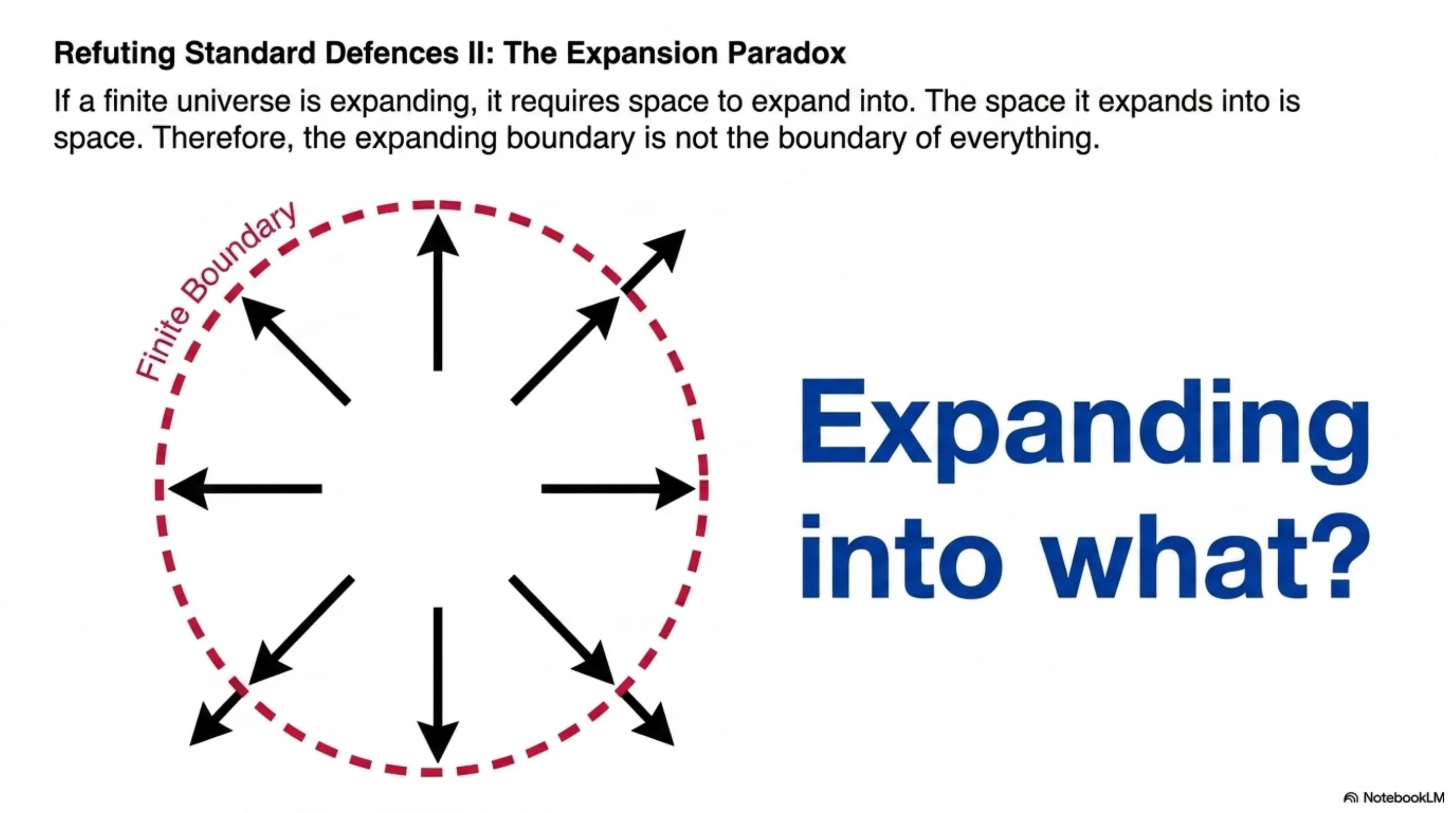
Third: they say the finite universe is inflating - expanding from
within. Expanding into what? If the universe is truly finite with
nothing outside it, there is nothing to expand into. If there is
something outside it to expand into, that something exists, which means
the universe is not all there is, which means the boundary is not the
boundary of everything, which means the universe is not finite in the
sense they claim. Expansion requires space to expand into. Space to
expand into is space. That space is part of the universe. The boundary
retreats. It always retreats. This is the definitional proof of Section
2 stated again in the language of inflation.
Figure 6. The Expansion Paradox: If a finite universe is expanding, it requires space to expand into.
That space is part of the universe, so the boundary retreats. A
truly finite universe cannot expand.
The three contradictions cannot be resolved individually because they
are generated by the same foundational error: asserting a finite
universe while retaining physical laws that require either infinity or a
boundary. The standard model does not resolve these contradictions. It
lives with them, names them - the cosmological constant problem, the
horizon problem, the flatness problem, the coincidence problem - and
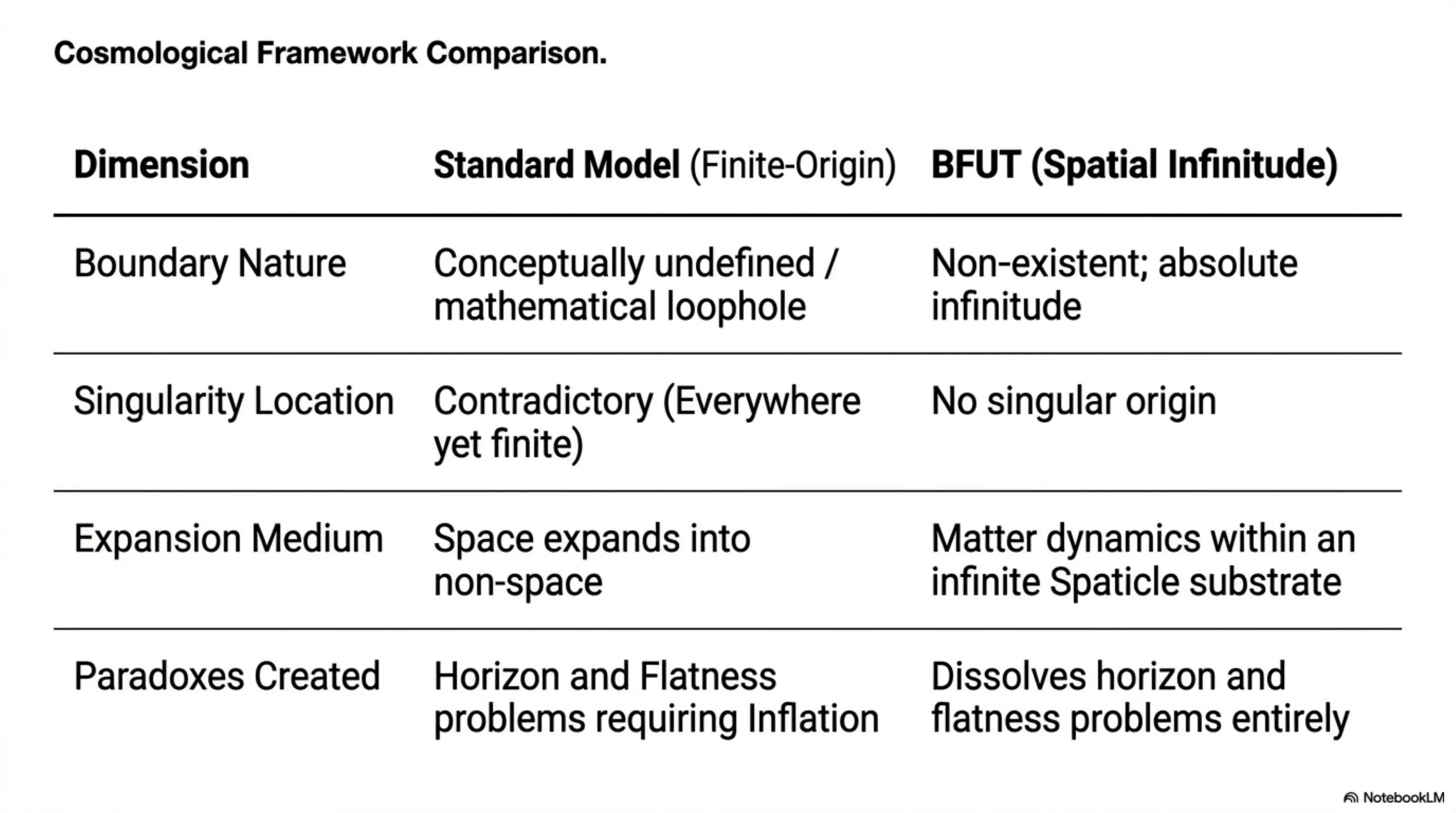
proposes patches for each one individually. BFUT does not need the
patches because it does not have the contradictions. An infinite eternal
universe conserves energy globally, has no horizon problem, is flat by
default, and has no coincidence problem. Within the BFUT framework,
these additional mechanisms are interpreted not as independent
necessities but as compensatory constructs introduced to preserve the
finite-origin picture.
Figure 7. Cosmological Framework Comparison: Key differences between the standard finite-origin model and the BFUT framework of spatial infinitude.
General
Relativity Breaks Down at the Singularity
The second response acknowledges that the singularity is a
mathematical artefact of classical general relativity extrapolated
beyond its range of validity. At the Planck density, quantum
gravitational effects dominate and the singularity represents a failure
of the theory instead of a physical state.
This response is intellectually honest but relocates instead of
resolves the boundary condition. If GR breaks down at the Planck scale
and is replaced by quantum gravity, the question becomes: where was the
Planck-density region from which the current universe expanded? The
singularity location argument applies to this question with equal
force.
Inflation
The third response invokes inflation: a period of exponential
expansion that stretched a small causally connected region,
approximately 10-26 metres in diameter, to a size larger than the
current observable universe. This eliminates the horizon problem and
appears to resolve the singularity location problem.
But inflation relocates instead of resolves the problem. The
inflationary patch had a location. Where was that location? By the
standard response it was everywhere. The singularity location argument
applies to the inflationary patch with the same force as to the
singularity itself.
Furthermore, the Borde-Guth-Vilenkin theorem [3] proves that any
spacetime that is on average expanding must be past-incomplete: it
cannot be extended arbitrarily far into the past without a boundary.
Inflation requires average expansion. Therefore inflation requires a
past boundary. The singularity location argument applies to that
boundary.
Inflation does not extend past the boundary it requires. It does not
resolve the boundary condition. It assumes one.
Loop Quantum Cosmology
Loop Quantum Cosmology [4,5] replaces the Big Bang singularity with a
quantum bounce, avoiding the classical singularity. The equations remain
well-defined through the bounce. This is a more physically direct
approach than classical inflation.
However, the quantum bounce does not resolve the spatial infinitude
argument. It transforms the question to: where was the minimum-volume
state at the bounce? If that state filled all of space, the universe is
infinite and the argument is trivially satisfied. If it had finite
spatial extent, the argument applies to its boundary.
LQC models that allow a past-eternal bouncing universe concede the
key structural claim of BFUT: the universe has no beginning. The
disagreement is then about mechanism instead of the logical structure of
spatial infinitude. A bouncing eternal universe and an infinite eternal
universe both satisfy the definitional proof of Section 2.
The
Derivational Proof: Λ and the Infinite Uniform Distribution
The cosmological constant Λ, observed to have a value of
approximately 1.1 x 10-52 m-2, provides a derivational proof of
spatial infinitude through the following argument, detailed in the
companion paper on the cosmological constant [6].
In an infinite, uniform spatial distribution, the net gravitational
force at any point is zero by isotropy: the gravitational pull from
every direction cancels exactly. This is the established resolution of
the Newtonian cosmological paradox. For such a distribution, the Ricci
curvature tensor R_mu_nu vanishes everywhere by symmetry. The Einstein
field equations reduce to:
Λ g_mu_nu = (8 π G / c4) T_mu_nu
giving directly:
ρ_substrate = Λ c2 / (8 π G) approximately 5.9 x 10⁻²⁷
kg/m3
This derivation is only valid for an infinite uniform distribution. A
finite universe does not have the isotropy required for R_mu_nu = 0
everywhere: near the boundary, the distribution is asymmetric and the
Ricci tensor does not vanish. The fact that Λ has a well-defined
positive value consistent with a uniform infinite distribution is
therefore derivational evidence that the universe is spatially
infinite.
This density, ρ_substrate, is the equilibrium density of the Spaticle
field: a continuous, physically real substrate filling space, developed
throughout the BFUT programme and applied here to the infinitude
argument. I did not invent the idea that space might be more than empty
geometry. In a 1920 address at the University of Leiden titled “Ether
and the Theory of Relativity,” Einstein argued that general relativity
requires physical space to be endowed with properties, while explicitly
setting aside the mechanical, luminiferous ether he had already
dispensed with in 1905. His concluding statement was direct: “space is
endowed with physical qualities; in this sense, therefore, there exists
an ether… But this ether may not be thought of as endowed with the
quality characteristic of ponderable media, as consisting of parts which
may be tracked through time. The idea of motion may not be applied to
it” [13].
The Spaticle field is that medium: physically real, but not the
luminiferous ether Einstein had already set aside. It supplies the
measurable quantity his own equations required but that he stopped short
of assigning: an intrinsic equilibrium density, together with the
derived stiffness, relaxation time, and propagation speed developed
elsewhere in the BFUT programme.
The value ρ_substrate approximately 5.9 x 10⁻²⁷ kg/m3 is of the
same order of magnitude as the observed mean matter density. In a finite
universe with a boundary, this proximity would
be a coincidence. In an infinite universe where matter arises from
the substrate, it is a physical consequence.
The Observational Proofs
Galaxy Orientation Evidence
If the universe were finite with a boundary, or if it originated from
a finite region through a Big Bang or inflationary event, one would
expect some large-scale directional imprint in structure formation. Such
an imprint, if present, should appear as a robust global preferred axis
or a universal directional relic across sufficiently large survey
volumes.
The current observational record does not establish such a result.
Various studies have reported local or regional handedness asymmetries,
spin correlations, and environmental alignments in subsets of galaxy
populations. These findings are not inconsistent with BFUT. Local and
regional coherence can naturally arise through gravitational sorting and
environment-dependent structure formation. However, such local or
scale-dependent effects do not amount to a single globally established
preferred axis across the observable universe. The relevant
observational point is therefore not that every asymmetry claim must be
rejected, but that no single globally compelling boundary-consistent
axis has been established at the level required to overturn the
large-scale isotropic character of the universe. This is more naturally
consistent with an infinite gravitationally structured universe than
with a finite bounded cosmos or a uniquely directed finite-origin
event.
Large-Scale
Ordered Motion Beyond the Naive Local Limit
Large-scale ordered motion is observed not only within individual
galaxies but also at progressively larger scales in filaments, clusters,
and surrounding environments. This is directly relevant to the question
of whether cosmic structure behaves as though large-scale coherence is
rapidly erased beyond a narrowly local regime.
Figure 4. Observational Consistency with Spatial Infinitude: The cosmological constant, galaxy orientations, and persistent large-scale coherent motion in filaments and clusters are all consistent with an infinite universe.
Recent observational work has reported one of the largest rotating
structures yet identified: a giant rotating cosmic filament
approximately 140 million light years in extent (about 43 Mpc),
containing a long string of galaxies embedded in a large-scale spinning
structure. This is already many times larger than the approximately 1
Mpc scale often treated as the threshold beyond which Hubble expansion
should dominate over local orbital-style coherence.
This is not an isolated observation. Independent studies have also
reported statistically significant coherent spin in galaxy clusters.
Earlier cluster-rotation analyses identified non-trivial subsets of
rotating systems, while more recent large-sample work using thousands of
clusters has reported strong statistical evidence for coherent cluster
spin. Independent CMB-based work has also reported rotational kinematic
Sunyaev-Zel’dovich signatures aligned with cluster rotation directions,
providing an additional observational channel for the same
phenomenon.
At somewhat smaller but still clearly supra-galactic scales,
observational work has reported dynamical coherence between galaxy
rotation and the average motion of neighbouring galaxies across
several-megaparsec environments, with the strongest signal in the 1-6
Mpc range and coherence maps extending still farther. Taken together,
these results indicate that structured non-random motion persists well
beyond the simplistic boundary between purely local dynamics and pure
Hubble flow.
The Absence of Boundary
Pressure
A finite universe with a physical boundary would imply an asymmetric
physical environment near that boundary. Matter and radiation close to
such a boundary would not experience balanced conditions in all
directions: the interior would contribute gravitational and radiative
influence from one side, while no corresponding contribution would exist
beyond the boundary. This would generate a directional asymmetry in the
physical conditions near the edge.
No such asymmetry has been detected in direction-dependent
measurements of the CMB, galaxy distributions, or large-scale velocity
fields. The universe is isotropic to one part in 105 in the CMB and
remains consistent with large-scale isotropy within current survey
precision in galaxy distributions. A boundary at any accessible scale
would be expected to produce a detectable asymmetry. No such asymmetry
is observed.
The Balloon
Analogy and Its Rotation Failure
The balloon analogy proposes that galaxies are like dots on an
expanding balloon surface: they recede from each other as the balloon
expands without any force acting between them. This analogy becomes
increasingly strained once one admits that large-scale ordered motion
persists in filaments, clusters, and multi-megaparsec environments well
beyond the scale often treated as the onset of purely metric
separation.
On an expanding balloon surface, the intuitive expectation is that
sufficiently large-scale ordered return motion should be progressively
diluted as the background expansion dominates. Yet observations continue
to show coherent large-scale motion beyond the simplistic local regime.
That does not by itself falsify every metric-expansion formulation, but
it does undermine the common pedagogical claim that beyond roughly local
scales the dominant physical behaviour should reduce to passive
recession alone.
The deeper problem is therefore not a single supercluster anecdote
but a scale ladder: from galaxy environments to clusters to very large
filaments, ordered motion persists where a naive expanding-container
intuition would expect it to fade. The balloon analogy is at best
incomplete and at worst physically misleading when elevated from
pedagogy to ontology.
Predictions
Prediction 1: No preferred axis in galaxy orientations will be found
at any survey scale, consistent with an infinite isotropic universe.
Falsification: detection of a statistically significant preferred axis
in galaxy spin orientations across survey volumes exceeding 500
megaparsecs.
Prediction 2: Coherent rotational and other ordered large-scale
structures will continue to be found at progressively larger scales as
survey volumes increase, with no sharp natural stopping scale.
Falsification: a robust confirmed absence of such ordered structures
beyond a well-resolved scale after sufficient survey coverage.
Prediction 3: No universal expansion-induced asymmetric orbital
distortion of the kind expected from a naive expanding-container
interpretation will be found as larger systems are mapped more
precisely. Falsification: repeated detection of a clean scale-dependent
dynamical distortion uniquely attributable to such an expansion term
instead of ordinary gravitational/environmental structure.
Prediction 4: The CMB temperature will be found to be consistent with
2.725 K in every direction and at every accessible distance, with no
boundary signature. Falsification: detection of a systematic temperature
gradient consistent with proximity to a finite boundary.
Prediction 5: No edge, no wraparound signal, no preferred centre -
ever. As observational instruments extend their reach, no edge of the
universe will be found in any direction. No wraparound signal will be
detected - no observation of the same structure seen from two different
directions at different distances, which would be the signature of a
finite universe whose light has circled back. Every telescope at every
scale will find itself at the apparent centre of an isotropic universe
extending equally in all directions - not because every observer happens
to be at the centre, but because in an infinite universe every point is
the centre. There is no centre. There is no edge. The observable
universe will expand as instruments improve, and what lies beyond each
new horizon will be more of the same: matter, structure, and space,
without boundary, without end. Falsification: detection of a genuine
spatial edge, a confirmed wraparound signal, or any observation that
cannot be explained without invoking a finite universe.
Conclusion
The universe has no boundary. This conclusion follows from three
independent categories of argument. Conceptually, a physical boundary of
space is incoherent. Logically, the standard model's own answer to the
singularity-location question points away from a finite localised
origin. Derivationally and observationally, the cosmological constant
result, the absence of a single robust global preferred axis, and the
persistence of large-scale ordered motion from filaments to clusters and
supra-galactic environments are all more naturally consistent with an
infinite universe than with a finite expanding one.
Three standard responses to the spatial infinitude argument, the
finite hypersphere, the GR breakdown, and inflation, each relocate
instead of resolve the boundary condition, or concede structural
elements of spatial infinitude. The Borde-Guth-Vilenkin theorem confirms
that inflation requires a past boundary, and Loop Quantum Cosmology, in
its most honest formulation, concedes a past-eternal universe.
Spatial infinitude is not a philosophical preference. It is the
logically required, derivationally supported, and observationally
consistent description of the universe. The boundary is not there
because it cannot be there. Space, by definition, has no edge.
APPENDIX A
Mathematical
Appendix: Universe Has No Boundary
The mechanical derivations in this appendix can be independently
verified. The interpretive steps are clearly distinguished from the
derivations throughout.
Illustrative Reductio: Why a Literal Physical Boundary Cannot Serve
as a Coherent Model of the Universe
The shell calculation below is not meant to model standard closed
FLRW cosmology, but to make explicit a simple physical point: if
finitude is re-physicalised as an actual enclosure, then the universe
becomes an effective vacuum vessel, and the question immediately becomes
whether any enclosing boundary could resist the implied external
pressure at cosmic scale.
If the universe were finite and physically bounded, its interior
would behave as an effective low-pressure domain relative to any
external medium. In that case, the boundary would not
merely define an edge; it would have to withstand an immense net
inward pressure. Without an extraordinarily strong enclosing shell, such
a structure would collapse instead of expand. The intuition is familiar
even at ordinary scale. A loosely folded paper sphere can be puffed
outward into a roughly spherical form, but the slightest inward pressure
crushes it immediately. A rigid metal vessel can resist that same
atmospheric pressure only because its shell is sufficiently strong for
its size. As the radius increases, the total force acting on the
enclosing surface rises dramatically, so the shell must become
correspondingly stronger. At cosmological scale, the required boundary
ceases to be a plausible physical object and becomes an absurdity.
This
appendix is not presented as a model of standard closed FLRW cosmology,
but as a reductio against any attempt to re-physicalise finitude as a
literal enclosing boundary.
The setup
Before the calculation, one physical fact must be stated explicitly
because it determines the structural problem entirely. The universe is,
to all physical purposes, a vacuum: the mean matter density of the
observable universe is low enough that the interior of the universe is
indistinguishable from a perfect vacuum for structural purposes. The
internal pressure is effectively zero. This means any proposed boundary
shell faces a structural condition far worse than a standard pressure
vessel. A normal pressure vessel has internal pressure pushing outward,
which partially counteracts external forces. Here there is no such
counter-pressure. The shell is simultaneously being pushed inward by
whatever exists outside and sucked inward by the vacuum it contains. It
must withstand the full load entirely on its own, with nothing pushing
back from the interior. The calculation below uses this condition.
If the universe were finite, it would require a physical boundary - a
shell containing all of space. Section 2 of the main paper presents this
as an illustration of physical impossibility. Here every step is shown
numerically.
The calculation asks: modelling the boundary as a spherical pressure
vessel (the strongest conceivable physical structure), how thick would
it need to be?
The formula - spherical pressure vessel
For a thin-walled spherical pressure vessel under internal pressure
P, required wall thickness t to prevent failure is:
t = P × R / (2 × σ)
where P = internal pressure, R = radius of the sphere, σ = tensile
strength of the
material.
The measured inputs
R = radius of observable universe. The proper radius of the
observable universe is approximately 46.5 billion light years (diameter
93 billion light years), accounting for the expansion of space in the
standard model between emission and observation. In BFUT, there is no
expanding space, so the relevant distance is the observable radius of
approximately 46.5 billion light years = 4.4 × 10²⁶ m. The
calculation holds at any finite radius - the conclusion that no
physical boundary can exist is independent of which figure is used.
P = pressure differential across the boundary shell. Since the
interior is a vacuum (internal pressure = 0), the full external pressure
acts unopposed. Earth's atmospheric pressure is used as the minimum
conceivable external pressure: P = 101,325 Pa. This is a deliberately
conservative choice - there is no physical reason to expect external
pressure to be as low as one atmosphere, and any realistic external
medium would exert far more. But even this minimum produces an
impossible result.
σ = tensile strength of steel = 4 × 10⁸ Pa. This is the strongest
common structural material. Any conceivable boundary material must be at
least this strong to resist pressure.
Full calculation
t = P × R / (2σ)
= 101,325 × 4.4×10²⁶ / (2 × 4×10⁸)
= 4.458×10³¹ / 8×10⁸
= 5.57×10²² m
Converting: 1 light year = 9.46×10¹⁵ m
t = 5.57×10²² / 9.46×10¹⁵ = 5.9 × 10⁶ light years ≈ 5.9 million light
years
The Milky Way is approximately 100,000 light years in diameter. The
required boundary shell is approximately 59 Milky Way diameters
thick.
Mass of this shell
Volume of shell: V ≈ 4πR²t = 4π × (4.4×10²⁶)² × 5.57×10²² = 1.36×10⁷⁷
m³
Density of steel: ρ = 7,800 kg/m³
Mshell = ρ × V = 7800 × 1.36×10⁷⁷ = 1.06×10⁸¹ kg
Estimated mass of observable universe: M_universe ≈ 10⁵³ kg
Mshell / M_universe = 10⁸¹ / 10⁵³ = 10²⁸
The boundary shell would need to be approximately 10²⁸ times more
massive than the entire observable universe it contains. This is not a
constraint that can be satisfied by any physically plausible structure.
This calculation assumes atmospheric pressure, which is the lowest
physically meaningful external pressure. If higher external pressures
are assumed, the required shell thickness and mass increase
proportionally, making the scenario even more physically impossible.
Lower pressures reduce the required thickness, but the conclusion
remains unchanged: no physically possible boundary can exist. Therefore,
the universe is spatially infinite.
The Spaticle Field Energy Density - Compact Derivation
Section 5 of the main paper derives ρ_s = Λc²/(8πG) from the reduced
Einstein field equations. The full numerical derivation with every step
shown is in companion paper [6] Appendix A. The key result:
Sharma, V. S. (2026). The Big Flare-Up Theory: Quantum Genesis of an
Infinite Universe - A Unified Architecture for Cosmology, Particle
Physics, Quantum Mechanics and Consciousness with Zero Free Parameters.
Zenodo. DOI: 10.5281/zenodo.19149785
Borde, A., Guth, A. H., & Vilenkin, A. (2003). Inflationary
spacetimes are not past-complete. Physical Review Letters, 90(15),
151301.
Bojowald, M. (2001). Absence of a singularity in loop quantum
cosmology. Physical Review Letters, 86(23), 5227.
Ashtekar, A., & Singh, P. (2011). Loop quantum cosmology: A
status report. Classical and Quantum Gravity, 28(21), 213001.
Sharma, V. S. (2026). Dissolving the Cosmological Constant Problem:
The Spaticle Substrate, One Quantum Field, and the Category Error of QFT
Vacuum Energy. Zenodo. DOI: 10.5281/zenodo.19242083
Longo, M. J. (2011). Detection of a dipole in the handedness of
spiral galaxies with redshifts z ~ 0.04. Physics Letters B, 699(4),
224-229.
Shamir, L. (2022). Asymmetry between galaxies with clockwise
handedness and counterclockwise handedness. Astrophysical Journal,
923(2), 218.
Lee, J. H., Pak, M., Song, H., Lee, H.-R., Kim, S., & Jeong, H.
(2019). Mysterious Coherence in Several-Megaparsec Scales Between Galaxy
Rotation and Neighbor Motion. The Astrophysical Journal, 884(2),
104.
Goldstein, S., & Hill, J. C. (2025). Evidence of galaxy cluster
rotation in the cosmic microwave background. arXiv:2512.10951.
Baxter, E. J., Sherwin, B. D., & Raghunathan, S. (2019).
Constraining the rotational kinematic Sunyaev-Zel'dovich effect in
massive galaxy clusters. Journal of Cosmology and Astroparticle Physics,
2019(06), 046.
Tudorache, M. N., Jung, S. L., Jarvis, M. J., Heywood, I.,
Ponomareva, A. A., Varasteanu, A., Maddox, N., & Yasin, T. (2025). A
giant rotating galaxy filament at redshift z = 0.032.
arXiv:2508.13053.
Einstein, A. (1920). Ether and the Theory of Relativity. Address
delivered at the University of Leiden, 5 May 1920. English translation
by G. B. Jeffery and W. Perrett, in Sidelights on Relativity (1922), pp.
3–24. London: Methuen. Available via MacTutor History of Mathematics and
Project Gutenberg.
About the Author
Vijay Shankar Sharma is a Chartered Accountant and MBA from the
Indian School of Business, with an Advanced Development Program from The
Wharton School, University of Pennsylvania. Independent researcher, no
institutional affiliation, no external funding. ORCID:
0009-0001-9622-6121. Contact: vss@vijayshankarsharma.com