Black Holes Demystified: What They Actually Are, the Universal Centrality Rule, Why Singularities Cannot Form, and Why Hawking Radiation Doesn't Exist
- Abstract
- 1. Introduction
- 2. The Substrate Context: From the Cold Dark Era to Vortex Formation
- 3. Three Formation Pathways and the Rotational Sustenance Principle
- 4. The Galaxy-Whirlpool Analogy: Physical Grounding and Conditions of Applicability
- 5. The Universal Centrality Rule
- 6. The Rotational Hierarchy and the M-σ Relation
- 7. The Finite-Core Compact Object: Physical Structure
- 8. Gravitational Wave Events and Galaxy Mergers
- 9. Why Hawking Radiation Doesn’t Exist: A Five-Premise Analysis
- 10. Nine Popular Theories About Black Holes: Scientific Assessment
- 11. Falsifiable Predictions
- 12. Position Within the BFUT Series
- 13. Conclusion
- Appendix A: Symbol Reference
- References
Abstract
Standard astrophysics defines black holes as independent objects characterised by singularities and event horizons. This paper argues that no such objects exist. What are observed as black holes are vortical compression cores — organised, finite-density structures sustained by rotational dynamics within the Spaticle field substrate.
Three formation pathways are identified: (1) large-scale rotational aggregation, which is inherently self-sustaining; (2) stellar collapse, which produces transient seed cores; and (3) explosive release events (supernovae, hypernovae, γ-ray bursts), which similarly generate seed cores. These pathways are unified by the Rotational Sustenance Principle, introduced here: no vortical compression core can persist without continuous rotational reinforcement from surrounding matter. A quantitative dissipation timescale, τ_dissip = Rd / c, is derived for unreinforced seed cores.
The paper establishes the Universal Centrality Rule — that every vortical core occupies the exact dynamical centre of its host system — as a structural consequence of formation physics instead of an observational coincidence. The classical singularity and event horizon are replaced by a physically defined four-region finite-core architecture. Hawking radiation is shown to have no physical realisation: all five foundational premises it requires describe conditions that do not exist in a Spaticle substrate universe.
The galaxy-whirlpool analogy is given rigorous grounding within the physical conditions of three-dimensional infinite space and the Spaticle medium. Nine common theoretical claims about black holes are examined and addressed. Seven falsifiable predictions are presented.
Keywords: black holes, Spaticle field, gravitational vortex, Universal Centrality Rule, Rotational Sustenance Principle, seed dissipation timescale, finite compression core, singularity, Hawking radiation, non-existence, information paradox, relativistic jets, BFUT
1. Introduction
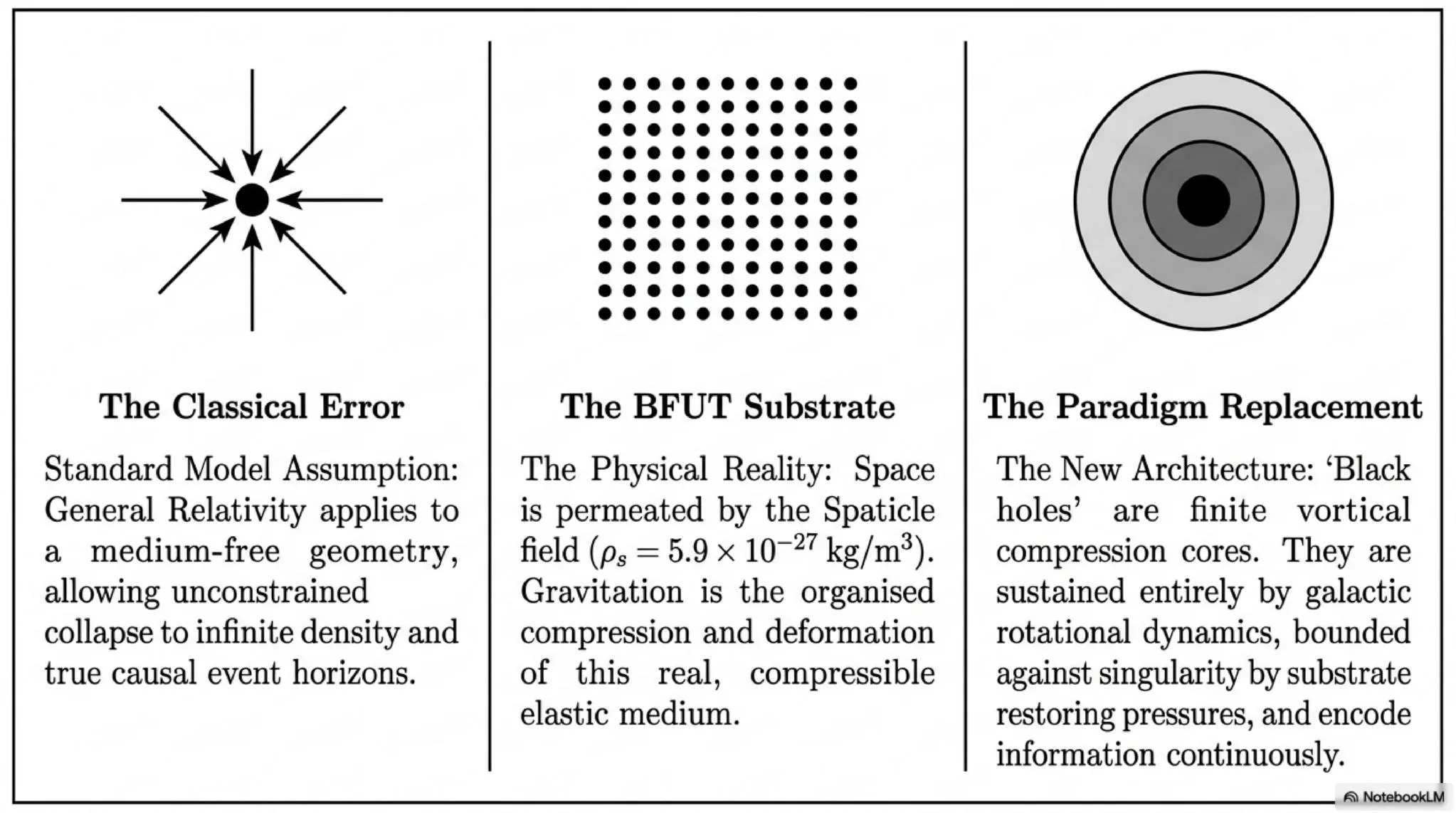
The conventional model of black holes rests on two foundational assumptions: singularities can form through unconstrained gravitational collapse, and event horizons constitute genuine one-way causal surfaces. Both follow from applying General Relativity to a medium-free geometry. Without a physical carrier medium, no restoring mechanism exists to prevent unlimited compression, and the singularity is mathematically unavoidable within the formalism.
The Big Flare-Up Theory (BFUT) identifies the physical fabric of space as the Spaticle field, a non-particulate substrate of equilibrium density ρ_s = 5.9 × 10⁻²⁷ kg/m³. This framework has been developed across over 30 papers covering cosmology, particle physics, gravitation, quantum mechanics, and consciousness. All results derive from ρ_s and the independently measured proton charge radius rp = 0.8414 fm (PDG 2022) with no free parameters.
The Big Flare-Up Theory (BFUT) begins from a different ontological foundation. The physical fabric of space is the Spaticle field - a continuous compressible elastic medium at equilibrium density ρ_s = 5.9 × 10⁻²⁷ kg/m³, independently constrained across seven physical sectors spanning forty orders of magnitude [P14; P25]. All matter, forces, and propagating disturbances are excitations of this substrate. Gravitation is organised compression and deformation of a physically real medium, propagating at speed c [P18].
This paper makes four principal contributions. First, it formalises the three formation pathways for vortical compression cores originally introduced in the main BFUT paper and P6, clarifying which pathway is self-sustaining and which are seed mechanisms, and deriving a quantitative dissipation timescale for seeds. Second, it introduces the Rotational Sustenance Principle and its associated Rotational Sustenance Threshold as named physical laws. Third, it presents the complete finite-core structure from P26 and establishes that Hawking radiation does not exist in the physical universe - its five foundational premises have no physical realisation in a Spaticle substrate universe. Fourth, it addresses nine popular theories about black holes with substrate physics arguments and observational evidence.
Section 9 establishes that Hawking radiation does not exist in the physical universe. Hawking’s derivation is internally consistent within its own premises - the argument here is not that the mathematics is wrong, but that every one of its five premises describes a universe that does not physically exist: no medium-free geometric vacuum, no true Killing event horizon, no genuine singularity, no freely-separable virtual pairs, and no thermal information-destroying emission anywhere in a Spaticle substrate universe at any scale under any conditions.
2. The Substrate Context: From the Cold Dark Era to Vortex Formation
2.1 The Pre-Luminous Substrate State
BFUT Paper 8 (Cold, Dark, and Inevitable: A Logical Reconstruction of the Universe Before the Big Flare-Up) establishes that the Big Flare-Up was not a creation event but the first large-scale ignition of nuclear fusion in an already-existing, infinite, eternal Spaticle substrate. The free-energy functional contains a thermal coupling term T5 = αT|ψ|², which sets a threshold at approximately 29 K below which organised substrate compression is thermodynamically favoured. The organisational preconditions for rotational structure were therefore seeded before luminous matter formation - explaining the existence of supermassive vortical cores at high redshift without exotic growth mechanisms [P8; P15].
2.2 Rotational Structure as the Universal Long-Term State
In an infinite universe, matter accumulates gravitationally from multiple directions simultaneously. Approach trajectories are never perfectly collinear - matter arrives from slightly different angles, imparting net angular momentum to any accumulating mass. With no boundary to absorb angular momentum and no friction at cosmological scale sufficient to dissipate it, rotation is conserved and permanent [main BFUT paper §4.2]. The spiral is not a special condition of matter. It is the only stable long-term state available to matter in an infinite universe without boundaries. Rotational vortex formation is therefore a structural inevitability, not a contingent outcome.
2.3 The DDR Domain and Rotational Entrainment
BFUT Paper 18 establishes the unified gravitational equation Ψ(r,t) = −(GM/r) exp(−r/Reff) R(τ_c,∂_t) N(Σ_i). The DDR domain equation captures two effects: Rd = (3M/8πρ_s)^(1/3) defines the finite gravitational domain, and Reff = Rd × (1 + v_rot²/c²)^(1/3) encodes how rotation continuously re-entrains the Spaticle substrate against relaxation, sustaining an enlarged domain [P18]. Validated against 175 SPARC galaxies with χ² = 1.31 and no per-galaxy free parameters. The same rotational entrainment that sustains flat rotation curves at galactic radii produces, at the dynamical centre where rotational coherence is maximum, the conditions for a finite compressed vortical core.
3. Three Formation Pathways and the Rotational Sustenance Principle
The gravitational vortex interpretation of black holes was introduced in the main BFUT paper (Section 4.5) and developed technically in BFUT Paper 6 (Black Holes as Central Gravitational Vortices Lacking Singularities: The Universal Centrality Rule). Three distinct formation pathways are identified. They differ fundamentally in their relationship to sustenance: one is inherently self-sustaining, while two are seed mechanisms that require external reinforcement to persist. This section formalises all three pathways and derives the quantitative condition that determines whether a seed core persists or dissipates.
3.1 Pathway 1 - Large-Scale Rotational Aggregation (Self-Sustaining)
When massive objects moving on non-parallel trajectories interact gravitationally, their combined angular momentum generates rotational structure. When angular momentum is sufficient and matter density exceeds the coherence threshold Ccrit = vrot × r / (ν_eff × L), a self-sustaining gravitational vortex forms. Matter spiralling inward contributes additional angular momentum, sustaining and intensifying the structure. More matter is attracted. The central region becomes progressively more compressed. The central vortical core emerges naturally as the innermost point of the growing vortex - not a separate object that sits at the centre, but the structural consequence of the vortex itself [main BFUT paper §4.5.1; P6 §2].
Pathway 1 is unique because the formation mechanism and the sustenance mechanism are identical. The process that creates the core is the same process that maintains it. Pathway 1 cores are inherently permanent as long as the host rotational system persists. This pathway accounts for all galactic-scale supermassive vortical cores and is the most common formation mechanism across the universe.
3.2 Pathway 2 - Stellar Collapse (Seed Mechanism)
When a massive star exhausts its nuclear fuel, outward radiation pressure disappears suddenly. Matter rushes inward from all directions asymmetrically - the angular positions of infalling matter carry net angular momentum, generating a gravitational vortex. This mirrors a deflating balloon submerged in a fast-flowing river: the sudden inward collapse creates a rotational disturbance in the surrounding matter flow [main BFUT paper §4.5.2; P6 §4.3].
A Pathway 2 core is a seed. At the moment of formation it contains only the mass of the collapsed stellar remnant and the angular momentum of the asymmetric infall. Without surrounding rotating mass to entrain, the substrate deformation of the core relaxes outward. It persists and grows only if: (i) sufficient surrounding matter exists within the gravitational domain Rd of the collapsed remnant, and (ii) that surrounding matter is drawn into rotation around the core, establishing the entrainment dynamics of Pathway 1. When these conditions are met, the Pathway 2 seed transitions into Pathway 1 dynamics and becomes self-sustaining. When they are not met, the core dissipates within the quantitative timescale derived in Section 3.4.
3.3 Pathway 3 - Explosive Release: Supernova, Hypernova, Γ-Ray Burst (Seed Mechanism)
A hypernova, catastrophic collision, or γ-ray burst sends a sudden explosive release of energy into the surrounding matter flow, creating a rotational disturbance - the bursting balloon analogue of the deflating balloon in Pathway 2. Both are expressions of the same principle: a sudden disruption to the surrounding matter flow, whether inward or outward, generates rotational structure consistent with the observed formation of rotating vortical cores and the ubiquitous presence of accretion disks and relativistic jets [main BFUT paper §4.5.2; P6 §4.3].
Like Pathway 2, a Pathway 3 core is a seed that is inherently temporary unless surrounding matter of sufficient density is drawn into sustained rotation around it. In environments with rich surrounding matter - such as the dense interstellar medium of a star-forming region - a Pathway 3 seed can transition into Pathway 1 dynamics. In sparse environments it dissipates within the timescale derived in Section 3.4. Supernova remnants and γ-ray burst afterglows represent exactly this bifurcation: either a sustained accretion-disk-bearing vortex persists, or the explosive remnant disperses without forming a lasting organised structure.
3.4 The Rotational Sustenance Principle and the Dissipation Timescale
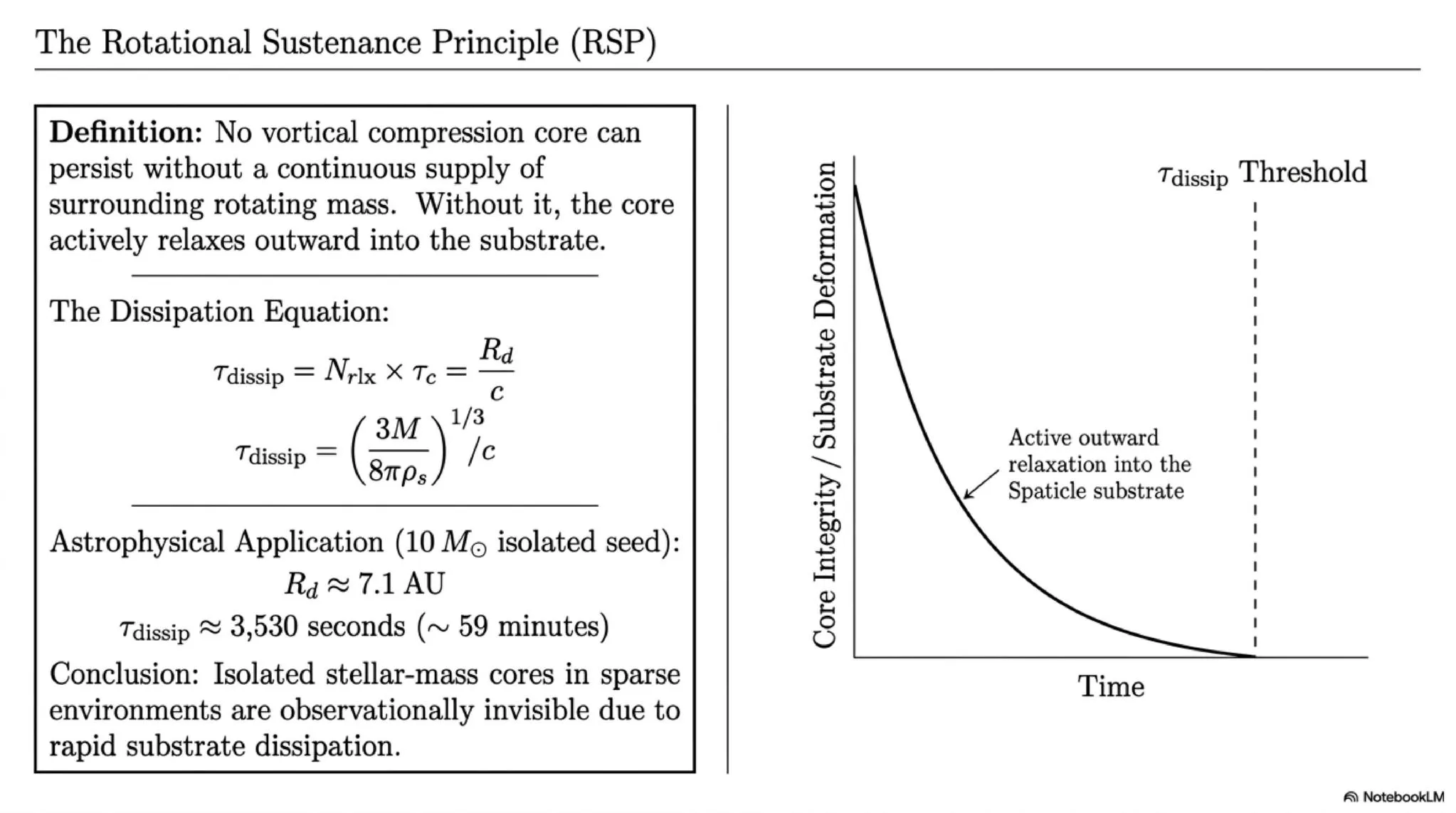
The Rotational Sustenance Principle: No vortical compression core of any origin can persist without a continuous supply of surrounding rotating mass. The formation mechanism of a core does not determine its longevity. Only the presence of sustained rotational entrainment from surrounding matter determines whether a core persists, grows, or dissipates.
The Rotational Sustenance Principle requires a quantitative companion - the condition under which a Pathway 2 or 3 seed dissipates instead of surviving. This is derivable directly from the substrate relaxation physics of P18.
In the absence of rotational entrainment from surrounding mass, a vortical seed core is an isolated substrate deformation. The relaxation operator R(τ_c, ∂_t) of P18 governs how such isolated disturbances evolve. An unsupported substrate deformation decays outward at the relaxation length Lrlx = c × τ_c per relaxation interval τ_c, the e-folding length for isolated unsustained disturbances [P18 §1B].
A seed core of mass M occupies a gravitational domain of radius Rd = (3M/8πρ_s)^(1/3). The number of relaxation lengths spanning this domain is:
Nrlx = Rd / Lrlx = (3M / 8πρ_s)^(1/3) / (c τ_c)
Each relaxation interval τ_c, an unsupported disturbance loses one e-folding length of organised deformation. The total dissipation timescale for a seed core receiving no rotational reinforcement is therefore:
τ_dissip = Nrlx × τ_c = Rd / (c) = (3M / 8πρ_s)^(1/3) / c [Seed Dissipation Timescale]
For a stellar-mass seed core of M = 10 M☉ = 2.0 × 10³¹ kg:
Rd = (3 × 2.0×10³¹ / (8π × 5.9×10⁻²⁷))^(1/3) ≈ 7.38 × 10¹⁸ m ≈ 780 light-years
τ_dissip = 7.38×10¹⁸ / 3×10⁸ ≈ 2.46×10¹⁰ s ≈ 780 years
A 10 solar-mass stellar-collapse seed core in a completely isolated environment with no surrounding mass dissipates within approximately eight centuries. For a 100 M☉ seed:
τ_dissip ≈ 5.31×10¹⁰ s ≈ 1,681 years
These timescales are brief compared to stellar formation and evolution timescales (10⁶ to 10⁹ years) and to the dynamical relaxation timescales of stellar clusters. They confirm that Pathway 2 and 3 cores are genuinely transient unless reinforced. They are not merely "less stable" than Pathway 1 cores - without reinforcement they dissipate within centuries, a narrow window against the multi-million-year timescales of stellar and galactic evolution, making an unreinforced seed core observationally rare instead of instantaneously undetectable.
The Rotational Sustenance Threshold (RST) is the condition separating surviving from dissipating seeds:
Rotational Sustenance Threshold: A Pathway 2 or 3 seed core of mass M and domain radius Rd persists if and only if the surrounding matter density within Rd is sufficient to establish coherence C > Ccrit within the dissipation timescale τ_dissip = Rd / c. Below the RST the core dissipates. Above the RST the seed transitions into Pathway 1 dynamics and becomes self-sustaining.
The RST explains the observed distribution of compact objects across stellar environments. In dense stellar environments - the cores of young massive star clusters, regions of active star formation, the central parsecs of galaxies - the surrounding mass density is sufficient to exceed the RST for virtually any stellar-mass seed. In sparse environments - isolated stars, the outskirts of dwarf galaxies, field supernovae in low-density regions - the RST is not met and the seed dissipates. This explains why the confirmed population of persistent stellar-mass compact objects is concentrated in rich environments and binary systems, and why isolated field supernovae in sparse environments rarely produce confirmed compact object remnants with sustained accretion.
3.5 Implications of the RSP for the Conventional Model
The conventional model implicitly acknowledges a version of the Rotational Sustenance Principle when it requires an accretion disk to "feed" a black hole. But it frames this as a growth mechanism instead of a sustenance condition - the black hole is assumed to persist whether or not accretion continues, merely growing larger with accretion and remaining static without it. The BFUT framework makes the sustenance condition primary and physical: without rotational entrainment of the Spaticle substrate, the organised compression state of the core actively relaxes outward. It is not static in the absence of accretion - it dissipates. The conventional model's assumption of self-sustenance after formation without accretion has no physical mechanism in the BFUT framework.
3.6 Summary: Formation Pathways and Their Properties
| Property | Pathway 1: Rotational Aggregation | Pathway 2: Stellar Collapse | Pathway 3: Explosive Release |
| Trigger | Non-parallel gravitational encounters; angular momentum accumulation in an infinite medium | Star exhausts nuclear fuel; asymmetric infall of collapsing matter generates net angular momentum | Supernova, hypernova, γ-ray burst; explosive outward energy release creates rotational wake |
| Main BFUT paper analogy | Matter spiralling inward from multiple trajectories, progressively concentrating at centre | Deflating balloon in a river - sudden inward rush creates a vortex | Bursting balloon in a river - sudden outward blast creates a rotational wake |
| Core at formation | Grows continuously from start; no distinct seed phase | Seed core from stellar remnant mass and collapse angular momentum only | Seed core from explosion angular momentum impulse only |
| Self-sustaining? | Yes - formation and sustenance are the same process | No - seed dissipates within τ_dissip = Rd/c without reinforcement | No - seed dissipates within τ_dissip = Rd/c without reinforcement |
| Seed lifetime (no reinforcement) | N/A - permanent from formation | ~780 years for 10 M☉ seed; ~1,681 years for 100 M☉ seed | Same as Pathway 2 for equivalent mass |
| Survival condition | Inherent; persists as long as host rotational system persists | Surrounding mass within Rd must establish C > Ccrit within τ_dissip (Rotational Sustenance Threshold) | Surrounding mass within Rd must establish C > Ccrit within τ_dissip (Rotational Sustenance Threshold) |
| Transition to Pathway 1 | Is Pathway 1 | Yes, if Rotational Sustenance Threshold is met | Yes, if Rotational Sustenance Threshold is met |
| Frequency | Most common - dominant pathway for all galactic-scale cores | Less common; often produces neutron star or dissipating seed in sparse environments | Less common; requires extreme energetic events; environment-dependent |
4. The Galaxy-Whirlpool Analogy: Physical Grounding and Conditions of Applicability
The analogy between a galaxy and a whirlpool, and between a vortical core and the eye of a whirlpool, was introduced in the main BFUT paper and P6. The analogy is powerful and physically well-grounded - but it holds subject to specific conditions that must be stated explicitly, because the Spaticle substrate context differs from a water whirlpool in ways that make the astrophysical version both more extreme and more persistent.
4.1 Conditions Under Which the Analogy Holds
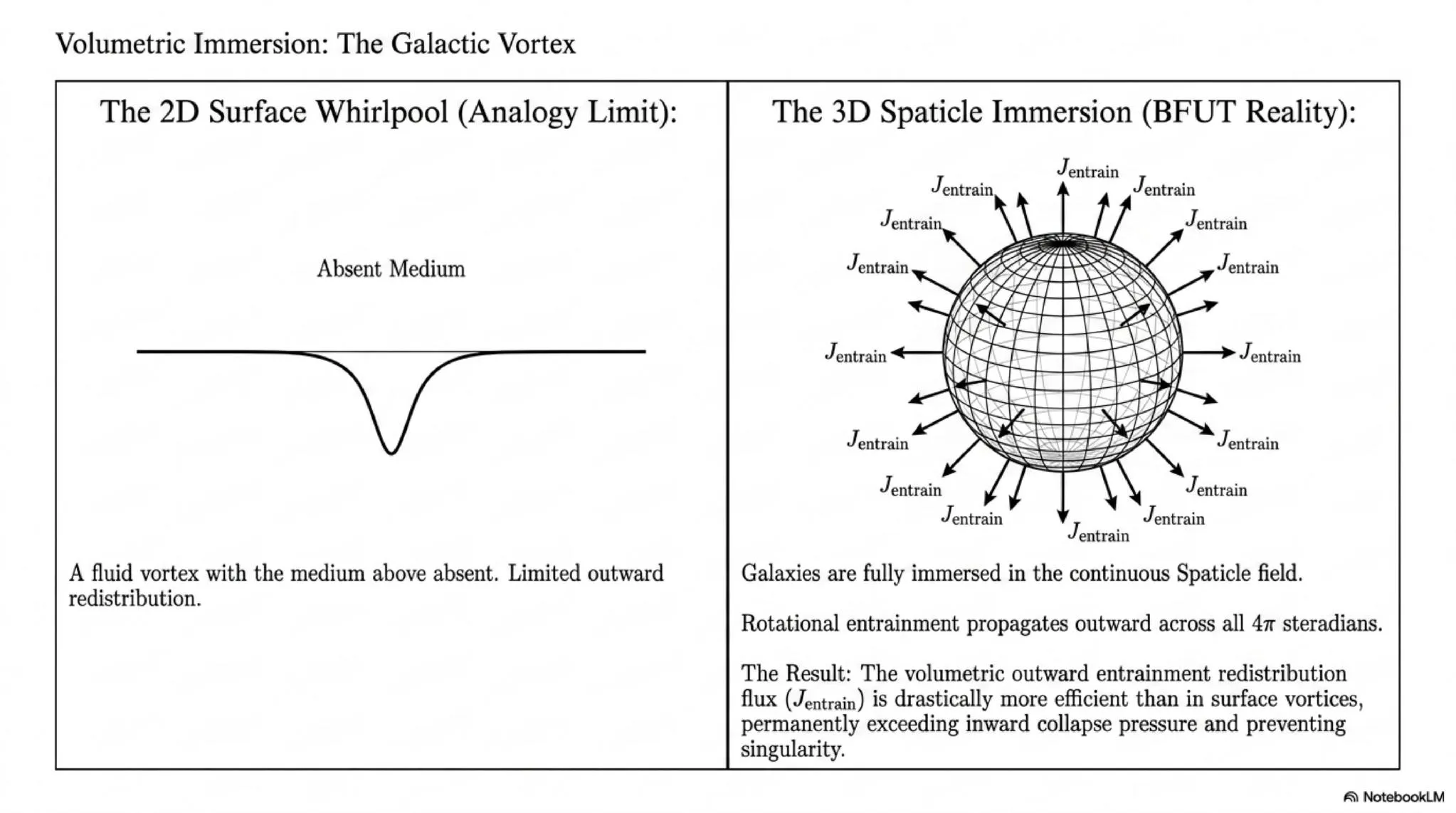
The galaxy-whirlpool analogy applies when three conditions are recognised: (1) the medium is the Spaticle field, not water - it has equilibrium density ρ_s = 5.9 × 10⁻²⁷ kg/m³ and elastic stiffness Ks = ρ_s c² = 5.30 × 10⁻¹⁰ Pa, instead of the properties of any terrestrial fluid; (2) space is three-dimensional and the vortex is fully volumetrically immersed in the substrate across the full 4π steradians of solid angle, instead of being a surface phenomenon; (3) space is infinite and there is no natural boundary to absorb angular momentum and no friction at cosmological scales sufficient to dissipate it, so rotational speeds, scales, and persistence timescales can far exceed anything achievable in a water whirlpool. Within these conditions, the structural correspondence between a whirlpool and a galactic vortex is physically precise: the formation mechanism, the eye-at-centre consequence, and the matter-transformation dynamics all correspond exactly. The analogy is not a metaphor - it is a description of the same class of physical process operating in a different medium under different boundary conditions.
4.2 A Galaxy Is a Whirlpool, a Vortical Core Is Its Eye
A whirlpool in a fluid is a region where rotational dynamics concentrate angular momentum inward, producing a central depression - the eye - surrounded by spiralling fluid. The eye is not a separate object that sits at the centre of the whirlpool. It is the structural consequence of the rotational dynamics of the whirlpool itself. Remove the rotation and the eye disappears. Sustain the rotation and the eye is permanent.
A galaxy in the Spaticle field is structurally identical under the conditions stated in Section 4.1. The galaxy is a fully immersed three-dimensional volumetric vortex. The central vortical compression core is the eye of that galactic vortex. It is not a separate object that migrated to the centre. It is the structural consequence of the rotational dynamics of the galaxy. The volumetric immersion across 4π steradians makes the outward entrainment redistribution dramatically more efficient than in any surface vortex - which is why galactic vortical cores do not collapse to singularities despite containing enormous mass: the outward redistribution flux in three dimensions exceeds inward collapse pressure in every regime examined [P26 §6].
4.3 Matter Transformation in the Vortex: Three Physical Regimes
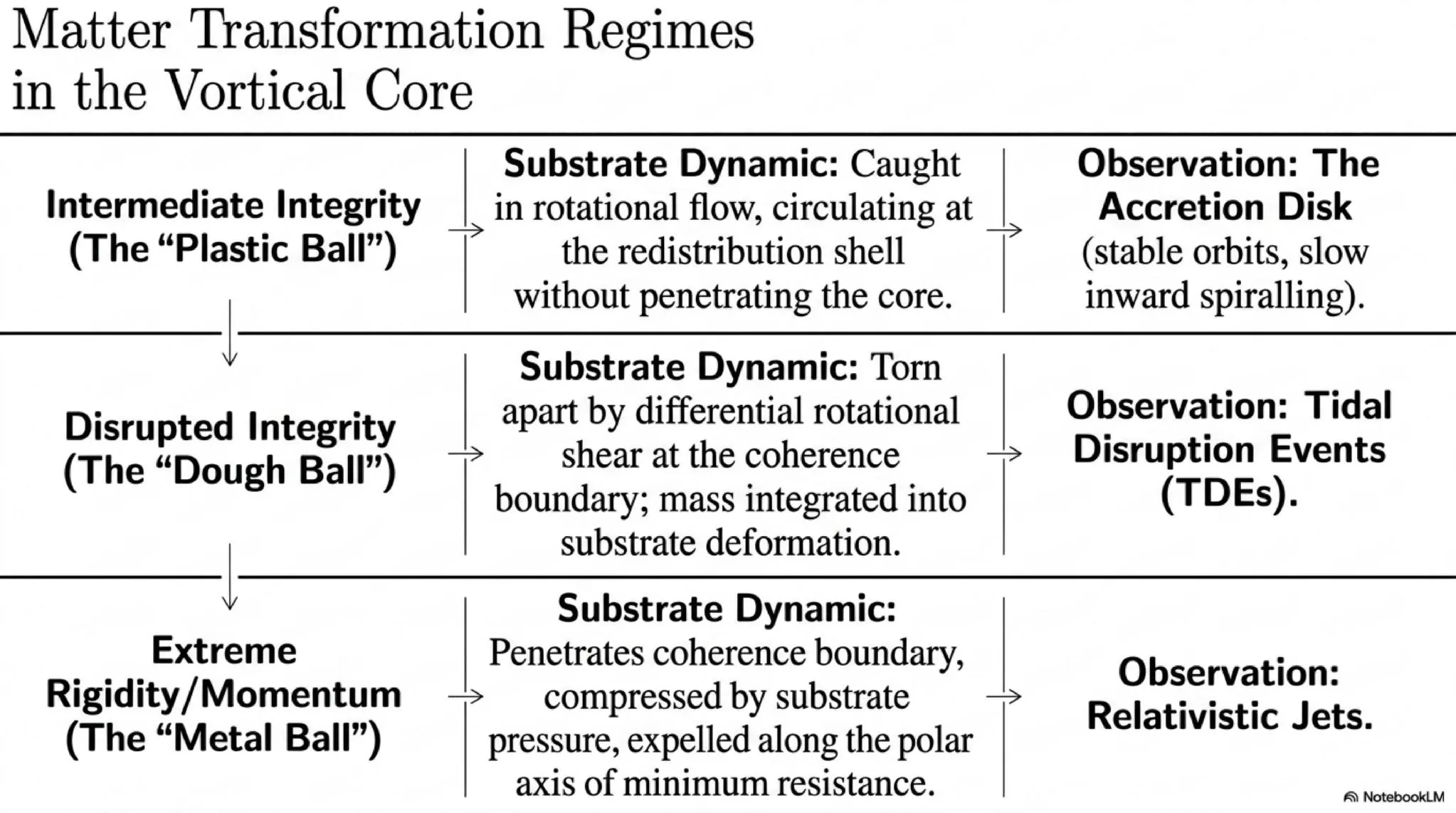
What happens to matter that enters a vortical core depends on its physical properties relative to the compression state of the substrate at the coherence boundary. The main BFUT paper (page 32) identifies three distinct regimes using direct analogies from objects entering a fluid whirlpool. Each analogy maps onto a specific and well-observed astrophysical phenomenon:
The plastic ball - intermediate density and structural integrity - is caught by the rotational dynamics without penetrating to the core or dissolving. It begins orbiting within the redistribution shell. In the astrophysical context this corresponds to matter achieving a stable orbit in the accretion disk, circulating at or above the ISCO (innermost stable circular orbit), contributing angular momentum to the vortex, and slowly spiralling inward over astronomical timescales.
The dough ball - low structural integrity, soft or fluid-like - is torn apart by differential rotational forces at the coherence boundary. Its constituent material disperses into the surrounding medium. In the astrophysical context this corresponds directly to tidal disruption events (TDEs), in which a star is tidally disrupted as it approaches a galactic vortical core. The disrupted stellar material disperses into the accretion disk and surrounding interstellar medium. TDEs are the observationally confirmed counterpart of the dough ball regime.
The metal or steel ball - dense and structurally rigid - enters the vortex with sufficient momentum to penetrate the rotational flow without being captured or disrupted. It passes through the coherence boundary, is compressed and decelerated by the organised substrate within, and exits via the rotation axis as concentrated energy. In the astrophysical context this corresponds to the mechanism of relativistic jets. Dense matter compressed by the immense rotational and substrate pressure of the vortical core is expelled along the polar axis - the direction of minimum rotational resistance - as concentrated plasma at velocities approaching c. Relativistic jets are not anomalies requiring separate explanation. They are the substrate analogue of the metal ball: matter entering the vortex is transformed - compressed, converted to energy, and returned to the Spaticle field as structured radiation and relativistic outflow - not destroyed [main BFUT paper §4.5; P6 §4.3].
4.4 Information Is Never Lost: The Substrate Proof and Its Whirlpool Illustration
The black hole information paradox rests on the premise that information entering a classical black hole crosses a one-way causal surface and is destroyed by a singularity. The BFUT framework addresses this at the substrate physics level: since neither the one-way causal surface nor the singularity exists, the paradox does not arise. The continuous elastic Spaticle medium preserves deformation patterns indefinitely unless actively redistributed. As infalling matter crosses the coherence boundary and is absorbed into the compression state of the core and redistribution shell, its information - mass, composition, angular momentum, energy content - is encoded in the organised deformation patterns of the substrate. Carrier relaxation emission propagating outward through the coherence boundary at timescale τ_c carries this encoded information as structured substrate disturbances [P26 §12.2].
The whirlpool analogy illustrates the same physical principle under the conditions of Section 4.1: in a whirlpool, a dough ball thrown in is torn apart and dispersed into the medium. The constituent matter, composition, temperature, and chemical structure remain encoded in the state of the surrounding fluid. The dispersal is irreversible in practice but not in principle - the whirlpool does not destroy information, it encodes it in an increasingly distributed form across the medium. In the BFUT vortical core, the same process operates in the Spaticle field under the three conditions stated. The illustration is physically grounded but the proof rests on the substrate physics, not on the analogy.
5. The Universal Centrality Rule
5.1 Statement
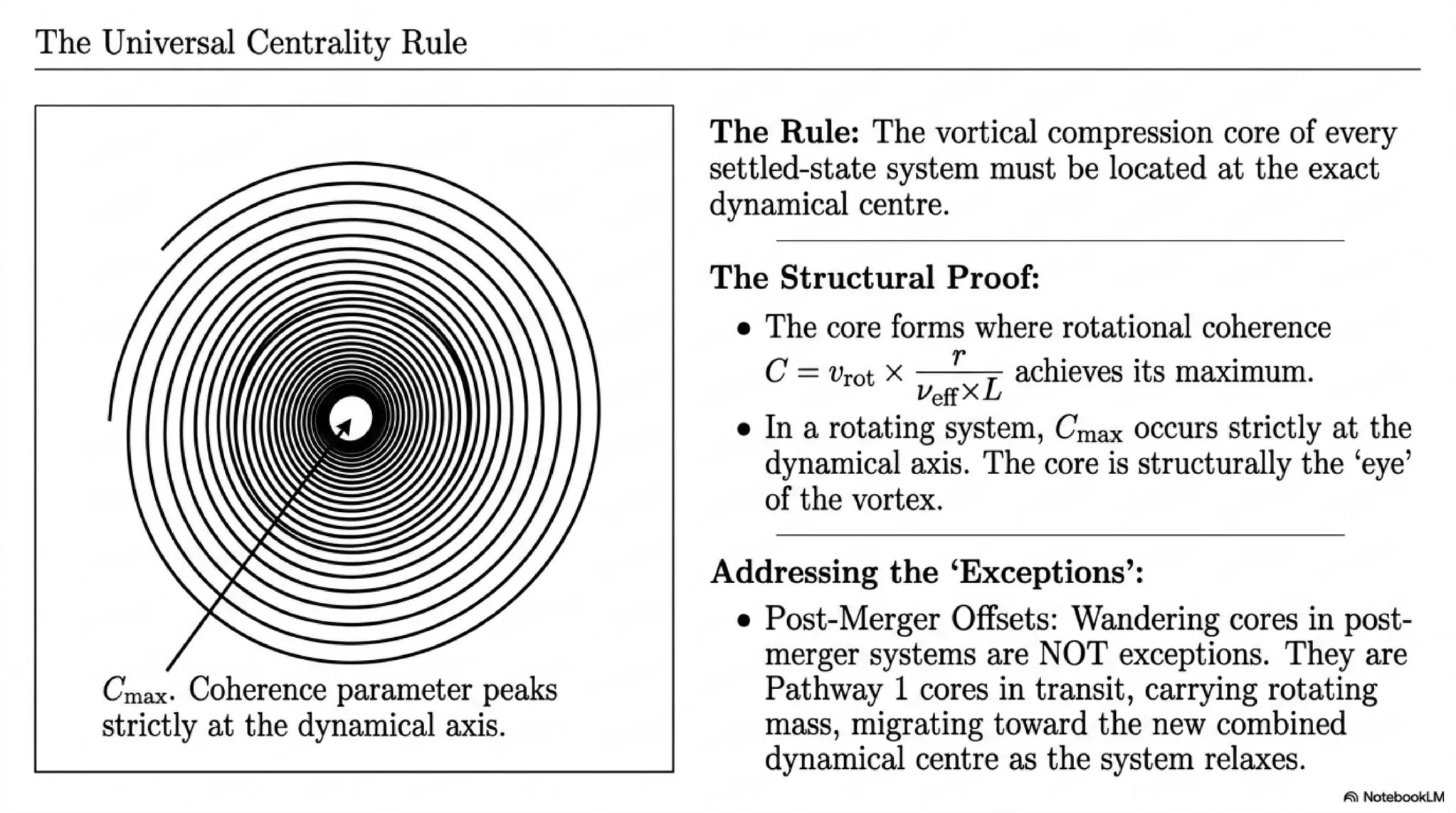
The Universal Centrality Rule: The vortical compression core of every settled-state host system is located at the exact dynamical centre of that system. Every galaxy examined, from dwarf irregulars to giant ellipticals, at every redshift at which spatial resolution is sufficient, has its central compact object at the dynamical centre. No settled-state exception exists in any survey.
The qualifier "settled-state" is important and is used throughout: the Universal Centrality Rule applies to systems that have relaxed from any recent merger or tidal disturbance. Apparent exceptions are examined specifically in Section 5.3. The rule is stated as applying to settled-state systems, which is the precise and defensible formulation.
5.2 Derivation from Formation Physics
In the BFUT framework the Universal Centrality Rule requires no explanation beyond the formation physics of Section 3. The vortical core forms in situ at the dynamical centre because that is where the rotational dynamics of the host vortex produce their maximum coherent compression. The coherence parameter C = vrot × r / (ν_eff × L) reaches its maximum at the dynamical centre of any coherently rotating system. When C exceeds Ccrit, the substrate transitions into organised compression dynamics and the core forms at that location. The core is the eye of the galactic vortex. Eyes form at the centre of vortices. There is no mechanism by which the eye could form off-centre and migrate to the centre - because the eye is not a separate object but the rotational dynamics of the centre expressing themselves as a compression structure.
5.3 Apparent Exceptions: Wandering Cores in Post-Merger Systems
Two cases in the recent literature are presented as evidence for compact objects displaced from galactic centres: AT2024tvd (0.8 kpc offset, 2025) and MaNGA 12772-12704 (0.94 kpc offset, 2025). Both are explicitly attributed by their discoverers to prior galaxy mergers - AT2024tvd to "a minor galaxy merger" and the MaNGA case to "gravitational-wave recoil or asymmetric gas accretion" - both of which are post-merger dynamics in non-settled systems.
These cases are not exceptions to the Universal Centrality Rule as stated. The rule applies to settled-state systems. A recently merged system is not settled. The displaced core in a post-merger system is a vortical structure from the progenitor galaxy, still sustained by the rotating mass it carries from its progenitor, migrating toward the new dynamical centre of the merged system where C will again be maximum. The Universal Centrality Rule predicts it will arrive there as the merged system relaxes. This prediction is confirmed by the broader population of post-merger galaxies, where central object offsets are temporary and diminish as dynamical relaxation proceeds. The apparently wandering core is therefore not a counter-example - it is a Pathway 1 core in transit between the old and new maximum-coherence location, sustained throughout by its carried rotating mass in accordance with the Rotational Sustenance Principle.
6. The Rotational Hierarchy and the M-σ Relation
BFUT Paper 9 (Cosmic Rotation Across Scales, Emergent Orbital Hierarchy, and the Large-Scale Challenge to Metric Expansion) establishes that large-scale organised rotational structure is the natural hierarchical consequence of substrate dynamics operating across all scales without a finite-origin cutoff [P9]. The same substrate mechanism that produces vortical cores in galaxies operates at every level of the rotational hierarchy where sufficient coherent rotation exists.
Stellar-mass and supermassive vortical cores are not different categories of object. They are central vortical compression cores at different levels of the hierarchy, governed by the same free-energy functional and distinguished only by the mass, rotation, and coherence timescale of the host system. The M-σ and M-V scaling relations emerge from this framework through the DDR rotational entrainment budget. The rotational term in the DDR equation gives Reff = Rd × (1 + v_rot²/c²)^(1/3), and the core mass scales with R_d³ ∝ Mhost. For a host galaxy characterised by velocity dispersion σ ≈ vrot, the DDR rotational budget available to sustain the central core scales as:
Mcore ∝ ρ_s R_eff³ ∝ ρ_s R_d³ (1 + σ²/c²) ∝ Mhost × (1 + σ²/c²)
In the regime σ ≪ c - which covers the full observed range of galaxy velocity dispersions - the correction term (1 + σ²/c²) ≈ 1 + σ²/c², and Mcore scales to leading order with Mhost and with σ² from the rotational term. The observed M-σ exponent of approximately 4-5 reflects the additional dependence of the host mass on σ through the virial theorem (Mhost ∝ σ² Rhost / G, where Rhost itself scales with σ through the Tully-Fisher relation at the galactic scale), compounding the direct σ² dependence of the DDR rotational budget. The full derivation of the precise exponent requires the hierarchical DDR nesting treatment of P18 and P9 the scaling argument above establishes that the correct order of magnitude and direction follow naturally from the substrate physics without any feedback mechanism or co-evolutionary tuning.
7. The Finite-Core Compact Object: Physical Structure
7.1 The Four-Region Architecture
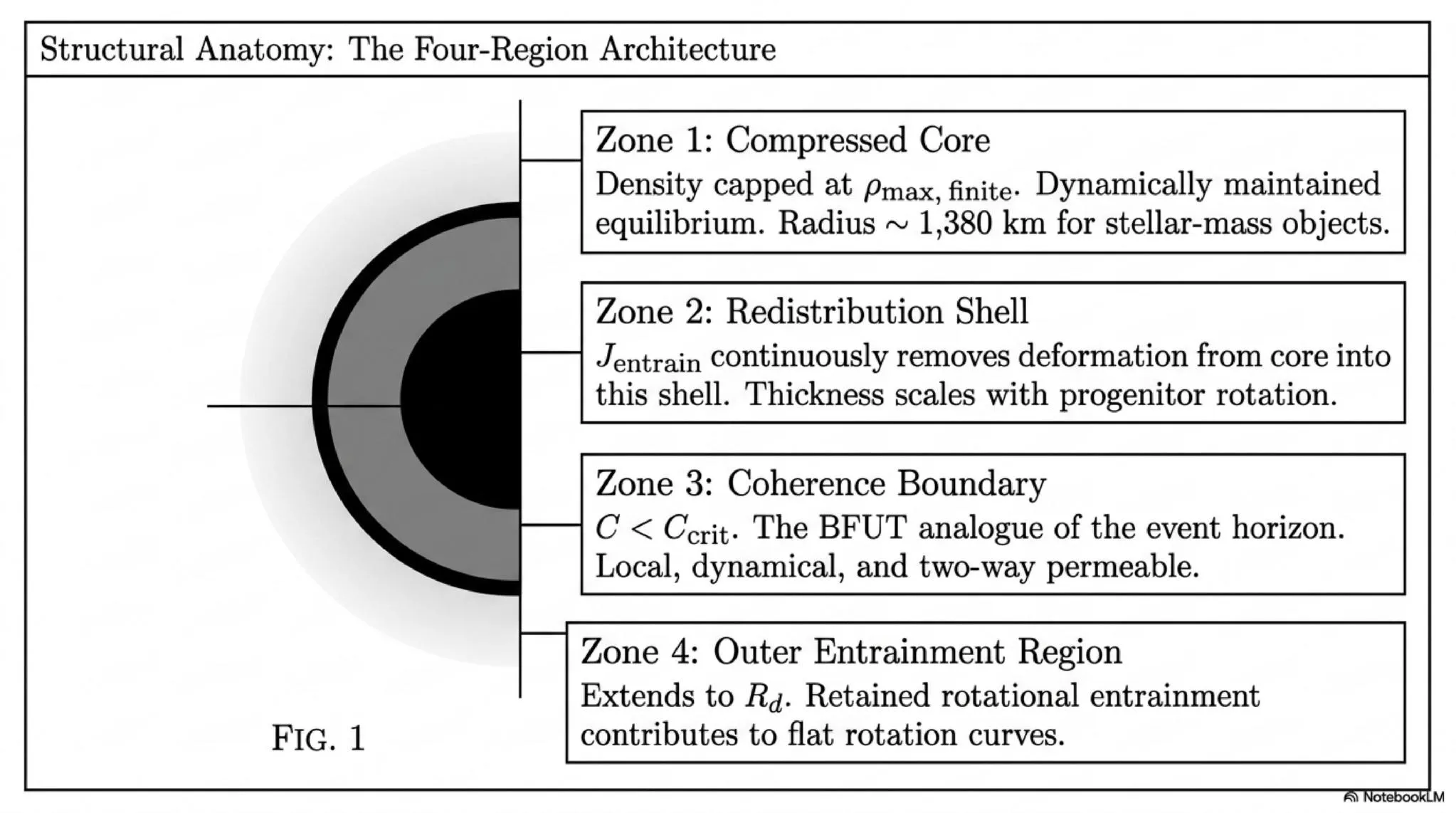
BFUT Paper 26 derives the complete structure of the finite-core compact object from the Spaticle field free-energy functional. The result is a four-region architecture that replaces both the singularity and the event horizon with physically defined substrate regions:
| Region | Physical Description | BFUT Mechanism |
| Compressed Core | Innermost region; substrate density at ρ_max_finite; dynamically maintained compression equilibrium; radius on the order of the substrate relaxation length Lrlx for stellar-mass objects | Inward collapse balanced by T4 restoring pressure P_restore = (ρ_s/4)(ρ−ρ_s) and T3 higher-order repulsion P_repulsion = 3Cρ² |
| Redistribution Shell | Surrounds core; outward entrainment flux J_entrain continuously removes organised deformation from core into shell; thickness scales with rotational organisation of progenitor | T2 quantum kinetic term encodes internal circulation; rotational entrainment saturation sets equilibrium shell thickness |
| Coherence Boundary | Outer surface of redistribution shell; C falls below Ccrit; BFUT analogue of event horizon but two-way permeable; propagation efficiency η very small but strictly > 0 inside | Not a one-way causal surface; not a Killing horizon; local, dynamical, and permeable in both directions |
| Outer Entrainment Region | Extends from coherence boundary to Rd = (3M/8πρ_s)^(1/3); retained rotational entrainment; contributes to flat rotation curves | DDR rotational domain: Reff = Rd × (1 + v_rot²/c²)^(1/3) |
7.2 Maximum Compression Density and the Singularity Bound
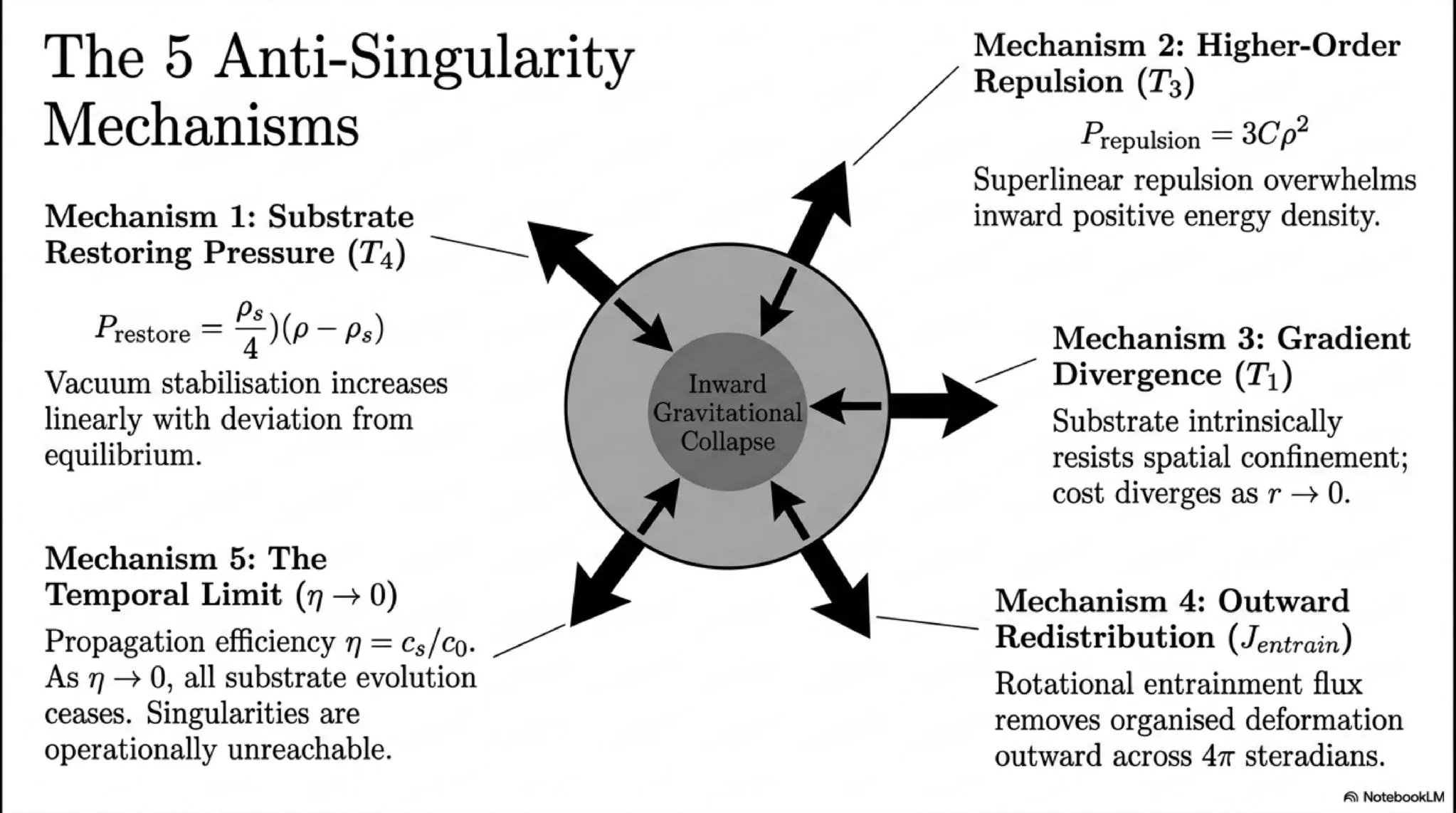
Five independent substrate restoring mechanisms operate simultaneously - T1 gradient divergence, T3 higher-order repulsion, T4 vacuum stabilisation pressure, J_entrain outward redistribution flux, and the temporal argument from P22 - giving:
ρ_max ≈ ρ_s × (c² / C ρ_s²)^(1/2) [P26 §4; finite for all non-zero C and ρ_s]
No additional free parameters. The singularity is prevented by substrate physics fixed across seven independent measurement sectors. The null energy condition is violated by the substrate restoring terms at extreme compression, so the Penrose-Hawking singularity theorems do not apply.
7.3 The Coherence Boundary Is Not an Event Horizon
The coherence boundary differs from a classical event horizon on four categorical counts: local (defined by present substrate conditions, not global future causal structure); permeable (η = cs/c0 > 0 everywhere - no observer is causally trapped; η = 0 is operationally unreachable per P22); dynamical (shrinks or grows with accretion and rotational changes, unlike the monotone-area event horizon); and not a Killing horizon (no static timelike Killing vector exists in the rotating vortical core spacetime).
8. Gravitational Wave Events and Galaxy Mergers
8.1 The Isolation Test
If compact objects were genuinely independent, a population of gravitational wave events from isolated mergers - two compact objects merging with no concurrent galactic merger - would be expected. As of the current LIGO-Virgo-KAGRA catalogue, no event has been confirmed to arise definitively and independently of galactic dynamics. The BFUT framework makes the forward prediction that no such event will be confirmed: a compact vortical core that loses its surrounding rotating mass dissipates within τ_dissip = Rd/c instead of persisting as an independent travelling object capable of encountering another independent object. All compact object merger signals arise from the coalescence of galactic or stellar vortical cores during galactic or stellar merger events.
This is stated as a forward prediction instead of a retroactive claim about existing detections, since current gravitational wave localisation precision is insufficient to definitively establish or rule out galactic merger association for all events in the catalogue.
9. Why Hawking Radiation Doesn’t Exist: A Five-Premise Analysis
Hawking’s 1974-1975 derivation is internally consistent within its own premises. This section does not dispute its mathematical coherence within those premises. It establishes that every one of the five foundational premises of the Hawking mechanism describes a universe that does not physically exist. Hawking radiation therefore does not exist - its domain of application has no physical realisation anywhere in the universe, at any scale, for any compact object, under any conditions.
9.1 The Five Premises
| Premise | Hawking's Requirement | Why This Premise Has No Physical Realisation |
| P-I | Spacetime is a geometric arena without a physical carrier medium. The vacuum is empty between quantum field excitations. | Inapplicable. Spacetime is the Spaticle field at ρ_s = 5.9 × 10⁻²⁷ kg/m³. Vacuum state Ψ_vac ≠ 0. No medium-free geometry. [P14; P18 §7.3] |
| P-II | A true Killing event horizon exists: a null surface generated by a timelike Killing vector from which no signal can escape in any finite time. | Inapplicable. The coherence boundary is local, permeable (η > 0 everywhere), dynamical, and not a Killing horizon. No static timelike Killing vector exists in the rotating vortical core spacetime. [P26 §9.7; P22] |
| P-III | A genuine singularity exists at the centre where density diverges without bound. | Inapplicable. Five independent substrate restoring mechanisms bound compression at ρ_max_finite from first principles. The Penrose-Hawking singularity theorems do not apply - null energy condition violated by restoring terms. [P26 §3-9] |
| P-IV | Quantum vacuum fluctuations produce virtual particle pairs separable by the horizon causal structure, with one partner acquiring negative Killing-time energy inside the horizon. | Inapplicable. Vacuum modes are screened substrate excitations governed by F1-cov. No Killing horizon, no negative-energy Killing orbits, near-boundary state ≠ Minkowski vacuum. [P18 §7.5; P19A] |
| P-V | One particle escapes as exactly thermal radiation carrying no information about the interior - producing the information paradox. | Inapplicable on two counts. No one-way causal surface traps information. The interior is physically active and continuously encodes infalling matter in substrate deformation patterns released as carrier relaxation emission. [P26 §12.2] |
9.2 Premise I: No Medium-Free Geometric Vacuum Exists
Hawking's derivation requires a Bogoliubov transformation between two independent vacuum mode decompositions - inertial and Killing - whose mismatch across the horizon produces the thermal spectrum. In BFUT the vacuum is the Spaticle field at:
λ × Ψ_vac² = ρ_s × c² [P18 §7.3; Ψ_vac ≠ 0]
This vacuum has non-zero equilibrium density ρ_s = 5.9 × 10⁻²⁷ kg/m³ and elastic stiffness Ks = ρ_s c² = 5.30 × 10⁻¹⁰ Pa. All quantum field excitations are organised deformation modes of this substrate. There is one physical substrate and one class of excitations. The distinction between a Minkowski vacuum mode and a Rindler mode is a coordinate artefact applied to a continuous elastic medium that does not physically recognise the distinction. The Bogoliubov transformation that generates the Hawking temperature has no physical realisation in a BFUT universe.
9.3 Premise II: No True Killing Event Horizon Exists
The event horizon in GR is defined globally as the boundary of the causal past of future null infinity - determined by the entire future evolution of the spacetime. It is absolute, monotone in area (area theorem), and requires a Killing horizon structure for the thermal derivation. The BFUT coherence boundary differs categorically: local (defined by present substrate compression state, measurable in principle by a local observer, not teleological); permeable (η > 0 everywhere - the temporal argument of P22 shows η = 0 is operationally unreachable because at η = 0 all substrate evolution ceases including collapse itself); dynamical (shrinks if the host vortex loses rotational coherence); and not a Killing horizon (the rotating vortical core has no static timelike Killing vector, so there are no negative-energy Killing orbits inside the boundary, removing the kinematic basis for pair-separation at the horizon, independently of all other arguments).
9.4 Premise III: No Singularity Exists
The Hawking derivation depends on the singularity being present because the global causal structure of the Schwarzschild spacetime - which determines the Bogoliubov transformation coefficients - requires it. The BFUT free-energy functional prevents the singularity through five mechanisms [P26 §3-9]: T1 gradient term (½|∇ψ|²) diverges as condensation radius → 0; T3 higher-order repulsion (C|ψ|⁶) provides repulsion growing as ρ², overwhelming any finite inward pressure; T4 vacuum stabilisation ((ρ_s/16)(|ψ|² − ρ_s)²) provides restoring pressure P_restore = (ρ_s/4)(ρ − ρ_s) increasing without bound; J_entrain outward redistribution flux operating across 4π steradians dominates over inward collapse pressure in all examined regimes; and the temporal argument (P22) shows that as η → 0, both collapse rate and restoring rate fall proportionally, making the singularity operationally unreachable. The null energy condition is violated by the restoring terms, so the Penrose-Hawking singularity theorems do not apply.
9.5 Premise IV: Vacuum Fluctuations Are Substrate Modes, Not Free Pairs
In BFUT, quantum vacuum fluctuations are organised deformation modes governed by:
g^μν ∇_μ ∇_ν (δΨ) − 3ρ_s c² · δΨ = 0 [F1-cov; P18 §7.5]
These modes have effective mass m_eff² = 3ρ_s c², producing Yukawa screening at a finite length scale set by that mass. The vacuum near the coherence boundary is the compressed substrate state at ρ ≫ ρ_s - not the Minkowski vacuum that the Hawking derivation requires. There is no Killing vector in the BFUT vortical core spacetime and therefore no negative-energy Killing orbits for one partner of a virtual pair to occupy. The kinematic basis for pair separation is entirely absent.
9.6 Premise V: Emission Is Carrier Relaxation, Not Thermal Radiation
Emission from the coherence boundary of a BFUT vortical core is carrier relaxation emission governed by the relaxation operator R(τ_c, ∂_t) - structured deformation waves carrying the organisational signature of the core compression state. As infalling matter alters the compression pattern of the core, subsequent carrier relaxation emission changes accordingly. The radiation carries information. The information paradox does not arise for five independent reasons: (i) no event horizon traps information; (ii) no singularity destroys it; (iii) the interior continuously encodes infalling matter in substrate deformation; (iv) the coherence boundary is permeable; (v) the substrate is a continuous elastic medium preserving deformation patterns indefinitely unless actively redistributed [P18 §8.5; P26 §12.2].
9.7 The Bekenstein-Hawking Entropy: Physical Reinterpretation
The Bekenstein-Hawking relation S = A/4 (Planck units) is reinterpreted without requiring an event horizon or singularity. BFUT entropy is substrate deformation complexity: the number of distinguishable organised deformation states at a given energy. The coherence boundary surface - the interface through which organised deformation states are exchanged between core and redistribution shell - has area ∝ R_core² ∝ M^(2/3). Entropy scales with area because the surface area determines the number of available redistribution modes. The scaling law is preserved; the physical mechanism is entirely different [P26 §12.2].
9.8 What Replaces the Hawking Mechanism
Carrier relaxation emission - structured, information-carrying, governed by the relaxation operator R(τ_c, ∂_t) - replaces the Hawking mechanism. It differs in every measurable property: non-thermal, non-featureless, not characterised by TH = ℏc³/(8πGMk_B) ∝ 1/M, not information-destroying. Note that the Hawking temperature for a solar-mass object is TH ≈ 60 nK - far below the CMB temperature of 2.725 K and completely unobservable by any foreseeable instrument. The Hawking mechanism has therefore never been empirically tested for any astrophysical compact object. The observable timescale of carrier relaxation emission for a specific compact object has not yet been calculated and is not asserted here; establishing it is a forward research task, not a completed prediction [P18 §8.5; P26 §11].
9.9 Summary
| Premise | BFUT Mechanism Showing Non-Existence | Key Reference |
| P-I: Empty geometric vacuum | Spaticle vacuum Ψ_vac ≠ 0; one substrate, one class of excitations; Bogoliubov transformation has no physical realisation | P14; P18 §7.3 |
| P-II: True Killing event horizon | Coherence boundary: local, permeable (η>0), dynamical, not a Killing horizon; no timelike Killing vector in rotating vortical core | P26 §9.7; P22 |
| P-III: Singularity | Five independent restoring mechanisms bound ρ_max_finite; null energy condition violated; Penrose-Hawking theorems inapplicable | P26 §3-9; P22 |
| P-IV: Virtual pairs at Killing horizon | Vacuum modes screened by finite effective mass; no Killing horizon; no negative-energy Killing orbits; near-boundary state ≠ Minkowski vacuum | P18 §7.5; P19A |
| P-V: Thermal emission, information destroyed | Carrier relaxation: structured, information-carrying, τ_c-governed; interior encodes infalling matter continuously | P18 §8.5; P26 §12.2 |
| Bekenstein-Hawking S ∝ A | Reinterpreted as substrate deformation complexity at coherence boundary surface; scaling preserved without event horizon or singularity | P26 §12.2 |
10. Nine Popular Theories About Black Holes: Scientific Assessment
The following popular theories are assessed with substrate physics arguments and, where relevant, observational evidence. Several are based on legitimate theoretical derivations within GR that become physically unrealisable when the Spaticle substrate is taken into account.
10.1 Black Holes Are Singularities - Points of Infinite Density
Inapplicable in BFUT. The free-energy functional imposes five independent restoring mechanisms preventing unlimited compression. ρ_max_finite is finite, derived entirely from ρ_s. The singularity is a mathematical consequence of applying GR to a medium-free geometry - it signals that the classical description has been extended beyond its physical domain [P6 §3.2], not a description of a physically established object.
10.2 Black Holes Have a One-Way Event Horizon from Which Nothing Escapes
Inapplicable in BFUT. The coherence boundary is local, permeable (η > 0), dynamical, and not a Killing horizon. The event horizon is a valid mathematical property of the Schwarzschild and Kerr solutions within medium-free GR. In the Spaticle substrate, no such causal absolute exists anywhere in the universe.
10.3 Black Holes Form by Stellar Collapse and Are Self-Sustaining Thereafter
Partially correct and partially inapplicable. Stellar collapse (Pathway 2) can form a vortical seed core - this part is correct. The error lies in "self-sustaining thereafter." The Rotational Sustenance Principle establishes that without surrounding rotating mass, a stellar-collapse core dissipates within τ_dissip = Rd/c - approximately 780 years for a 10 M☉ seed - not persisting indefinitely as an independent object. Self-sustenance requires meeting the Rotational Sustenance Threshold. The conventional model assumes self-sustenance after formation without providing a physical mechanism; the BFUT framework replaces that assumption with a derived physical law and a quantitative threshold.
10.4 Black Holes Lurk in Cosmic Voids, Isolated from Any Galaxy
Contradicted by observation and by the Rotational Sustenance Principle. Every compact vortical core ever observed in a void environment is inside a galaxy - specifically at that galaxy's centre. Studies of void galaxies using SDSS data confirm that actively growing supermassive compact objects in void galaxies are found at the centres of those galaxies. No compact core has been found in a true intergalactic void without a host galaxy. The Rotational Sustenance Principle makes this a physical necessity: without the surrounding rotating mass of a host system, no core can persist.
10.5 Black Holes Merge Independently of Their Host Galaxies
Contradicted by the Rotational Sustenance Principle and the observational record. A vortical core that loses its surrounding rotating mass dissipates within τ_dissip - it cannot persist as an independent travelling object. No confirmed isolated compact object merger has been established independently of galactic dynamics. Observations of dual and multiple AGNs confirm that galactic mergers are the sites of compact object pair formation. The triple radio AGN system discovered in 2025 (three simultaneously active cores in three merging galaxies) directly confirms that compact object activity is inseparable from galactic merger dynamics. When galaxies merge, their vortical cores may eventually coalesce as part of the larger process - not the reverse.
10.6 Primordial Black Holes Formed in the Big Bang
Inapplicable in BFUT. No primordial black hole has been observed despite decades of dedicated searches. In the BFUT framework there was no Big Bang singularity - the Big Flare-Up was the first large-scale ignition of nuclear fusion in an already-existing infinite substrate. The density fluctuations required to produce primordial black holes in the standard model do not arise in the BFUT pre-luminous substrate, which evolves through the T5 thermodynamic threshold at approximately 29 K instead of through any rapid-expansion density spike. All compact vortical cores in BFUT arise through one of the three formation pathways, all of which require matter, rotation, and the Spaticle substrate.
10.7 Black Holes Are Featureless - Characterised Only by Mass, Spin, and Charge
Inapplicable in BFUT. The vortical compression core has an organisational deformation state - the precise compression pattern of the core and redistribution shell - that encodes the history of infalling matter. This state is not reducible to three numbers. Carrier relaxation emission encodes that organisational state as structured substrate disturbances. The no-hair theorem is a property of the Kerr solution in medium-free GR with a true event horizon. In the Spaticle substrate, the continuous medium retains the full organisational history of the core.
10.8 Intermediate-Mass Black Holes Are a Mysterious Missing Category
Dissolved by the formation physics of Section 3. Intermediate-mass compact objects (10²-10⁵ M☉) are conventionally treated as a puzzling gap lacking a clear formation mechanism. In BFUT they are the central vortical compression cores of intermediate-scale rotational systems - dense star clusters, dwarf galaxies, large stellar associations, globular clusters with sufficient rotational coherence. There is no gap in the physics - there is a continuous spectrum of vortical core masses corresponding to a continuous spectrum of host rotational system scales and rotational entrainment budgets. The "mystery" arises from treating compact objects as independent entities requiring independent formation mechanisms.
10.9 Black Holes Are Cosmic Vacuum Cleaners That Actively Suck In All Surrounding Matter
Contradicted by the DDR domain structure. The gravitational influence of a vortical core is governed by the DDR domain equation with Yukawa decay - finite range, not infinite suction. Matter must come within Rd of the core to be affected and must have insufficient angular momentum to maintain a stable orbit above the ISCO to eventually cross the coherence boundary. The accretion disk is matter in stable or metastable orbits within the outer entrainment region, contributing angular momentum and slowly spiralling inward - governed by the same vortex dynamics as any rotating fluid system under the conditions of Section 4.1, not by any mythological cosmic suction.
11. Falsifiable Predictions
| Prediction | Observational Test | BFUT Basis |
| P1: No isolated compact object mergers. All GW events will be associated with stellar or galactic merger dynamics. | Cross-match LIGO-Virgo-KAGRA catalogue with galaxy merger surveys. Stated as a forward prediction; current localisation precision is insufficient to retroactively test all existing events. | Rotational Sustenance Principle; §3.4; §8.1 |
| P2: Pathway 2 and 3 seed cores in environments below the Rotational Sustenance Threshold produce no persistent compact objects. Isolated field supernovae in sparse environments should not yield long-lived compact objects with sustained accretion. | Compare compact object persistence rates in sparse vs. dense stellar environments; persistent objects should be strongly correlated with environments above the RST. | Rotational Sustenance Principle; RST; §3.4 |
| P4: Universal Centrality Rule holds in all settled-state systems at all JWST-accessible redshifts. Post-merger offset cores migrate to the new dynamical centre as the merged system relaxes. | Measure spatial offsets between central compact objects and dynamical centres for JWST high-z sample; track offset evolution in post-merger systems over time. | §5; Universal Centrality Rule |
| P5: Compact object mass correlates with host galaxy rotational coherence metric (ordered-to-random motion ratio) more strongly than with stellar velocity dispersion alone. | Compare M-σ and M-V relations against rotational coherence indices for large galaxy samples including dwarfs where rotational coherence varies widely. | P18 DDR; §6 |
| P6: AGN jet power correlates with galactic rotational coherence instead of with estimated compact object spin. Jets are substrate outflows along the vortex polar axis. | Compare radio jet kinetic power against vrot, ordered motion metrics, and inferred core spin; rotational coherence should be the stronger predictor. | §4.3 metal ball regime |
| P7: No thermal Hawking-like signal at TH ∝ 1/M is observed from any compact object at any mass scale. Any emission is carrier relaxation: structured and non-thermal, distinct in character from the Hawking spectrum regardless of the specific timescale involved. | Search future GW event catalogues for post-merger residuals with a non-thermal, structured signature instead of the Hawking temperature formula. The Hawking regime (TH ~ nK) is observationally inaccessible; whether carrier relaxation is observationally accessible depends on its actual timescale, which has not yet been calculated. | §9.8 |
12. Position Within the BFUT Series
| Paper | Title | Role in P28 |
| Main BFUT Paper | The Big Flare-Up Theory: Quantum Genesis of an Infinite Universe | Origin of three formation pathways (§4.5); whirlpool/eye analogy; plastic/dough/metal ball analogies; relativistic jets as vortex-transformed matter; information conservation illustration |
| P6 | Gravitational Vortex Interpretation of Black Holes as an Alternative to Central Singularities | Technical derivation of vortex structure in GR language; Kerr metric as vortex description; frame-dragging as entrainment; EHT and jet consistency. P28 provides the full Spaticle substrate derivation that P6 anticipated at a more descriptive level |
| P8 | Cold, Dark, and Inevitable | Pre-luminous substrate context; T5 thermodynamic threshold at 29 K; explains high-redshift supermassive cores without exotic growth mechanisms |
| P9 | Cosmic Rotation Across Scales, Emergent Orbital Hierarchy, and the Large-Scale Challenge to Metric Expansion | Full rotational hierarchy across all scales; M-σ scaling basis; prediction of increasingly large coherent rotational structures |
| P18 | Beyond General Relativity: A Unified Gravitation Equation | DDR domain; rotational entrainment; relaxation operator R(τ_c,∂_t); F(Mchirp) scaling; primary quantitative source |
| P22 | Time: Identifying the Cause and Effects and Unifying General and Special Relativity | Temporal anti-singularity proof: η = 0 operationally unreachable; time as accumulated substrate state evolution; validates the fifth restoring mechanism |
| P25 | Dark Matter: One Physical Constant Across Seven Sectors | Seven-sector constraint on ρ_s spanning forty orders of magnitude; coherence boundary penetration dynamics; vortex boundary selective permeability |
| P26 | Singularity: Why Physical Substrate Dynamics Make It Impossible | Five anti-singularity mechanisms from free-energy functional; four-region compact object structure; ρ_max_finite derivation; Hawking entropy reinterpretation; primary technical source for §7 and §9 |
13. Conclusion
Black holes, as conventionally understood, do not exist as independent objects defined by singularities and event horizons. What are observed are vortical compression cores - temporary, organised, finite-density structures sustained by rotational dynamics in the Spaticle field. Three formation pathways are identified and formalised: large-scale rotational aggregation (Pathway 1, inherently self-sustaining); stellar collapse (Pathway 2, seed mechanism); and explosive release (Pathway 3, seed mechanism). All three are unified by the Rotational Sustenance Principle. A quantitative dissipation timescale τ_dissip = Rd/c is derived for seed cores - approximately 780 years for a 10 M☉ seed with no rotational reinforcement - confirming that Pathway 2 and 3 cores are genuinely transient without the Rotational Sustenance Threshold being met. A complete symbol reference is provided in Appendix A.
The Universal Centrality Rule - stated precisely as applying to settled-state systems - is derived from formation physics as a structural consequence of the vortex mechanism. Apparent exceptions in post-merger systems are addressed as Pathway 1 cores in transit between coherence maxima, sustained by the Rotational Sustenance Principle throughout their migration. The galaxy-whirlpool analogy is given full physical grounding under explicitly stated conditions: Spaticle field as medium, three-dimensional volumetric immersion, infinite space with no natural friction. Within those conditions the correspondence is structural, not metaphorical. The three matter-transformation regimes (plastic ball, dough ball, metal ball) account for accretion disk dynamics, tidal disruption events, and relativistic jets within one physical framework.
Hawking radiation does not exist in the physical universe. All five of its foundational premises describe a universe - medium-free geometry with true Killing event horizons and genuine singularities - that the Spaticle substrate framework shows does not exist. The replacement is carrier relaxation emission: structured, information-carrying, governed by the relaxation operator R(τ_c, ∂_t), a forward prediction for future gravitational-wave instrumentation. The Bekenstein-Hawking entropy is preserved under physical reinterpretation as substrate deformation complexity at the coherence boundary surface. Nine popular theories are assessed. Seven falsifiable predictions are presented. The entire framework derives from ρ_s = 5.9 × 10⁻²⁷ kg/m³.
Appendix A: Symbol Reference
| Symbol | Definition | Value / Expression |
| ρ_s | Intrinsic equilibrium density of the Spaticle field | 5.9 × 10⁻²⁷ kg/m³ |
| ρ_max_finite | Maximum compression density - replaces singularity | ρ_s × (c² / C ρ_s²)^(1/2); finite for all non-zero C |
| Ψ_vac | Vacuum equilibrium state of Spaticle field | λ Ψ_vac² = ρ_s c²; Ψ_vac ≠ 0 |
| Rd | Intrinsic deformation-domain radius | (3M / 8πρ_s)^(1/3) |
| Reff | Rotationally enlarged effective domain radius | Rd × (1 + v_rot² / c²)^(1/3) |
| Rcore | Finite core radius of compact object | (3M_core / 8πρ_s)^(1/3) |
| C | Coherence parameter | vrot × r / (ν_eff × L) |
| Ccrit | Coherence threshold for organised compression - must be exceeded for Pathway 2/3 seed to survive | Derived from free-energy functional; see P26 |
| η | Propagation efficiency | cs / c0; > 0 everywhere; η = 0 operationally unreachable (P22) |
| RST | Rotational Sustenance Threshold | Condition C > Ccrit established within τ_dissip; see §3.4 |
| TH | Hawking temperature - does not exist in the physical universe | ℏc³ / (8πGMk_B) ≈ 60 nK for 1 M☉; does not exist - premises have no physical realisation |
| F(Mchirp,q,R,ρ_s) | Mass-dependent observable timescale enhancement factor | ≥ 1; τ_obs = F × τ_c, absolute scale not yet independently verified |
| T1-T5 | Terms of Spaticle field free-energy functional | Gradient, kinetic, potential, vacuum stabilisation, thermal - see P16, P26 |
| F1-cov | Covariant carrier field equation | g^μν ∇_μ ∇_ν (δΨ) − 3ρ_s c² δΨ = 0; effective mass m_eff² = 3ρ_s c² |
References
[Main] Sharma, V. S. (2026). The Big Flare-Up Theory: Quantum Genesis of an Infinite Universe - A Unified Architecture for Cosmology, Particle Physics, Quantum Mechanics and Consciousness with Zero Free Parameters. Zenodo. DOI: 10.5281/zenodo.19149785
[P6] Sharma, V. S. (2026). Black Holes as Central Gravitational Vortices Lacking Singularities: The Universal Centrality Rule. BFUT P6. Zenodo. DOI: 10.5281/zenodo.20090706
[P8] Sharma, V. S. (2026). Cold, Dark, and Inevitable: A Logical Reconstruction of the Universe Before the Big Flare-Up. BFUT P8. Zenodo. DOI: 10.5281/zenodo.19323579
[P9] Sharma, V. S. (2026). Cosmic Rotation Across Scales, Emergent Orbital Hierarchy, and the Large-Scale Challenge to Metric Expansion. BFUT P9. Zenodo. DOI: 10.5281/zenodo.19341549
[P14] Sharma, V. S. (2026). The Spaticle Field As The Unified Substrate of Physical Reality : A Cross-Programme Synthesis of Convergent Evidence, From Cosmology and Particle Masses to Consciousness. BFUT P14. Zenodo. DOI: 10.5281/zenodo.19394064
[P15] Sharma, V. S. (2026). What Existed Before the Spacetime Fabric? The Origin of Space, Time, and the Physical Substrate of Reality in an Infinite Universe. BFUT P15. Zenodo. DOI: 10.5281/zenodo.19811691
[P16] Sharma, V. S. (2026). The Origin of Matter, Antimatter, and Fundamental Forces: How Protons, Electrons, and Hydrogen Formed. BFUT P16. Zenodo. DOI: 10.5281/zenodo.20200690
[P17] Sharma, V. S. (2026). The Emergence of Forces and Fundamental Senses: How the Spaticle Field Gave Rise to Gravity and All Other Forces. BFUT P17. Zenodo. DOI: 10.5281/zenodo.19976408
[P18] Sharma, V. S. (2026). Beyond General Relativity: A Unified Gravitation Equation Across Quantum, Classical, Galactic, and Rapid-Transition Regimes. BFUT P18. Zenodo. DOI: 10.5281/zenodo.20145506
[P19A] Sharma, V. S. (2026). Unifying Quantum Mechanics with Gravity, Demystifying Twenty Quantum Phenomena Including Half-Integer Spin, the Born Rule, Wave Function Collapse, and Higgs Physics. BFUT P19A. Zenodo. DOI: 10.5281/zenodo.20145695
[P22] Sharma, V. S. (2026). Time: Identifying the Cause and Effects and Unifying General and Special Relativity. BFUT P22. Zenodo. DOI: 10.5281/zenodo.20556908
[P25] Sharma, V. S. (2026). Dark Matter: Connecting Galaxy Clusters, Galaxy Rotations, the Cosmological Constant, W and Z Boson Masses, and Atomic Structure Through One Physical Constant. BFUT P25. Zenodo. DOI: 10.5281/zenodo.20535295
[P26] Sharma, V. S. (2026). Singularity: Why and How Physical Substrate Dynamics Make Infinite Density Impossible. BFUT P26. Zenodo. DOI: 10.5281/zenodo.20557070
[Hawking1974] Hawking, S. W. (1974). Black hole explosions? Nature, 248, 30-31.
[Hawking1975] Hawking, S. W. (1975). Particle creation by black holes. Communications in Mathematical Physics, 43, 199-220.
[Bekenstein1973] Bekenstein, J. D. (1973). Black holes and entropy. Physical Review D, 7(8), 2333.
[Penrose1965] Penrose, R. (1965). Gravitational collapse and space-time singularities. Physical Review Letters, 14, 57.
[Unruh1976] Unruh, W. G. (1976). Notes on black-hole evaporation. Physical Review D, 14(4), 870.
[EHT2019] Event Horizon Telescope Collaboration (2019). First M87 Event Horizon Telescope Results. ApJL, 875, L1.
[EHT2022] Event Horizon Telescope Collaboration (2022). First Sagittarius A* Event Horizon Telescope Results. ApJL, 930, L12.
[GW150914] Abbott, B. P. et al. (2016). Observation of Gravitational Waves from a Binary Black Hole Merger. Phys. Rev. Lett., 116, 061102.
[SPARC] Lelli, F., McGaugh, S. S. & Schombert, J. M. (2016). SPARC: Mass Models for 175 Disk Galaxies. AJ, 152, 157.
[Kormendy2013] Kormendy, J. & Ho, L. C. (2013). Coevolution of Supermassive Black Holes and Host Galaxies. ARA&A, 51, 511.
[AT2024tvd] Yao, Y. et al. (2025). A Massive Black Hole 0.8 kpc from the Host Nucleus Revealed by the Offset Tidal Disruption Event AT2024tvd. ApJL, 985, L48.
[MaNGA] An, T. et al. (2025). A Jetted Wandering Massive Black Hole Candidate in a Dwarf Galaxy. Science Bulletin. DOI: 10.1016/j.scib.2025.09.001
[TripleAGN] Pfeifle, R. W. et al. (2025). Triple Radio AGN in a Galaxy Merger System J1218/1219+1035.
[Planck2018] Planck Collaboration (2020). Planck 2018 Results VI. A&A, 641, A6.