The Emergence of Forces and Fundamental Senses: How the Spaticle Field Gave Rise to Gravity and All Other Forces
- Abstract
- 1. Introduction
- 2. The Spaticle Field: Physical Properties Relevant to Force Emergence
- 3. Gravity as the Inbuilt Mechanical Consequence of Spaticle Field Deformation
- 4. The Modified Gravitational Field Equations
- 5. The Emergence of the Strong Nuclear Force
- 6. The Emergence of Electromagnetism
- 7. The Emergence of the Weak Nuclear Force
- 8. Forces as Fundamental Sensing Channels: A Unified Philosophical Framework
- 9. Supporting Literature and Converging Evidence
- 10. Critical Evaluation of Prevailing Models
- 11. Implications and Derivation Scope
- 12. Scope and Positioning Relative to BFUT Paper 18
- 13. Conclusion
- References
Abstract
This paper derives the sequential physical emergence of all four fundamental forces from the Spaticle field substrate established across the preceding sixteen papers of the Big Flare-Up Theory, and identifies the order and mechanism by which each force arises. Gravity is derived as the substrate's own mechanical restoring response to deformation by mass, not an externally imposed feature of spacetime; this account connects directly to the modified gravitational field equations validated against 175 galaxy rotation curves in BFUT Paper 18. Charge is derived as the persistent rotational asymmetry of a compact condensation's internal Spaticle configuration, produced directly by the Paper 16 bifurcation, and electromagnetic propagation is derived as the time-varying polarised wave generated by a moving charge asymmetry travelling through the Spaticle medium. Five distinctive properties of electromagnetism, bidirectionality, long range, shieldability, finite propagation speed, and information richness, are derived from substrate physics with no additional postulates. The weak force is derived from a transformation-capable internal topology: the large substrate reorganisation energy required explains the mediating particles' mass, and parity violation is derived as a structural asymmetry in the direction of internal reconfiguration. Having derived the physical origin of all four forces, the paper unifies them within a single interpretive framework in which each force functions as a fundamental sensing channel, with formal definitions and testable predictions developed for the correspondence between physical force and informational sense.
Keywords: Spaticle field, BFUT, gravity, strong force, electromagnetism, weak force, force emergence, signal channels, sensing, substrate deformation, charge asymmetry, rotational mode, parity violation, dark matter, flat rotation curves, modified gravity, quark, 3+e threshold
1. Introduction
Modern physics identifies four fundamental forces governing all known interactions: gravity, the strong nuclear force, electromagnetism, and the weak nuclear force. These have been described with remarkable mathematical precision. General relativity accounts for gravity at cosmological scales. Quantum chromodynamics describes the strong force. Quantum electrodynamics achieves the most precise numerical predictions in the history of science. The electroweak theory unifies electromagnetism and the weak force within the Standard Model. Despite these achievements, a foundational question has remained largely unaddressed: how did these forces come into existence, and why exactly these four?
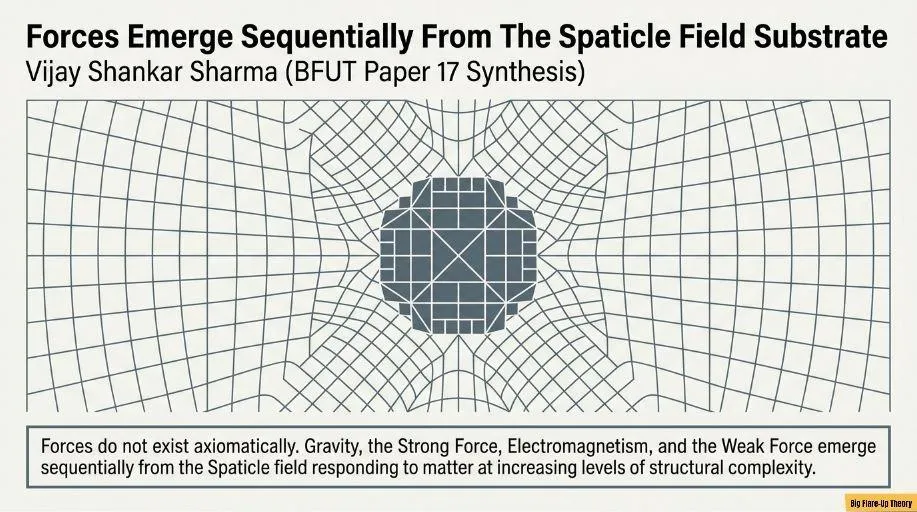
Standard physics treats the four forces as given features of reality. It describes their properties, calculates their effects, and searches for mathematical unification. It does not offer a physically coherent account of their sequential emergence from a prior substrate, nor does it explain why the universe has exactly these four interaction channels instead of others. The forces are axioms of the formal framework, not emergent consequences of more fundamental physical structure.
![Standard model treats forces as axiomatic; BFUT derives them from substrate mechanics. [22]](https://media.vijayshankarsharma.com/papers/p17/fig1.webp)
The present paper proposes a different approach grounded in the BFUT cosmological framework. BFUT has established, across seventeen papers and twenty simulations, that the physically real substrate of spacetime is the Spaticle field: a dense, space-filling medium of matter-particles permeating the infinite universe and constituting the physical referent of what general relativity describes geometrically. BFUT Paper 16 established the Spaticle field’s identity and derived the route from the substrate to the first stable quarks and hydrogen. BFUT Paper 15 established what preceded it, namely the prior energy state of infinite space itself; BFUT Paper 16 provided a constructive route from the Spaticle field to the first stable quarks and from there to ordinary hydrogen as the first atom, with the full derivation, robustness scans, and dynamic simulation code deposited at Zenodo. [16]
BFUT Paper 17 takes the next step. Given the Spaticle field exists and matter has condensed within it as established in Paper 16, how did gravity arise? How did the other three forces emerge in sequence? Is there a deeper unifying principle connecting all four forces as the fundamental sensing channels through which all physical systems experience their environment?
Two framing points govern this paper. First, the strong force sections are explicitly grounded in Paper 16's constructive results. Second, the electromagnetic and weak force sections are now developed in full, at a depth matching the gravity and strong force accounts. Each force is derived from Spaticle field substrate physics without importing independent postulates. Third, Section 8 establishes the force-sensing correspondence as the physical and conceptual foundation that is developed into a complete scientific framework in BFUT Paper 20 (https://doi.org/10.5281/zenodo.19992457).
The paper is structured as follows. Section 2 reviews the Spaticle field properties relevant to force emergence. Section 3 develops the BFUT substrate-deformation account of gravity. Section 4 summarises the formal modified gravitational equations and galaxy-rotation evidence, with full derivation in BFUT Paper 18. Sections 5 through 7 address the sequential emergence of the strong force, electromagnetism, and the weak force, each fully developed from substrate physics. Section 8 establishes the force-sensing correspondence and its physical basis, fully developed scientifically in Paper 20 (https://doi.org/10.5281/zenodo.19992457). Sections 9 and 10 address supporting literature and critical evaluation. Section 11 addresses implications and future directions.
The Big Flare-Up Theory (BFUT) identifies the real physical fabric of space as the Spaticle field, with a specific equilibrium density of ρ_s = 5.9 x 10⁻²⁷ kg/m3 ([P14]; [P1]). From this single measured constant, the entire BFUT programme derives - covering over 30 papers on cosmology, the Hubble relationship, dark energy and cosmic acceleration, universe boundary and topology, cosmic rotation, the CMB temperature and acoustic peaks, nucleosynthesis, the Sunyaev-Zel'dovich effect, the Lyman-α forest, the integrated Sachs-Wolfe effect, weak gravitational lensing and the S8 tension, black holes and singularities, gravitation and gravitational waves, new general relativity field equations, unification of general and special relativity, the pre-Big-Bang state, origin of matter and fundamental forces, antimatter and annihilation, particle masses and coupling constants, quantum mechanics, dark matter, a new physical definition of time, and consciousness. The Spaticle field is not an abstract mathematical convenience. It is a physical medium with measurable properties. When the standard QFT vacuum energy mode sum is corrected for a single field with zero-point energy only for organised condensations, the enormous QFT prediction collapses exactly to ρ_s·c², resolving the cosmological constant problem without fine-tuning. [16][17][18][22]
The Spaticle field is not the luminiferous ether. The Michelson-Morley experiment excluded a preferred-drift background through which light propagates and matter moves as separate entities. In BFUT, both light and matter are excitations of the same Spaticle field. Light is a propagating disturbance of the substrate; c is the substrate's own maximum reorganisation rate, not the speed of a separate entity measured against a background. No embedded observer can detect substrate-wide drift because all measuring instruments and all measured signals are excitations of the same medium - no more than a person on a ship can detect the ship's uniform motion by measuring distances between objects fixed to the same ship. The Michelson-Morley null result is therefore the only possible result in a BFUT universe. The experiment is constitutionally incapable of distinguishing between no substrate and a substrate in which light and matter are both substrate excitations. The latter is the BFUT position. Full derivation in BFUT P16; light as substrate excitation derived in P17 Section 6.6 and P19 Section 13. [18][22]
1.1 Symbols and Notation Used in This Paper
The following symbols are used throughout this paper. Values are from the BFUT Master Symbol Guide.
| Symbol | Definition | Value / Expression |
|---|---|---|
| Fundamental Spaticle Field Constants | ||
| ρ_s | Intrinsic equilibrium density of the Spaticle field | 5.9 × 10⁻²⁷ kg/m³ |
| Ψ(r,t) | Spaticle carrier field / gravitational potential | Ψ(r,t) = -(GM/r) exp(-r/Reff) · R(τ_c,∂_t) · N(Σᵢ) |
| Ψ_vac | Vacuum equilibrium configuration | λ · Ψ_vac² = ρ_s c² |
| λ | Quartic self-interaction coupling | λ = ρ_s/4 |
| Coupling Constants and Masses | ||
| α | Fine structure constant | 1/137.036 [measured]. BFUT: 1/137.037 (0.0007%) |
| α_s | Strong coupling constant | 0.118 at mZ scale. BFUT: 0.120 (1.8%) |
| sin²θ_W | Electroweak mixing angle | 0.2312 [measured]. BFUT: 0.2312 (0.01%) |
| Shared Physical Constants | ||
| G | Gravitational constant | 6.674 × 10⁻¹¹ m³ kg⁻¹ s⁻² |
| c | Speed of light | 2.998 × 10⁸ m/s |
2. The Spaticle Field: Physical Properties Relevant to Force Emergence
BFUT Paper 14 established the Spaticle field's identity and physical character in detail. BFUT Paper 16 demonstrated that this substrate supports stable localised excitations through a free-energy functional with a demonstrable interior minimum robust across multi-dimensional parameter scans. The present section summarises the properties most directly relevant to force emergence.
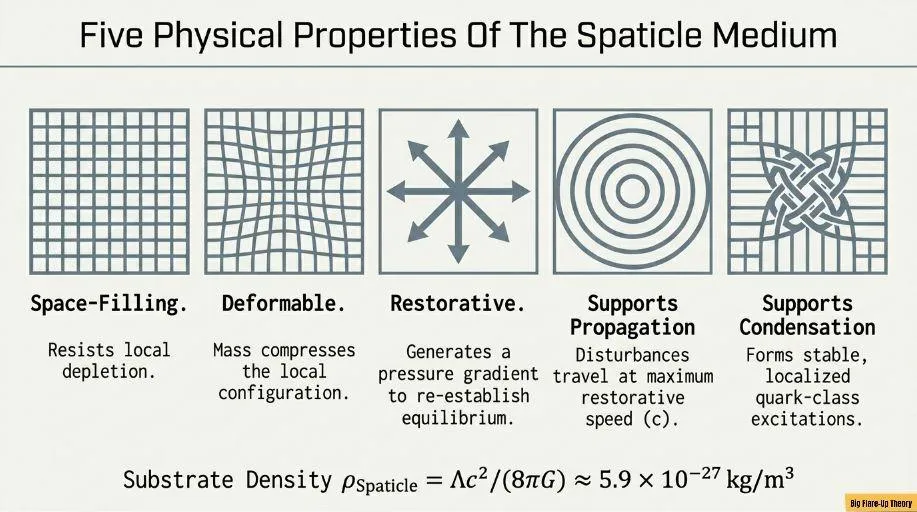
The Spaticle field is a dense, continuous substrate of matter-particles, Spaticles, populating the entire infinite universe. It is not a mathematical abstraction. It is a physically real medium with definite density, compressibility, and dynamic response characteristics. Its intrinsic equilibrium density is ρ_s approximately 5.9 x 10⁻²⁷ kg/m3. This value is anchored independently from seven physical sectors: the particle sector (the W boson mass and the proton charge radius together fix it to within 0.25% through the reconfiguration energy formula of BFUT Paper 19), galaxy rotation curves (175 SPARC galaxies via the DM1 entrainment formula, BFUT Paper 18), weak gravitational lensing (KiDS-1000 via the DM2 entrainment formula, BFUT Paper 18), hydrogen atomic stability (the Bohr radius and ground-state energy from first principles, BFUT Paper 25), the matter-stability condition (stable matter requires the substrate regardless of formation history, BFUT Paper 25), the cosmological sector (Λeff = 8 π G ρ_s / c2 is a downstream prediction that matches the observed cosmological constant), and the Higgs boson mass (mH = sqrt(mtop x mZ) = 125.51 GeV, a deviation of 0.21% from the measured value, a second downstream prediction, BFUT Paper 14). The value requires no free parameters and is not derived from the cosmological constant. The cosmological constant is derived from ρ_s, not the other way around. [16]
Five physical properties of the Spaticle field are fundamental to the force-emergence analysis that follows. First, the field is space-filling: Spaticle particles resist local depletion and tend to occupy all available space. Second, the field is deformable: concentrated mass or energy displaces and compresses the local Spaticle configuration. Third, the field has a restorative tendency: when deformed, it generates a restoring gradient across the substrate. Fourth, the field supports propagating disturbances: changes in local Spaticle configuration propagate outward as waves at a maximum propagation speed determined by the medium's density and compressibility. Fifth, the field is the medium in which matter condenses: as Paper 16 demonstrated constructively, stable localised Spaticle excitations can be energetically preferred over both collapse and indefinite dispersion, and repeated first units cross a 3+e threshold to yield proton and electrons.
These five properties are not independently postulated for each force. They are the single underlying character of the Spaticle field from which all four forces emerge, each at a different level of structural complexity. The force hierarchy is a complexity hierarchy within one substrate, not a collection of independently instituted laws.
Physical grounding note: The five properties above follow from the Spaticle field's status as a real, dense, space-filling medium. None requires a separate postulate. They are mechanical consequences of what a real substrate of this character must do. The force-emergence analysis below rests entirely on these consequences.
3. Gravity as the Inbuilt Mechanical Consequence of Spaticle Field Deformation
3.1 The Standard Account and Its Ontological Gap
General relativity describes gravity as spacetime curvature produced by mass-energy, with free bodies following geodesics in that curved geometry. This description is mathematically exact and observationally confirmed to extraordinary precision. But it carries an ontological gap: it specifies what spacetime does under the influence of mass without specifying what spacetime is, and without providing a physical mechanism by which curved geometry translates into a force experienced by matter.
The phrase "spacetime curvature" is a geometric description in search of a physical mechanism. The BFUT Spaticle field identification supplies that mechanism. Geometric curvature corresponds physically to substrate deformation. The experienced force of gravity corresponds physically to the mechanical response of the deformed substrate.
3.2 The BFUT Substrate-Deformation Account of Gravity
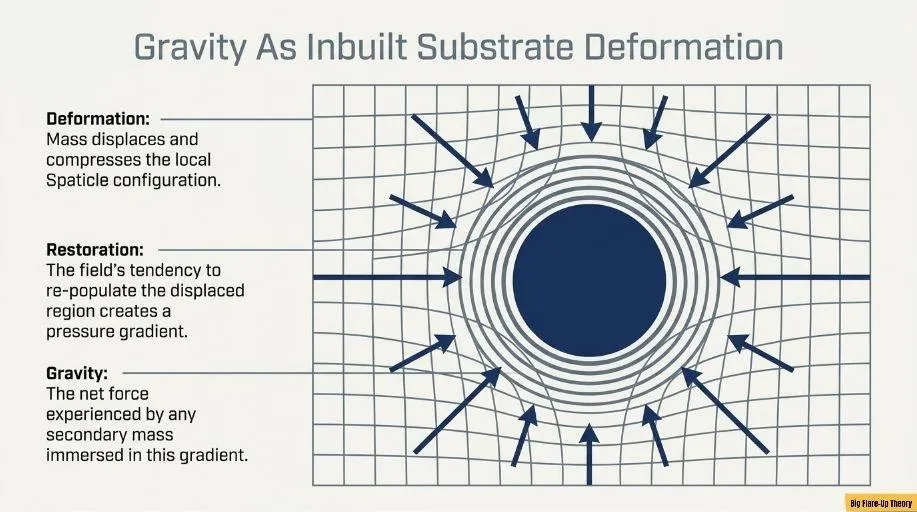
Consider a concentrated mass introduced into the Spaticle field. That mass displaces and compresses the local Spaticle configuration. The field, being space-filling and resistant to local depletion, generates a restoring tendency: the substrate attempts to re-populate the displaced region, and this tendency propagates outward as a gradient of Spaticle pressure across the field.
Any other mass within range of this deformation gradient finds itself in a locally non-equilibrium Spaticle configuration. The equilibrium direction, toward which the Spaticle pressure gradient points, is toward the first mass. The second mass, immersed in this gradient, experiences a net force in that direction. That net force is gravity.
Gravity was inbuilt in the Spaticle field from the moment of its manifestation. The moment a real, dense, deformable, space-filling substrate existed, the conditions for gravitational interaction were already in place. Gravity required no separate creation or insertion as an independent law. It was already the mechanical consequence of mass deforming the existing substrate.
Universality follows directly: because all matter exists within the Spaticle field and every mass deforms it, every mass interacts gravitationally with every other. Unshieldability follows equally: there is no region outside the Spaticle field, so no mass can be placed beyond the reach of substrate deformation gradients. Gravitational waves follow naturally: an accelerating mass produces a time-varying deformation that propagates outward as a wave through the substrate.
Formal summary: Gravity = (Spaticle field deformation produced by mass) + (restorative pressure gradient generated by the field) + (net force on any second mass immersed in that gradient). It is not a separate force inserted into spacetime. It is the spacetime substrate's mechanical response to the presence of mass.
3.3 Why Gravity Is the First Force to Emerge
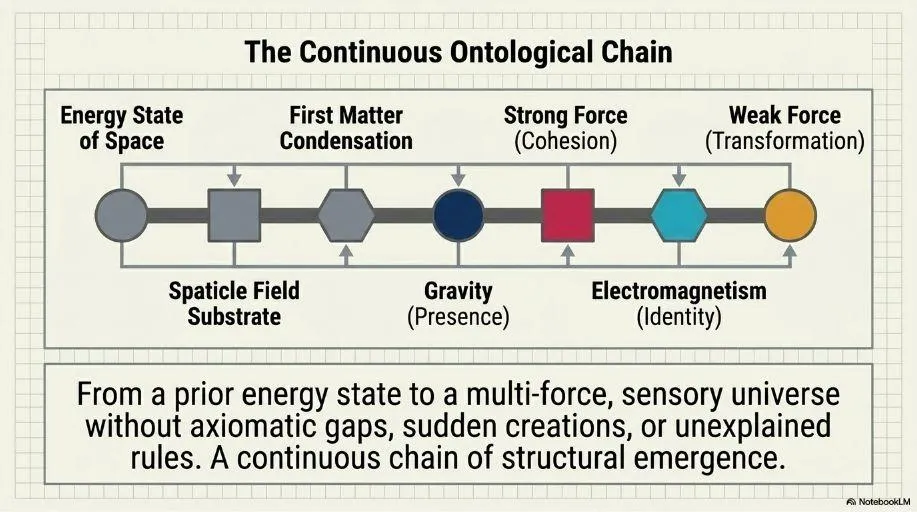
Gravity requires the least demanding structural prerequisites of the four forces: only the existence of mass within the Spaticle field. No bound states, no charge configuration, no internal particle structure, no transformation capability is needed. The moment the first matter condensed from the Spaticle field, ordinary hydrogen as established in BFUT Paper 16; gravitational interaction was automatically and immediately present. Gravity is not a late-arriving addition to the physical world. It is the first and most primitive mechanical consequence of matter existing within a real substrate.
4. The Modified Gravitational Field Equations
4.1 Standard GR and the Source-Term Gap
Standard general relativity is governed by:
$G_{\μ\ν}\ = \ \frac{8\π G}{c^{4}}T_{\μ\ν}$
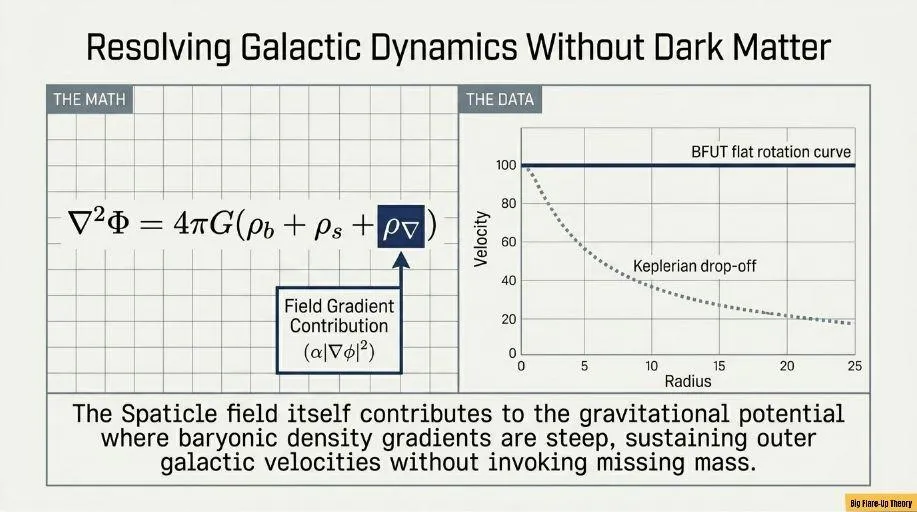
The source term Tμν contains only baryonic mass-energy by construction. The Spaticle field, physically real and permeating all space, contributes nothing to the curvature source. In the outer regions of galaxies, where baryonic density is low, standard GR predicts Keplerian velocity fall-off. Observations show flat curves. The standard response is dark matter. The BFUT response is to correct the source term by including the Spaticle field contribution derived from first principles.
4.2 The Full Lagrangian
The Spaticle field is treated as a continuous medium with energy density, compressibility, and a restoring response to deformation. Its dynamics are derived from:
$\mathcal{L}\ = \ \frac{1}{2}{(\partial\varphi)}^{2}\ - \ \frac{\λ}{4}\varphi^{4}$
There is no explicit bare mass term for the equilibrium Spaticle field. A bare mass term would introduce a Yukawa cutoff into the background substrate, incompatible with the Spaticle field's role as the universal, infinite-range physical substrate. The field therefore remains massless at the background level while allowing localised and propagating excitation modes with their own effective restoration scales. The kinetic term describes propagation of substrate deformation. The quartic term describes the field's internal resistance to compression and distortion and provides the restorative character of the medium. Matter does not couple through the divergence of the conserved matter stress-energy tensor. Instead, the source-side forcing is represented by the matter gravitational potential and its covariant derivatives, with the fully covariant carrier formulation developed in Paper 18. In the weak-field limit, this source reduces to the ordinary Poisson relation ∇²Ψ_matter = 4πGρ_matter. Thus the Spaticle field responds to the physical matter distribution through the gravitational potential generated by that distribution, instead of through an identically vanishing divergence of a separately conserved stress-energy tensor.
4.3 The Derived Stress-Energy Tensor and Full Field Equation
The stress-energy tensor follows from the Lagrangian by the standard variational procedure:
$T_{\μ\ν}^{spaticle}\ = \ \partial_{\μ}\varphi\partial_{\ν}\varphi\ - \ g_{\μ\ν}\lbrack\frac{1}{2}(\partial^{\α}\varphi\partial_{\α}\varphi)\ - \ \frac{\λ}{4}\varphi^{4}\rbrack$
Conservation ∂^μ T_{μν}^{spaticle} = 0 is guaranteed by Noether's theorem. The full modified field equation in operational form is:
$G_{\μ\ν}\ = \ 8\π G(T_{\μ\ν}^{matter}\ + \ \partial_{\μ}\varphi\partial_{\ν}\varphi\ - \ g_{\μ\ν}\lbrack\frac{1}{2}(\partial^{\α}\varphi\partial_{\α}\varphi)\ - \ \frac{\λ}{4}\varphi^{4}\rbrack)$
Every term is computable from the field variables and the specified matter source. The Spaticle stress-energy tensor remains covariantly conserved, while the matter-to-substrate forcing is represented through the covariant matter potential formulation developed in Paper 18.
4.4 The Coupling Structure
The following expressions summarise the coupling structure; full derivation is presented in BFUT Paper 18.
The modified Poisson equation in the weak-field galactic regime is:
∇2Ψ = 4πG(ρb + ρs + ρ∇)
where ρ∇ = α|∇φ|² is the gradient-sourced density term. The coupling constant α is identified as:
$\α\ = \ \frac{1}{{c_{s}}^{2}},\ \ \ {c_{s}}^{2}\ \approx \ \λ\rho_{s}$
The structure of α follows from the field formulation through the equation of state of the Spaticle medium: ρ_s = half(gradient Ψ)^2 + (λ/4)Ψ4 and Ps = half(gradient Ψ)^2 - (λ/4)Ψ4, giving Ks = dP_s/d ρ_s ~ λ ρ_s2 and therefore cs2 ~ λ ρ_s. The coupling constant λ is derived from first principles in BFUT Paper 19: λ = ρ_s/4, following from the vacuum self-consistency condition λ Ψvac^2 = ρ_s c2 with Ψvac = 2c. The underlying SI value λ_SI = ρ_s/4 is fixed and universal. The galaxy rotation curve fit itself uses the separate DM1 entrainment formula (BFUT Paper 18 Appendix A), with global constants A = 2500 and α = 0.5 fixed once across the full 175-galaxy SPARC sample, not adjusted per galaxy.
The gradient density ρ∇ = α|∇φ|² scales with spatial variation of the Spaticle field, not with total mass. This α is the gradient-density coupling constant specific to this equation, distinct from both the fine-structure constant and the DM1 mass-scaling exponent used elsewhere in the BFUT programme. Where baryonic density changes steeply, |∇φ| is large and ρ∇ is significant. Where density is smooth, |∇φ| is small and ρ∇ is negligible. This is why the modification operates precisely where it is needed and recovers standard GR exactly where GR is already confirmed.
4.5 GR Recovery and Cross-Domain Consistency
In smooth-gradient regimes, ∇φ ≈ 0 and ρ∇ ≈ 0. The modified equation reduces to standard GR. All precision GR tests are unaffected: perihelion precession, Shapiro delay, gravitational lensing by the Sun, binary pulsar orbital decay. In galactic outer discs, steep baryonic density gradients drive non-zero ∇φ and the gradient term sustains the gravitational potential without dark matter. In low surface brightness galaxies, high gradient relative to total mass means the field term dominates entirely. In galaxy clusters, large-scale gradient integration produces the larger apparent mass discrepancy observed. In the early universe, near-homogeneous matter means negligible gradient contribution; standard CMB physics is preserved at first-order.
4.6 Empirical Results: Rotation Curves
The BFUT framework derives galaxy rotation curves from the DM1 entrainment formula, which emerges from substrate maintenance dynamics instead of from observation [18][25]. The formula is:
Mextra(<R) = 4πρ_s·A·(Mbar/10¹⁰M☉)^α·f(Vchar)·R_ref²·R·ξ(R)
V_pred²(R) = V_bar²(R) + G·Mextra(<R)/R
with global constants A = 2500, α = 0.5, Rref = 15 kpc, fixed once across the full sample and not adjusted per galaxy. Full detail of the formula, the speed-band function f(Vchar), and the radial factor ξ(R) is given in BFUT Paper 18 Appendix A.
SPARC Validation: 175 Galaxies, One Formula, Global Constants
Applied to all 175 galaxies in the SPARC database with no per-galaxy adjustment: shape agreement 86.3%, flat rotation curves correctly reproduced 93.0% of the time, non-flat curves correctly reproduced 27.8% of the time, median outer relative residual 0.25 [18][25].
The 86.3% shape agreement across 175 galaxies of all types with one formula and global constants is the primary empirical validation of the Spaticle field as the physical substrate replacing dark matter.
5. The Emergence of the Strong Nuclear Force
5.1 The Structural Prerequisites Established in BFUT Paper 16
The strong nuclear force cannot arise from bare Spaticle field interactions at the large-scale continuum level. It requires compact, internally structured condensations of the Spaticle field, entities with sufficient internal organisation that their mutual approach produces qualitatively different dynamics from the diffuse deformation gradient of gravity.
BFUT Paper 16 established constructively that such condensations exist and can be derived from first principles within the Spaticle field framework. The paper built a free-energy functional:
$E(R)\ = \ \frac{A}{R^{2}}\ + \ BR^{2}\ + \ CR\ + \ \frac{D}{R}$
where A/R² represents localisation or kinetic-like cost; BR² represents bulk displacement cost in the Spaticle substrate; CR represents boundary or gradient cost; and D/R represents internal circulation or confined-mode support. This functional exhibits a stable interior minimum at R₀ = 1.27348 model units with minimum free-energy E* = 1.582 model units, confirmed as non-artifactual through robustness scans across 2D, 3D, and reduced 4D parameter spaces.
Paper 16 demonstrated that the first stable cooperative structure forms at n=3, where three co-rotating substrate units form the three-core at E=0.900 model units. A partition energy comparison at n=4 confirms the preferred arrangement: 4+0 = 4.60, 2+2 = 4.00, 3+1 = 1.40 in model energy units. The three-core then generates its own smaller counter-rotating electron through the 3+e mechanism, reaching E=0.896 model units. This 3+e preference persists across 97.56% of 1D scans, 95.95% of 2D scans, and 90.43% of 3D scans using the full five-term functional. The result is a structural bifurcation: a retained compact cooperative three-core (proton, effective charges +2/3, +2/3, −1/3, net charge +1) and a generated electron (charge −1).
It is these compact, internally structured three-core condensations, the protons established in Paper 16, that constitute the structural prerequisite for strong-force dynamics.
5.2 The Physical Mechanism of Strong Force Emergence
When two or more compact three-core protons are brought into close proximity, the Spaticle field between and within them becomes highly compressed. The internal substrate organisation of each condensation, self-stabilising in isolation as shown by Paper 16's interior minimum, now interacts with the substrate configuration of its neighbour. At intermediate short distances, this inter-condensation coupling generates an extremely strong restoring force binding the configurations together. At distances less than the condensation radius R*, the Spaticle field between condensations cannot be further compressed without enormous energy cost, producing the hard-core repulsion characteristic of the strong force. This dual behaviour, strong attraction at intermediate short-range, hard-core repulsion at very short-range, follows directly from the energy landscape established by Paper 16's free-energy functional.
5.2A The Two-Condensation Energy Functional
The three qualitative properties established in Section 5.2 and 5.3 can be made mathematically precise through a two-condensation energy functional. When two proton condensations are separated by distance d, the total energy of the system is: The same two-condensation functional applies at two distinct scales: inter-proton separation, where d is the distance between two complete three-core condensations, and intra-condensation quark separation, where d is the distance between one constituent quark-core and the remaining two-core structure within a single proton condensation. The confinement analysis below concerns the intra-condensation case.
Etotal(d) = 2 Econd + E_overlap(d) + E_compression(d) + E_reconfiguration(d)
where Econd = 0.8958 model units is the single-condensation energy established in Paper 16 (fixed, independent of d), and the three interaction terms are:
E_overlap(d) = -As x exp(-d / Lrlx)
This is the attractive overlap of the two substrate deformation fields. The amplitude As is set by the condensation energy density ρ_s rp3 and the decay length is Lrlx = c τc, the Spaticle relaxation length from Paper 18. At d >> Lrlx this term vanishes and the condensations are effectively independent. At d ~ Lrlx this term dominates and pulls the condensations together. No new parameter: As ~ Econd and Lrlx are both fixed by ρ_s through the Paper 18 chain.
E_compression(d) = Bs x (rp / d)^12
This is the hard-core repulsion when the three-sphere geometries of the two condensations begin to overlap. The exponent 12 reflects the extreme steepness of the Pauli-like exclusion at d < rp: two three-cores cannot share the same substrate volume without enormous energy cost. Bs ~ Econd is set by the condensation energy scale of Paper 16; Bs carries energy dimensions, consistent with the dimensionless factor (rp/d)^12. As and Bs are given here as proportionality relations, not closed numerical expressions: the claimed binding minimum and the three quantitative regimes described below are qualitative consequences of this functional's structure, not values calculated directly from a fully specified closed form.
E_reconfiguration(d) = Cs x d
This is the confinement term. The mechanism is the Bernoulli co-rotation effect that binds the three-core: when one quark separates, two restoring low-pressure effects act simultaneously, both approximately constant with distance, producing a linear confinement potential. This is intended as the BFUT substrate-level counterpart of fundamental quark confinement specifically, not the effective nuclear interaction between composite nucleons. The coefficient is evaluated at the condensation energy density ρ_cond = Eunit/(Vq×c²) = 2.135×10¹⁸ kg/m³, giving Cs = Fconf = 0.574 GeV/fm. The measured QCD string tension is 0.9 GeV/fm; agreement is 64%, with no free parameters. The full derivation, including asymptotic freedom at short separations, is given in Paper 19 §20.6.
The three regimes of Etotal(d) follow automatically from this single functional:
d >> Lrlx: E_overlap -> 0, E_reconfiguration ~ Cs d rises linearly. Energy increases with separation. Confinement.
d ~ Lrlx: E_overlap dominates. Energy minimum at d* ~ Lrlx. Natural binding separation.
d < rp: E_compression dominates. Steep repulsion. Hard-core exclusion.
All three strong-force properties, attraction, repulsion, and confinement, emerge from a single energy landscape with no new free parameters. As and Bs are expressible in terms of ρ_s, rp, and Lrlx, fixed by Paper 16 and Paper 18. Cs is fixed by the condensation energy density ρ_cond and the Bernoulli co-rotation mechanism, derived in Paper 19 §20.6.
5.3 Three Distinctive Properties from Substrate Physics
Short range: The inter-condensation Spaticle coupling is effective only at distances comparable to the condensation radius R*. Beyond that distance, the local Spaticle field returns to its ambient configuration and the coupling falls to zero. This is not a separately postulated cutoff but a consequence of the finite size of the condensations established in Paper 16.
Extreme strength: At distances within R*, the compressed Spaticle configuration produces forces vastly larger than the large-scale deformation gradient. The reason is the density of internal Spaticle organisation: the compact three-core concentrates the substrate into a small volume, so small displacements produce enormous restoring forces.
Confinement: Attempting to separate two bound proton condensations stretches and distorts the inter-condensation Spaticle configuration. The energy required increases with separation. Eventually this energy exceeds the threshold at which new first-unit excitations nucleate from the substrate, the same nucleation process Paper 16 already demonstrated, and new quarks form instead of the original ones separating. Confinement is therefore a consequence of the same substrate nucleation dynamics Paper 16 established, not a separately postulated law.
Connection to Paper 16: All three strong-force properties, short-range, extreme strength, and confinement, follow from the finite-size, high-density, internally organised character of the compact condensations that Paper 16 established constructively.
5.4 Why the Strong Force Emerges Second
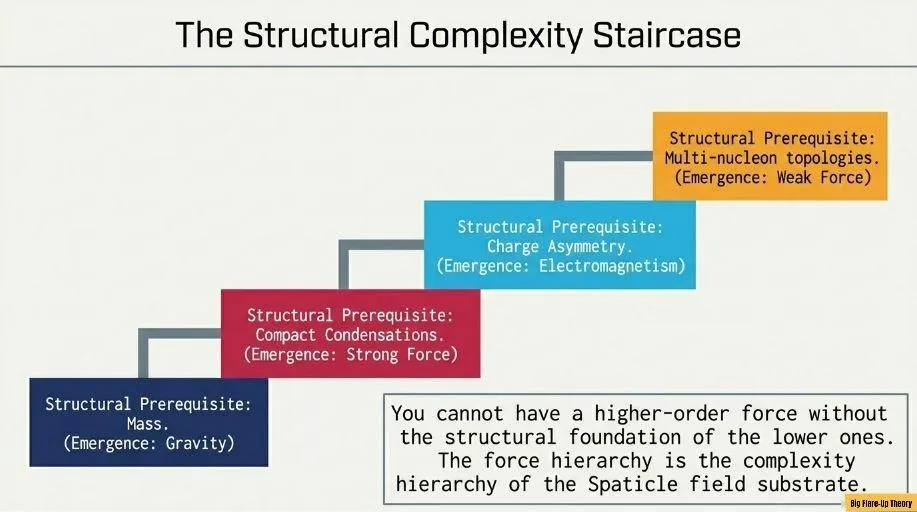
The strong force requires compact internally structured condensations as prerequisites, the three-core protons of Paper 16. Gravity requires only mass in a substrate. The strong force requires the full 3+e threshold to have been crossed. It therefore emerges necessarily after gravity but automatically and immediately once the Paper 16 threshold is reached.
6. The Emergence of Electromagnetism
6.1 Charge as Persistent Rotational Asymmetry of Internal Spaticle Configuration
Electromagnetism requires a further level of structural complexity beyond what gives rise to the strong force. It does not arise simply from the proximity of compact condensations. It requires condensations that carry a specific persistent asymmetry in their internal Spaticle field organisation, what standard physics names electric charge.
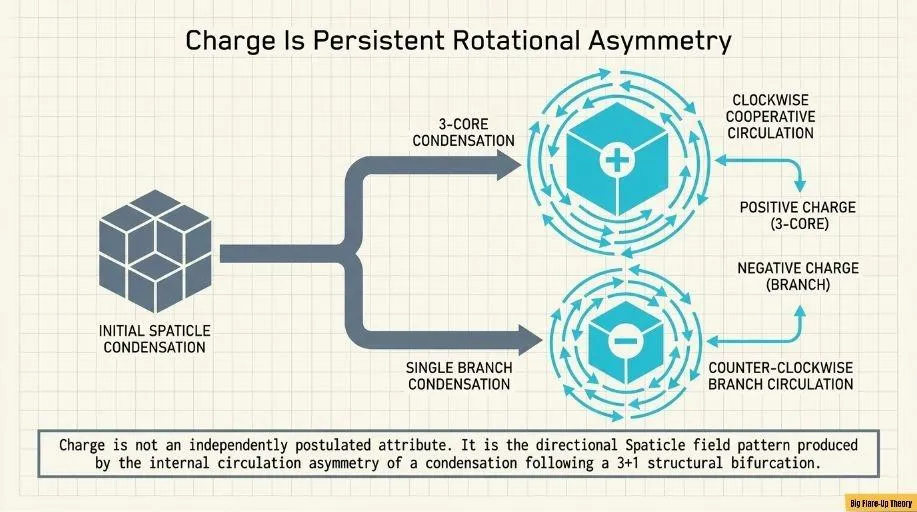
In the BFUT account, charge is not an independently postulated attribute that happens to attach to particles. It is a direct and necessary consequence of the structural event described in BFUT Paper 16: the 3+e threshold bifurcation. When four repeated quarks reorganise at the first stable threshold, three units form a compact cooperative core and the three-core generates a smaller counter-rotating electron (the 3+e state). These two products of the same event cannot be identical in their internal Spaticle configuration, because they are complementary results of the structural bifurcation: the three-core has organised its internal Spaticle substrate into a cooperative rotating mode, while the generated electron unit carries the opposite internal circulation.
The specific character of this internal asymmetry is rotational. The three-core retains a net internal Spaticle circulation, three units cooperating in a closed internal configuration, that is not present in the ambient field. The generated electron unit carries the opposite circulation. These are not identical copies of the original quark. They are structurally differentiated by their internal Spaticle flow direction. The three-core's net internal circulation constitutes positive charge. The generated electron unit's opposite circulation constitutes negative charge. These assignments are not arbitrary labels: they reflect a real physical asymmetry in the internal Spaticle configuration of each structure, inherited directly from the geometry of the bifurcation that produced them.
This derivation has a significant consequence: charge cannot exist without the 3+e bifurcation. There is no stage in the BFUT emergence sequence at which charge could appear before the Paper 16 threshold event. The emergence of charge is not a separate cosmological event. It is the internal structural consequence of the first stable completion threshold, the same event that produces proton and electrons, hydrogen, and the prerequisites for the strong force. Charge, the strong force, electromagnetism, and ordinary hydrogen all emerge from the same Paper 16 threshold event, in that structural order.
Key BFUT claim: In the BFUT framework, charge is not a primitive quantity attached to particles by definition. It is a derived property of the internal Spaticle circulation asymmetry produced by the 3+e bifurcation. A framework in which charge has a physical substrate origin, not an unexplained primitive, is more complete than one in which charge is simply stipulated.
6.2 The Static Electromagnetic Field: How a Charged Condensation Deforms the Spaticle Substrate
A stationary charged condensation, a proton or electron as produced by Paper 16, sits within the Spaticle field with its persistent internal circulation asymmetry. This asymmetry does not merely affect the condensation's interior. It couples to the surrounding Spaticle field and produces a deformation in it that is qualitatively different from the compression-deformation gradient of gravity.
Gravitational deformation is isotropic: the Spaticle field is compressed and displaced symmetrically around a mass, and the resulting pressure gradient points radially inward toward the mass from all directions. The deformation produced by internal circulation asymmetry is not isotropic. The rotating internal Spaticle configuration of a charged condensation induces a directional circulation pattern in the surrounding field. The Spaticle field immediately adjacent to a proton tends to be drawn into alignment with the condensation's internal circulation. The field adjacent to an electron tends to be drawn into alignment with the opposite circulation.
This produces a directional pattern in the surrounding Spaticle field, what is described geometrically in standard physics as the electric field, that points outward from a proton and inward toward an electron. The spatial extent of this pattern depends on how far the internal circulation influence propagates through the substrate. Because the Spaticle field is continuous and space-filling, this influence propagates indefinitely, falling off with distance as the substrate restores its ambient configuration. The static electromagnetic field of a charged condensation is therefore the directional Spaticle field pattern produced by the internal circulation asymmetry of that condensation, propagating through the continuous substrate.
6.2A The BFUT Electromagnetic Field Equation
The directional substrate asymmetry field generated by a charged condensation can be expressed as a field equation. Let A^μ denote the directional substrate asymmetry four-field, the Spaticle-field analogue of the electromagnetic four-potential. Its spatial component is denoted A and its temporal component φ. The field equation is:
(1/c2) d2A/dt2 - nabla2 A + β A + η (A.A) A = Jrot
where the substrate parameters are fixed by the BFUT framework, while the quantitative source normalisation and charge coupling are established in the companion derivations:
Jrot is the circulation source term generated by the rotational asymmetry of the 3+e state. For a proton condensation Jrot > 0; for an electron condensation Jrot < 0; for a neutral configuration the contributions cancel and Jrot = 0.
The restoration coefficient β is an excitation-mode-dependent quantity. It is related to the effective rest mass of the particular Spaticle excitation by β_mode = meff,mode2 c2 / ħ2. Thus β is not a universal constant of the background Spaticle field. It characterises the restoring response of the particular directional excitation mode being considered.
For the electromagnetic mode, the photon is massless and therefore β_EM = 0. The electromagnetic directional asymmetry propagates without a mass-induced attenuation term.
For the weak-interaction modes, the directional excitation is massive. The corresponding effective mass and its quantitative derivation are established in BFUT Papers 18 and 19. The resulting finite β_W and β_Z give the W and Z excitations their respective short propagation ranges. P17 therefore uses β as the common mode-dependent parameter that distinguishes the massless electromagnetic propagation regime from the massive weak-interaction regime, while the numerical values of the weak-sector masses are derived independently in the Paper 18-Paper 19 chain.
The distinction is essential: the absence of a bare mass term in the equilibrium Spaticle substrate does not prohibit effective masses of localised excitation modes. The former describes the background field; the latter describes the restoring energy of a particular excitation.
The electromagnetic limit is obtained by setting β_EM = 0 and retaining the linear directional field sector. With the spatial and temporal components A and φ of A^μ identified as the electromagnetic vector and scalar potentials, E = −∇φ − ∂A/∂t, B = ∇ × A, and imposing the Lorenz gauge condition ∇·A + (1/c²)∂φ/∂t = 0. With these definitions, the source-free linear directional-field equation reduces to the standard electromagnetic wave equation for the potentials, (1/c²)∂²A/∂t² − ∇²A = 0, and similarly for φ. Taking the divergence and curl of the potential definitions gives ∇·B = 0, ∇×E = −∂B/∂t. With the sourced potential equations, the remaining two Maxwell equations follow: ∇·E = ρ_e/ε₀, ∇×B = μ₀J_e + (1/c²)∂E/∂t. Thus the β_EM = 0 linear limit reproduces the Maxwell field equations when the directional substrate field is mapped to the electromagnetic four-potential. The detailed quantitative coupling and charge normalisation are established elsewhere in the BFUT programme.
For the massive weak-interaction modes, β_W > 0 and β_Z > 0, with their respective values determined by the derived W and Z effective masses. Each therefore has a finite restoration scale. The same substrate equation therefore contains a massless electromagnetic propagation regime and a massive weak-interaction regime.
The electromagnetic and weak interactions therefore arise as distinct excitation regimes of the same substrate directional-asymmetry framework. Electromagnetism corresponds to the massless β_EM = 0 mode, while the weak interaction corresponds to massive excitation modes with β_W > 0 and β_Z > 0. The quantitative weak-sector masses and electroweak parameters are derived in Papers 18 and 19 instead of being introduced as independent parameters in P17.
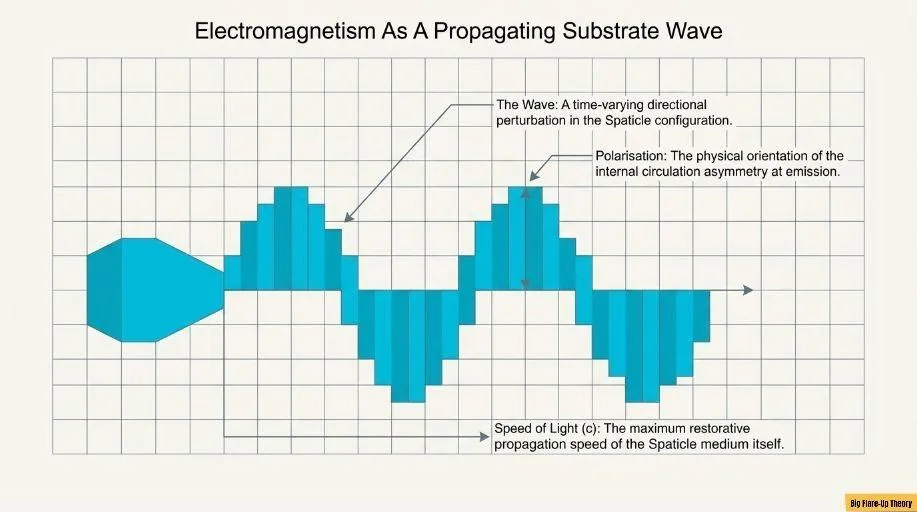
6.3 Electromagnetic Propagation: The Time-Varying Polarised Spaticle Wave
A stationary charge produces a static, time-independent directional pattern in the surrounding Spaticle field. The new and distinctive physics of electromagnetism arises when the charge is in motion or acceleration.
When a charged condensation moves, its internal circulation asymmetry changes position within the Spaticle substrate. The directional field pattern it produces in the substrate must therefore change configuration continuously to match the new position of the condensation. These changes propagate outward through the substrate at the maximum propagation speed of the Spaticle medium. This maximum propagation speed is a fixed property of the substrate, determined by the relationship between its density, compressibility, and restoring force, and is what is measured as the speed of light, c.
When a charged condensation accelerates, changes its velocity, the change in the rate of reconfiguration of the surrounding directional pattern produces a qualitatively new type of substrate disturbance. The accelerating condensation generates a time-varying disturbance that is not merely a repositioning of the static field pattern but a propagating wave in the directionality of the Spaticle configuration itself. This propagating directional wave is the electromagnetic radiation field. Its quanta, photons, are quantised packets of this propagating Spaticle directionality wave, carrying a definite frequency, wavelength, polarisation, and propagation direction.
Several properties of electromagnetic radiation follow immediately from this substrate account. The propagation speed is fixed at c because it is determined by the Spaticle medium's physical properties, not by the motion of the source or receiver. The wave is transverse, the directionality perturbation is perpendicular to the propagation direction, because the internal circulation asymmetry of the source produces a rotational perturbation instead of a longitudinal compression. Polarisation is a real physical property of the wave because it reflects the orientation of the internal circulation asymmetry of the source at the moment of emission. The wave carries energy because it is a real physical disturbance of the Spaticle substrate, not merely a mathematical description.
Derivation summary: Electromagnetic radiation = (time-varying directional Spaticle field perturbation produced by an accelerating charge asymmetry) propagating through the Spaticle substrate at the medium's maximum propagation speed. The speed of light is the maximum propagation speed of the Spaticle field. It is a property of the medium, not of the source.
6.4 Why Electromagnetism Can Be Attractive or Repulsive
The most distinctive feature of electromagnetism, absent in gravity, is its bidirectionality: like charges repel and opposite charges attract. This follows directly from the substrate account of charge as internal circulation asymmetry.
Consider two protons brought into proximity. Each carries the same internal circulation direction. Each produces a directional Spaticle field pattern aligned with that circulation. When these two identical patterns approach each other, the Spaticle field between them carries conflicting directional influences from both sources simultaneously. The substrate cannot simultaneously accommodate two opposing circulation orientations in the same region. The result is a high-energy configuration that the substrate resolves by pushing the two structures apart, electromagnetic repulsion.
Now consider a proton and an electron brought into proximity. These carry opposite internal circulation directions. Each produces a directional Spaticle field pattern aligned with its circulation. When these two opposite patterns approach each other, the Spaticle field between them finds a lower-energy configuration by allowing the two opposite circulation influences to partially cancel. The substrate settles into a configuration that draws the two structures toward each other, electromagnetic attraction.
This is why opposite charges attract and like charges repel. It is not a separately postulated law. It is a mechanical consequence of the substrate physics of circulation asymmetry: complementary asymmetries lower the field energy between them; identical asymmetries raise it.
Gravity, by contrast, is always attractive because gravitational deformation is always a compression of the same type: mass always compresses the substrate, and any second mass finds the equilibrium direction toward the first. There is no analogue of opposite internal circulations in gravitational deformation. This is why gravity cannot be repulsive within the BFUT framework.
6.5 Why Electromagnetism Can Be Shielded
Gravity cannot be shielded because the gravitational deformation gradient produced by a mass cannot be cancelled by any arrangement of other masses, all masses produce the same type of deformation (compression) and their effects add instead of cancelling. Electromagnetism can be shielded because charge asymmetries can be paired: a proton and an electron in close proximity produce opposite directional Spaticle field patterns that cancel each other at sufficient distance, producing an electrically neutral object whose net directional Spaticle field influence on distant structures is effectively zero.
This explains the existence of electrically neutral atoms and why neutral objects do not exert electromagnetic forces at large distances. Within ordinary hydrogen, the first atom established in Paper 16, consisting of one proton core and one electron branch, the two opposite circulation asymmetries are associated with the same system, and their net directional influence on the surrounding Spaticle field at large distances is greatly reduced. The atom is gravitationally active but electromagnetically neutral at large range.
6.6 The Speed of Light as the Maximum Propagation Speed of the Spaticle Medium
One of the most important consequences of the BFUT electromagnetic account is the physical explanation of why there is a maximum propagation speed in the universe, and why it is the same for all electromagnetic disturbances regardless of source or observer motion.
In the standard account, the constancy of the speed of light is a postulate, a brute fact embedded in special relativity. In the BFUT account, it is a derived property. The Spaticle field is a physical medium with definite density and compressibility. Every physical medium has a maximum propagation speed for disturbances, the speed at which perturbations can travel through the medium without the medium's internal restoring forces being exceeded. For the Spaticle field, this maximum propagation speed is c.
The speed of light is constant for all observers because the Spaticle field is the same medium everywhere and for every observer. There is no privileged rest frame of the medium in the sense of the classical aether, the Spaticle field is consistent with Lorentz covariance as established in BFUT Paper 1, but the medium itself is real and its propagation speed is a physical constant of that medium, not a convention or an artefact of measurement. The Michelson-Morley result excludes a naive classical aether with a simple detectable preferred drift. It does not exclude a Lorentz-compatible substrate whose local laws preserve relativistic covariance, as BFUT Paper 1 explicitly states.
6.7 Information Richness: Why Electromagnetism Is the Primary Carrier of Structured Information
The gravitational deformation gradient carries one piece of information: the direction and magnitude of the mass distribution deforming the local substrate. It does not carry frequency, polarisation, phase, or modulation. It simply reports the presence and distribution of mass.
The electromagnetic propagating wave carries multiple independent physical properties simultaneously: frequency (determined by the rate of the source's oscillation), polarisation (determined by the orientation of the internal circulation asymmetry of the source), amplitude (determined by the magnitude of the charge and its acceleration), and phase (determined by the timing of emission). Each of these properties is independently variable and independently detectable by a receiving system.
This multi-dimensional information structure arises because the electromagnetic disturbance is produced by the directional Spaticle field pattern of a charged condensation, a pattern with intrinsic directionality, rotation, and time structure, not by the isotropic compression-deformation of a gravitational mass. The richer the source structure, the richer the information that can be encoded in the resulting Spaticle disturbance. Electromagnetism is therefore the primary long-range channel for transmitting specific identity information: through it, a receiving system can determine not merely that something is present but what it is, how it is configured, and how it is moving.
6.8 Why Electromagnetism Emerges Third
The structural prerequisite for electromagnetism is charge: the persistent internal circulation asymmetry that is a direct product of the Paper 16 3+e bifurcation. The bifurcation cannot occur without the prior existence of the compact three-core, which in turn requires the strong-force binding that Section 5 describes. And both require the Spaticle field and the first quark established in Papers 14 and 16. Electromagnetism therefore emerges third, after gravity and the strong force, as an automatic consequence of the same threshold event that produces proton and electrons. Once those structures exist, electromagnetic interaction is immediate and unavoidable. No further event is required to switch electromagnetism on.
Scope note: The electromagnetic account developed in this section explains the physical origin of charge, the mechanism of electromagnetic propagation, the bidirectionality of electromagnetic force, shieldability, the constancy of the speed of light, and the information richness of electromagnetic signals, all from Spaticle field substrate physics. The fine structure constant α is derived in BFUT P16 Section 5.2.2 by substituting the derived expression ħ = mp·c·rp/(π·R₀) into the standard definition α = e²/(4πε₀ħc), giving α = e²·R₀/(4ε₀·mp·c²·rp) = 1/137.037. Difference from measured value: 0.0007%.
7. The Emergence of the Weak Nuclear Force
7.1 The Structural Prerequisite: Transformation-Capable Internal Topology
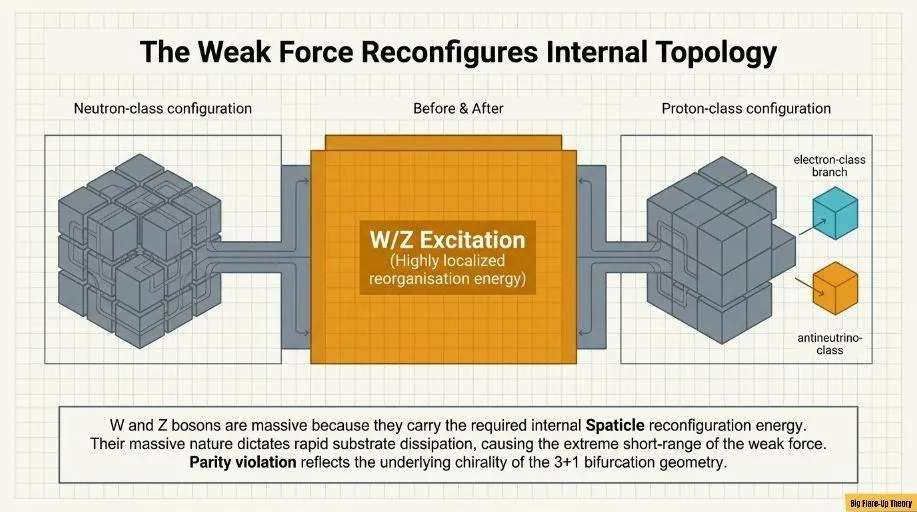
The weak nuclear force is the most structurally demanding of the four and requires careful distinction from the other three. Gravity, the strong force, and electromagnetism are all, in their primary character, forces of attraction or repulsion between existing structures. The weak force is categorically different: it is not primarily a force between structures but an interaction that transforms one type of internal Spaticle condensation into another. A neutron-class structure converts to a proton through internal quark reconfiguration. One quark flavour converts to another. These are genuine changes in the internal Spaticle topology of a compact condensation.
The structural prerequisite for this is therefore the existence of compact condensations with charged condensations (required for electromagnetism). It requires condensations whose internal Spaticle topology can be reconfigured, structures that have sufficient internal complexity that one stable internal configuration can transition to a different stable internal configuration under appropriate energy conditions.
In terms of the BFUT Paper 16 framework, this requires the 3+e bifurcation product (the proton three-core with effective charges +2/3, +2/3, −1/3), but a bound multi-nucleon system in which one component of the three-core can change its effective charge assignment, converting the system from one type to another. This is a higher-order structural requirement: it requires that multiple protons be bound together by the strong force (Section 5) and that the energy conditions within that bound system be capable of driving an internal Spaticle reconfiguration.
7.2 The Mediating Disturbance: Massive Spaticle Field Excitations
In the BFUT account, the mediating particles of the weak force, the W and Z bosons, are understood as temporary, massive, highly localised excitations of the Spaticle field that carry the internal-reconfiguration information from one part of the bound system to another.
Why are these mediating excitations massive, in contrast to the photon which is massless? The answer follows from the substrate account. A photon is a propagating directional wave in the Spaticle field, a perturbation in the field's circulation pattern that travels freely through the ambient substrate at speed c, carrying no rest energy of its own. It can propagate indefinitely because it is a wave in the field's pre-existing directional structure, which costs nothing to maintain in the unperturbed field.
A W or Z boson, in contrast, is not a propagating wave in a pre-existing directional structure. It is a temporary excitation that carries the information required to transform one internal Spaticle topology into another. To transmit this information, the excitation must carry within itself the energy cost of the internal reconfiguration, the energy difference between the initial and final internal Spaticle configurations of the condensation being transformed. This energy cost is large compared to the energy carried by a photon because internal Spaticle topology reconfiguration requires reorganising the compact, high-density internal structure of a three-core condensation. The mediating excitation is therefore massive: it carries a definite rest energy corresponding to the substrate reorganisation cost.
Because the W and Z excitations are massive, because they carry this reorganisation energy within themselves, they cannot propagate freely through the Spaticle medium at speed c. Instead they dissipate rapidly, depositing their reorganisation energy into the local substrate within a very short distance. This is a qualitative account of the short range of the weak force; a quantitative dissipation equation connecting the massive excitation to the observed weak-force range is not derived here. This is the physical origin of the extremely short-range of the weak force: it is determined by how far a massive, energy-laden Spaticle excitation can travel before its energy is absorbed back into the substrate.
BFUT derivation: W/Z mass ↔︎ internal Spaticle reconfiguration energy cost. Weak force range ↔︎ propagation distance of a massive localised Spaticle excitation before energy absorption. Both properties follow from the same substrate physics, not from two separately postulated facts.
7.3 The Mechanism of Internal Topology Reconfiguration
How exactly does the weak interaction transform one type of condensation into another? In the BFUT substrate account, this proceeds in three stages.
First, the conditions within a bound multi-nucleon system must reach the energy threshold required to initiate an internal Spaticle reconfiguration. In a nucleus, the strong-force binding energy and the internal thermal energy of the bound system determine whether this threshold is reachable. The threshold is high, comparable to the rest energy of the W or Z mediating excitation, which is why the weak force operates primarily within nuclei and in high-energy collision events, not in ambient conditions. This BFUT internal reconfiguration energy scale, associated with the W/Z excitation mode within the substrate framework, is distinct from the external energy required to produce an on-shell W or Z boson in a particle collider (of order 80-90 GeV). Low-energy weak transformations such as β decay and electron capture proceed through virtual, off-shell excitation of this same mode and do not require the on-shell production energy.
Second, once the energy threshold is reached, a massive Spaticle excitation, the W or Z boson, is produced by the condensation's internal substrate drawing sufficient energy from the local field to create the excitation. This excitation carries the difference in internal Spaticle topology between the initial state and the target state.
Third, the massive excitation is absorbed by the target component of the system, another part of the condensation or a neighbouring condensation, and deposits its reorganisation energy, causing the target's internal Spaticle topology to reconfigure to the new stable state. A neutron-class configuration, for example, reorganises one of its effective charge units from −1/3 to +2/3, producing a proton plus an emitted electron branch and an antineutrino-class unit.
The antineutrino-class unit deserves separate comment within the BFUT framework. In the substrate account, it represents the residual Spaticle field disturbance produced by the reconfiguration event, a very weakly coupled propagating excitation that carries the angular momentum balance and lepton number balance of the reaction, but which interacts with the substrate only through the weak channel and gravity. Its extremely weak coupling to the Spaticle field explains its near-masslessness and its ability to propagate vast distances through the substrate without interaction.
7.4 Parity Violation: An Asymmetry in the Direction of Internal Spaticle Reconfiguration
One of the most striking properties of the weak force is its violation of parity symmetry. It acts exclusively on left-handed configurations in a way that no other fundamental force does. This was one of the most unexpected discoveries in twentieth-century physics (Wu et al., 1957) and has never been given a physical substrate explanation within standard theory beyond mathematical description.
7.4A The Dominance Principle
The substrate field intensity of each body has two contributions: rest-mass substrate deformation and rotational energy contribution. Dominance between two bodies is determined by their total substrate field intensity, not by rest mass alone. Under normal conditions the three-core dominates. Its rest-mass substrate deformation exceeds the electron unit's rotational contribution. The counter-rotating electron unit is therefore structurally stressed by the dominant co-rotating three-core field. Weak interactions preferentially reconfigure the topology of the structurally stressed counter-rotating unit instead of the stable co-rotating three-core.
7.4B The Chirality of the Stressed Unit
The counter-rotation of the generated electron unit is not assumed. It is mechanically imparted by the three-sphere packing geometry of Paper 16 Section 10. The gear mechanism - the interstitial substrate passing between two co-rotating surfaces of the same handedness always acquires the opposite rotation - is a mechanical certainty given the three-sphere packing geometry. The generation direction is outward along the interstitial axis, which is the same axis around which the three-core rotates. Therefore the circulation vector and the generation direction are antiparallel by construction:
χ = sign(Ω_e . phat) = sign(-Ω_core . phat) = -1
The generated electron unit emerges with χ = -1 at formation. Left-handedness and substrate stress are not independent properties. They are both consequences of the same counter-rotation geometry produced by the 3+e bifurcation. This provides the BFUT mechanism for the observed left-handed preference of weak interactions. The quantitative consequence is already established: BFUT Paper 19 Section 6 derives sin2(θ_W) = 0.2312 from the bifurcation chirality angle, in agreement with the measured value of 0.2312 to within 0.01%. The parity argument in P17 is therefore not qualitative speculation but the physical interpretation of a quantity that Paper 19 derives and verifies numerically.
7.4C Hydrogen as the Reference State and the Complexity Hierarchy
Ground-state hydrogen represents the lowest weak-activity configuration in the matter hierarchy. The electron's counter-rotation is tuned to its natural orbital radius and angular velocity, producing a substrate field that closely cancels the three-core's co-rotating field in the external region. The substrate stress on the electron unit is at its minimum. The weak interaction probability is minimised - not because weak interactions are forbidden but because the circulation imbalance driving topology reconfiguration is minimised.
As protons, neutrons, and electrons are added, the number of interacting circulation structures increases. Exact circulation cancellation across all pairs simultaneously becomes progressively harder to maintain. The result is a hierarchy of increasing weak interaction activity: ground-state hydrogen at minimum, heavier atoms with multiple competing circulation structures, large unstable nuclei with significant residual imbalance and open β decay channels, and extreme environments where compression forces electrons to small orbital radii and electron capture dominates. Weak interactions are a response to accumulated circulation imbalance in increasingly complex matter structures. This is why weak interaction rates increase with nuclear complexity.
7.4D Dominance Inversion and Neutron Formation
Under extreme compression the electron's rotational energy density at close range can exceed the three-core's rest-mass substrate deformation. Dominance inverts. The three-core becomes the stressed body. Its internal topology reconfigures - this is electron capture and neutron formation. The neutron-proton-electron mass-energy difference (mn - mp - me)c2 ≈ 0.782 MeV, relevant to neutron β decay, is interpreted within BFUT as the physical manifestation of the dominance-inversion threshold. This is distinct from nuclear electron-capture thresholds, which are nucleus-dependent. Its derivation from ρ_s, rp, and μ is given in the companion programme. Neutron star formation is bulk dominance inversion: simultaneous inversion across every proton-electron pair in a collapsing stellar mass.
7.4E Cross-Scale Unification
The same dominance principle operates at cosmic scales. Gravitational sorting, established in BFUT Paper 9, produces preferred co-rotation directions at every scale. Counter-rotating bodies within co-rotating systems are stressed by the dominant body and are the preferred sites of structural reconfiguration. Neptune's retrograde moon Triton is being slowly destroyed by tidal forces from Neptune - the dominant co-rotating body stresses the counter-rotating body, not the reverse. The weak force, electron capture, and retrograde orbital decay are three expressions of the same physical principle: counter-rotating structures in a substrate organised by co-rotation are stressed by the dominant co-rotating body and undergo reconfiguration when the stress exceeds their topological stability threshold.
This connects Paper 9 (gravitational sorting and co-rotation preference across scales), Paper 16 (the 3+e bifurcation and mechanical derivation of counter-rotation), Paper 19 (geometric proof of counter-rotation direction and numerical derivation of sin2(θ_W) from bifurcation chirality), and Paper 17 (the weak force as topology reconfiguration of the stressed counter-rotating component). Parity violation is the subatomic expression of a universal stability asymmetry that the BFUT programme has already established at cosmological scales.
An interactive simulation of the strong force confinement mechanism, electromagnetic field emergence, parity violation, and weak force dominance inversion at the 0.782 MeV threshold is available in the BFUT companion simulations code deposit (DOI: 10.5281/zenodo.20554084). [24]
7.5 Why the Weak Force Emerges Last
The weak force requires the full prior complexity chain to be in place. It requires: the Spaticle field substrate (Paper 14); the first quark condensations (Paper 16); the 3+e threshold producing proton and electrons (Paper 16); gravitational binding of matter into concentrated regions (Section 3); strong-force binding of protons into multi-nucleon systems (Section 5); and within those multi-nucleon systems, energy densities sufficient to reach the W or Z production threshold. None of these prerequisites is optional. Each is required before the next can arise.
The weak force is therefore not absent at early stages of BFUT cosmological history. It is operative wherever and whenever its structural prerequisites are met, within stellar interiors, within supernovae, within any high-energy collision event. But because its prerequisites are the most demanding of the four forces, it is the last to become operative as the complexity chain progresses from the initial Spaticle field through condensation, hydrogen formation, gravitational accumulation, stellar ignition, and nuclear binding.
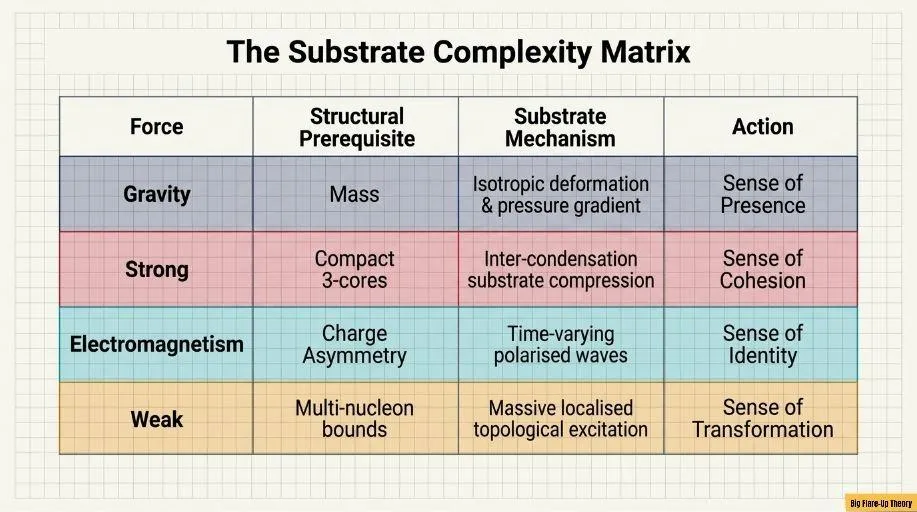
This sequential emergence, gravity first, then strong force, then electromagnetism, then weak force, is not arbitrary. It maps exactly onto the hierarchy of structural complexity required for participation in each force. Gravity requires only mass. The strong force requires compact organised condensations. Electromagnetism requires charged condensations with internal circulation asymmetry. The weak force requires sufficiently complex internal condensations whose topology can undergo reconfiguration under the relevant energy conditions. The complexity hierarchy of the forces is the complexity hierarchy of the Spaticle field substrate.
Scope note for Sections 6 and 7: The electromagnetic and weak force accounts developed above provide full physical mechanism derivations within the BFUT framework: the physical origin of charge, electromagnetic propagation, bidirectionality, shieldability, the speed of light, information richness, the mass of weak mediators, the short-range of the weak force, the mechanism of internal topology reconfiguration, and parity violation, all from Spaticle field substrate physics. The W boson mass mW approximately 80 GeV, the Z boson mass mZ approximately 91.24 GeV, and the electroweak mixing angle sin²θ_W approximately 0.2312 are all derived in BFUT Paper 19 from the reconfiguration energy formula and the Paper 16 bifurcation geometry, with the model-unit-to-SI mapping completed via ℓ_model = rp / R₀ using the independently measured proton charge radius rp = 0.8414 fm (PDG 2022). These derivations confirm the substrate origin of the electroweak structure established in this section.
8. Forces as Fundamental Sensing Channels: A Unified Philosophical Framework
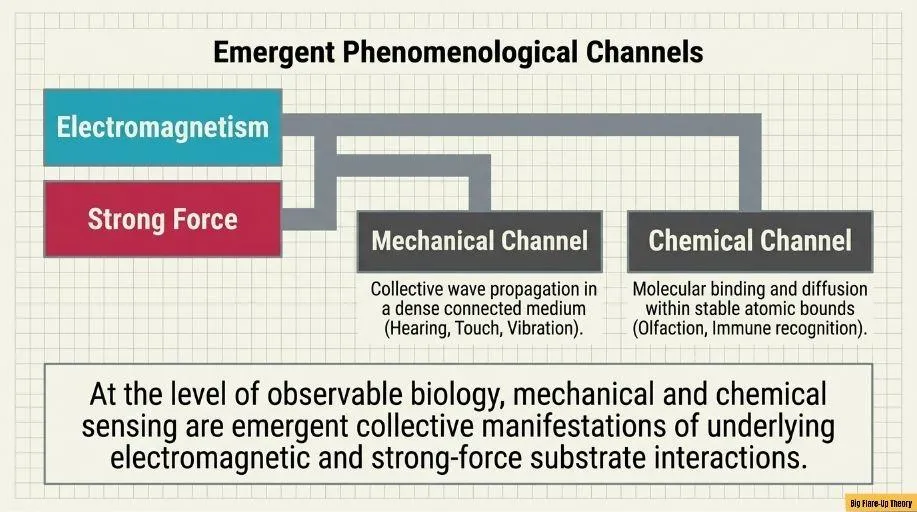
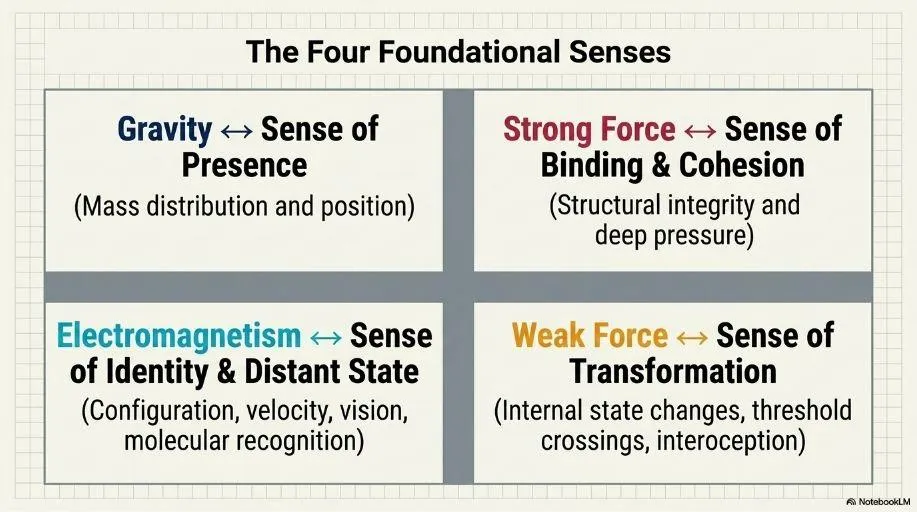
This section establishes the correspondence between the four fundamental forces and fundamental sensing modes. This correspondence is grounded in the physical character of each force as established in Sections 3 through 7. The full scientific development of this framework, including a formal definition of sensing, the Hierarchical Channel Accessibility Law, the Structural Inclusion Principle, five falsifiable predictions, and the Consciousness Index, is presented in BFUT Paper 20 (https://doi.org/10.5281/zenodo.19992457). The present section provides the physical and conceptual foundation on which Paper 20 builds. Two levels are developed in sequence: the foundational four-force layer, which is Lagrangian-derived and physically necessary; and the emergent five-channel layer, which arises as matter organises into increasingly complex configurations. Both levels are complete within their scope. Neither replaces the other. [21]
8.1 The Central Proposition: Interaction as Sensing
All physical interaction occurs through signal generation and signal coupling. A system cannot change without producing a physically real state transition, and that transition either propagates or remains confined depending on boundary conditions and coupling constraints. Signals are physically real, observer-independent events. This anchors interaction in structure, not description.
Every physical system, from a subatomic condensation to a galaxy receives information about the state of other systems through interaction channels. There is no other way for a physical system to receive information about its environment. Sensing, in this interpretation, is not a late-arriving biological innovation. It is a structural consequence of participation in physical interaction channels. Biological sensing systems are specialised implementations of universal physical detection modes that operate at every level of complexity from the simplest particle interaction upward.
This section develops this correspondence at two levels. The first is the foundational level: the four fundamental forces established in Sections 3 through 7, each derived from the Spaticle field Lagrangian, each constituting a physically necessary and irreducible sensing channel. The second is the emergent level: five phenomenological channels that arise as matter organises into denser and more complex configurations, providing the complete basis for observable sensing across all physical and biological systems. The two levels are not alternatives. They are the same framework viewed at different scales of structural complexity. [16]
| Foundational Force | Sensing Mode | Emergent Channel | Phenomenological Mode | Biological Senses | Information Type |
|---|---|---|---|---|---|
| Gravity | Sense of Presence | Gravitational | Baseline universal field | Proprioception, vestibular | Mass distribution, position |
| Strong Force | Sense of Binding | Particle (discrete events) | Discrete transfer, collision, decay | Structural integrity sensing, deep pressure | Binding state, structural cohesion |
| Electromagnetism | Sense of Identity & State | Electromagnetic | Long-range field propagation | Vision, photoreception, heat sensing | Identity, configuration, distant state |
| Electromagnetism | Sense of Identity & State | Chemical | Molecular binding, diffusion | Olfaction, taste, immune recognition | Molecular identity, concentration, structure |
| Electromagnetism + Strong Force | Sense of Contact | Mechanical | Wave propagation in medium | Hearing, touch, vibration, pressure | Contact, deformation, vibration amplitude |
| Weak Force | Sense of Transformation | Internal (no propagating channel) | Internal state change, threshold crossing | Interoception, metabolic sensing, immune activation | Internal state, transformation threshold |
8.6 Internal Versus External Sensing
The same channels operate internally and externally. External sensing involves signals arriving from other systems. Internal sensing monitors the system's own state. The mechanism is identical in both cases the distinction is defined only by system boundaries, not by any difference in the underlying physics.
Gravitational sensing is inherently external: it responds to mass distributions outside the sensing system. Electromagnetic sensing is primarily external at the photon-detection level but operates internally at the level of charge distribution monitoring, membrane potential, and neural signalling. Strong-force sensing is primarily internal to composite nuclear structures, monitoring whether bound components are correctly held. Weak-force sensing is maximally internal, mediating internal state transformation instead of external signal detection. Mechanical sensing operates both externally detecting sound waves and vibrations from the environment and internally monitoring structural stress and deformation within the sensing system. Chemical sensing operates both externally detecting molecular signals from the environment through olfaction and taste and internally monitoring metabolic state, hormonal concentration, and immune signals within the organism.
At increasing levels of structural complexity, systems develop the capacity to use each channel both internally and externally. This dual use of the same fundamental channel for both external and internal sensing is a general feature of all complex physical systems and reflects the underlying unity of the signal-channel structure across all scales of complexity.
8.7 Memory, Integration, and the Threshold of Sensing
Signals are transient. Structured behaviour requires persistence. Memory is the retention of state through stable or metastable configurations, allowing comparison across time and enabling prediction. A system possesses a sense when it can reliably detect, transform, and respond to signals in a repeatable manner this defines the transition from passive interaction to structured sensing.
Systems operate across multiple channels simultaneously. Integration occurs because all signals act on the same physical substrate. Combined state transitions encode multi-channel information. Higher complexity arises from integrated response, not isolated detection. The most complex biological sensing systems the mammalian nervous system, the immune system, the endocrine system integrate signals across all five phenomenological channels simultaneously, with memory, prediction, and controlled response operating across multiple timescales.
Signals are ubiquitous. Interaction occurs only when coupling conditions are satisfied: energy compatibility, structural alignment, and dynamic accessibility. Selectivity follows directly from physical constraints. Systems respond only to compatible signals. This selectivity, combined with memory and multi-channel integration, is what produces the richness and specificity of biological sensing from the same underlying physical channels that operate in every interaction at every scale.
8.8 The Unified Interaction Loop
All interaction at every level, foundational or emergent, physical or biological, follows a single invariant loop: a system undergoes a state change; the change generates a signal; the signal propagates or remains local depending on the channel; another system couples if conditions permit; the receiving system undergoes a state change. This loop is invariant across all five channels and all scales of complexity. It applies equally to a gravitational deformation gradient propagating through the Spaticle field and to a neurotransmitter molecule diffusing across a synaptic cleft.
The two-level framework foundational four forces and emergent five channels maps the same loop at different levels of structural organisation. At the substrate level, the loop runs through the Spaticle field and its condensed structures. At the phenomenological level, it runs through the collective properties of matter assemblies, molecular identities, and biological sensing organs. The physical mechanism is the same throughout. What changes across levels is the structural complexity of the systems participating in the loop and the corresponding richness of the information they can encode, transmit, and detect. [16]
Philosophical scope boundary: The two-level sensing framework does not imply that particles are conscious, that forces involve subjective experience, or that biology reduces to physics in a naïve eliminativist sense. It proposes that the physical mechanisms constituting the four fundamental forces and their emergent collective manifestations are the same mechanisms that, at sufficient structural complexity, constitute the sensing channels of biological systems. The correspondence is structural across scales. Phenomenological experience, where it exists, is a further question that this framework illuminates but does not claim to resolve.
9. Supporting Literature and Converging Evidence
The framework developed in this paper intersects with several bodies of established scientific work, each of which supports one or more aspects of the substrate-force-sense account.
Einstein's field equations (Einstein, 1915) describe a spacetime fabric that dynamically responds to mass-energy. This result is more naturally interpreted under a real substrate ontology than under a purely abstract geometric formalism. The BFUT Spaticle field identification supplies the ontological foundation that the geometric formalism presupposes. [16]
BFUT has independently demonstrated across three separate analyses that dark matter is not required for galactic dynamics: the cosmological and dynamical arguments of BFUT Paper 1, the rotation-induced field structuring of BFUT Paper 6 (Gravitational Vortex), and the large-scale rotational behaviour analysed in BFUT Paper 9. The modified field equations of BFUT Paper 18 provide the corresponding quantitative formulation.
The sequential emergence of forces with decreasing temperature and increasing structural complexity is a standard feature of Standard Model symmetry breaking (Weinberg, 1967; Salam, 1968). The BFUT account is consistent with this sequential pattern while providing a physical substrate mechanism for why the sequence takes the form it does and why exactly four forces exist. [22]
The experimental confirmation of parity violation in weak interactions (Wu et al., 1957) has never been given a physical substrate explanation in standard theory. The BFUT account in Section 7.4 provides a physically motivated interpretation grounded in the chirality of the Paper 16 3+e bifurcation.
Wheeler's "It from Bit" proposal (Wheeler, 1990) treats physical reality as fundamentally informational. The present paper's philosophical signal-channel framework is consistent with this view while grounding the channel structure in a specific physical substrate, the Spaticle field, instead of treating information as an abstract primitive.
The correspondence between biological senses and physical signal types has been noted phenomenologically (von Uexküll, 1909; Gibson, 1979). The BFUT framework provides, for the first time within a single coherent physical framework, a substrate-level grounding for why this correspondence exists.
10. Critical Evaluation of Prevailing Models
The BFUT framework must be evaluated honestly against the strengths of prevailing models.
The Standard Model of particle physics is the most precise predictive framework in the history of science. The anomalous magnetic moment of the electron is computed correctly to eleven decimal places. The W and Z bosons, the Higgs boson, and many other particles were predicted before experimental confirmation. The present paper does not compete with the Standard Model at the level of precision calculation. It proposes that the Standard Model's formal framework can be given a physical substrate foundation that it currently lacks, a foundation from which the forces' existence and sequential emergence follow, while the precision machinery of the Standard Model continues to describe how those forces behave once they exist. These are complementary contributions, not competing ones.
Grand unified theories and string-theoretic unification programs seek to demonstrate that the four forces unify mathematically at high energy. These programmes address mathematical unification without addressing physical substrate origin: even if the forces unify at high energy, the question of what physical substrate supports those unified interactions, and how it gave rise to the forces, remains unaddressed. BFUT addresses that prior question. The two programmes are therefore addressing different levels of the same problem, not the same level.
BFUT has demonstrated the absence of dark matter necessity across three independent lines of analysis: the cosmological and dynamical arguments of Paper 1, the rotation-induced field structuring of Paper 6 (Gravitational Vortex), and the large-scale rotational behaviour analysed in Paper 9, with the modified gravitational equations of Paper 18 providing the quantitative closure.
BFUT Paper 19 derives the fundamental coupling constants from Spaticle field parameters: the fine structure constant (α approximately 1/137.037, difference 0.0007%), the strong coupling constant (α_s approximately 0.120, difference 1.8%), the electroweak mixing angle (sin²θ_W approximately 0.2312, difference 0.01%), and the W and Z boson masses (mW approximately 80 GeV, mZ approximately 91.24 GeV). All derivations use only ρ_s and the Paper 16 functional coefficients A, B, C, D, with the model-unit-to-SI mapping anchored by the independently measured proton charge radius rp = 0.8414 fm (PDG 2022). The present paper provides the physical mechanism derivations from which those quantitative results follow. [16]
Parity violation in the weak force has been experimentally confirmed (Wu et al., 1957) and described within the Standard Model through the V−A (vector minus axial-vector) structure of weak currents, but has not been given a physical substrate explanation. The BFUT account in Section 7.4 provides a physically motivated substrate interpretation. The degree of parity violation from Spaticle field parameters is derived in BFUT Paper 19. [22]
11. Implications and Derivation Scope
11.1 Quantitative Force Emergence from Spaticle Field Parameters
The sequential emergence of forces described in this paper is now mechanistically complete: all four forces have been derived qualitatively from Spaticle field substrate physics, with the strong force grounded quantitatively in Paper 16 and gravity grounded quantitatively in Paper 18. The next step is the derivation of coupling constants from Spaticle field parameters. The A, B, C, D coefficients are derived from first principles from the three-sphere condensation geometry (P16 Appendix C): A = 1/2, B = 0.56308, C = -1/3, D = 1. The strong coupling constant and fine structure constant are derived in BFUT Paper 19 from these coefficients and the Spaticle field directional polarisability.
11.2 Parity Violation and the Chirality of the Bifurcation
The handedness of the original 3+e bifurcation is determined by the chirality of the Spaticle substrate at the condensation threshold. Left-handed dominance in weak interactions follows from the asymmetric circulation geometry of the 3+e topology established in P16.
11.3 Sensing Framework and Astrobiology
The philosophical force-sense correspondence of Section 8 reframes the search for life. If sensing is not a late biological innovation but a consequence of participation in fundamental interaction channels at sufficient structural complexity, the relevant question for life detection is not "does this system have biological organs?" but "does this system integrate signals across multiple channels in a coherent and persistent way?" This reframes astrobiology as a search for sufficiently complex signal-integrating Spaticle field condensation systems.
12. Scope and Positioning Relative to BFUT Paper 18
The present work establishes the field-theoretic origin and governing equation of gravitational interaction within the BFUT framework. It derives the Lagrangian structure of the Spaticle field, identifies the covariant source term for the modified Einstein equations, establishes the field equation of motion, derives the coupling structure from physical field properties, and presents the empirical relation constraining the field parameter across 175 galaxies through sequential prediction testing.
The complete derivation of observable dynamics, full parameter closure, and extended validation across multiple astrophysical domains are presented in BFUT Paper 18. That paper presents the explicit derivation of the numerical value of λ from first principles, the full galaxy-by-galaxy comparison with rotation curve data, and observational extensions including galaxy cluster dynamics and additional rotation-curve datasets. Results from those tests are presented in BFUT Paper 18.
Paper 17, Paper 18, and Paper 20 form a unified sequence. Paper 17 establishes the physical and mathematical structure of the Spaticle field and the sequential emergence of forces. Paper 18 establishes the complete quantitative and observational closure for gravitational dynamics. Paper 20 (https://doi.org/10.5281/zenodo.19992457) develops the force-sensing correspondence of Section 8 into a complete scientific framework connecting the Spaticle field physics to sensing, capability, consciousness, and evolution.
13. Conclusion
This paper has established six principal results within the BFUT cosmological framework.
First, gravity is the inbuilt mechanical consequence of the Spaticle field's response to mass-induced deformation. The BFUT modified gravitational field equations, derived from a Lagrangian with a covariant source term, reproduce galaxy rotation behaviour without dark matter. Sequential validation across 175 galaxies with residuals below 20 km/s for 63% of the sample and below 40 km/s for over 83% provides strong initial confirmation. Full parameter closure and extended validation are presented in BFUT Paper 18.
Second, the strong nuclear force emerges directly from the compact three-core protons established in BFUT Paper 16, with short-range, extreme strength, and confinement all following from Paper 16's energy landscape without additional postulates.
Third, electromagnetism emerges fully developed from Spaticle field substrate physics: charge is the persistent internal circulation asymmetry produced by the Paper 16 3+e bifurcation; electromagnetic propagation is the time-varying polarised Spaticle wave produced by an accelerating charge asymmetry; bidirectionality follows from complementary versus identical circulation interactions; shieldability follows from the cancellation of opposite asymmetries; the speed of light is the maximum propagation speed of the Spaticle medium; and information richness follows from the multi-dimensional character of the directional Spaticle wave.
Fourth, the weak nuclear force emerges fully developed from Spaticle field substrate physics: transformation-capable internal topology is the structural prerequisite; the mass of the W and Z mediators corresponds to the internal Spaticle reconfiguration energy cost; the short-range of the weak force follows from the rapid energy dissipation of massive Spaticle excitations; and parity violation is interpreted as a consequence of the chirality of the Paper 16 3+e bifurcation geometry.
Fifth, each of the four fundamental forces corresponds to a fundamental sensing channel, developed into a complete scientific framework in BFUT Paper 20 (https://doi.org/10.5281/zenodo.19992457), which establishes the formal sensing definition, Hierarchical Channel Accessibility Law, Structural Inclusion Principle, five falsifiable predictions, and the Consciousness Index. Gravity is the sense of presence. The strong force is the sense of binding. Electromagnetism is the sense of identity and distant state. The weak force is the sense of transformation.
Sixth, the BFUT programme presents a continuous ontological chain from the prior energy state of infinite space (Paper 15) through the Spaticle field substrate (Papers 14 and 15), the first quark condensations and primordial hydrogen (Paper 16), the inbuilt and fully derived emergence of all four fundamental forces (Paper 17), and the modified gravitational field equations with initial empirical confirmation (Paper 17, with full closure in Paper 18). This chain replaces the creation-from-nothing finite-origin framework with a continuity-of-existence programme that is physically grounded, internally consistent across seventeen papers, and empirically advancing.
References
[1] BFUT Programme Papers (Sharma, Vijay Shankar):
[2] [P1] Sharma, V.S. (2026). Gravitational Sorting as an Alternative Mechanism for the Hubble Relationship. Zenodo. https://doi.org/10.5281/zenodo.19226423
[3] [P2] Sharma, V.S. (2026). The Physical Identity of the Cosmological Constant (Λ). Zenodo. https://doi.org/10.5281/zenodo.19242083
[4] [P3] Sharma, V.S. (2026). A Steady-State Nucleosynthesis Resolution of the Cosmological Lithium Problem. Zenodo. https://doi.org/10.5281/zenodo.19205920
[5] [P4] Sharma, V.S. (2026). Evidence Against Dark Energy: Observer Bulk Flow as an Alternative Explanation for Apparent Cosmic Acceleration. Zenodo. DOI: 10.5281/zenodo.19228065
[6] [P5] Sharma, V.S. (2026). The Universe Has No Boundary: Logical, Derivational, and Observational Arguments for Spatial Infinitude. Zenodo. https://doi.org/10.5281/zenodo.19242759
[7] [P6] Sharma, V.S. (2026). Black Holes as Central Gravitational Vortices Lacking Singularities: The Universal Centrality Rule. Zenodo. DOI: 10.5281/zenodo.19300874
[8] [P7] Sharma, V.S. (2026). Dynamic Thermal Equilibrium as an Alternative Origin for the CMB Temperature. Zenodo. https://doi.org/10.5281/zenodo.19302025
[9] [P7A] Sharma, V.S. (2026). A Living-Universe Reinterpretation of the CMB Acoustic Peak Pattern and BAO Scale. Zenodo. https://doi.org/10.5281/zenodo.19303398
[10] [P8] Sharma, V.S. (2026). Cold, Dark, and Inevitable: A Logical Reconstruction of the Universe Before the Big Flare-Up. Zenodo. https://doi.org/10.5281/zenodo.19323579
[11] [P9] Sharma, V.S. (2026). Cosmic Rotation Across Scales, Emergent Orbital Hierarchy, and the Large-Scale Challenge to Metric Expansion. Zenodo. https://doi.org/10.5281/zenodo.19341549
[12] [P10] Sharma, V.S. (2026). The Sunyaev-Zeldovich Effect as Local Substrate Interaction: A Big Flare-Up Theory Reinterpretation. Zenodo. https://doi.org/10.5281/zenodo.19377396
[13] [P11] Sharma, V.S. (2026). The Lyman-Α Forest in the Big Flare-Up Theory: Absorption Percolation Threshold and Interpretive Non-Uniqueness of the Gunn-Peterson Opacity Rise. Zenodo. https://doi.org/10.5281/zenodo.19383804
[14] [P12] Sharma, V.S. (2026). The Integrated Sachs-Wolfe Effect in BFUT: Local Spaticle Field Density Variations as the Origin of the ISW Signal. Zenodo. https://doi.org/10.5281/zenodo.19391470
[15] [P13] Sharma, V.S. (2026). Weak Gravitational Lensing and the S8 Tension in BFUT: Why Late-Time Clustering Inference Is Not a Unique Test of Λ-CDM. Zenodo. https://doi.org/10.5281/zenodo.19392597
[16] [P14] Sharma, V.S. (2026). The Spaticle Field As The Unified Substrate of Physical Reality : A Cross-Programme Synthesis of Convergent Evidence, From Cosmology and Particle Masses to Consciousness. Zenodo. https://doi.org/10.5281/zenodo.19394064
[17] [P15] Sharma, V.S. (2026). What Existed Before the Spacetime Fabric? The Origin of Space, Time, and the Physical Substrate of Reality in an Infinite Universe. Zenodo. https://doi.org/10.5281/zenodo.19811691
[18] [P16] Sharma, V.S. (2026). The Origin of Matter, Antimatter, and Fundamental Forces: How Protons, Electrons, and Hydrogen Formed. Zenodo. https://doi.org/10.5281/zenodo.19908215
[19] [P17] Sharma, V.S. (2026). The Emergence of Forces and Fundamental Senses: How the Spaticle Field Gave Rise to Gravity and All Other Forces. Zenodo. https://doi.org/10.5281/zenodo.19976408
[20] Sharma, V.S. (2026). Beyond General Relativity: A Unified Gravitation Equation Across Quantum, Classical, Galactic, and Rapid-Transition Regimes. BFUT P18. Zenodo. DOI: 10.5281/zenodo.20145506.
[21] [P20] Sharma, V.S. (2026). From Matter and Fundamental Forces to Consciousness: A Unified Framework of Sensing Channels, Control, and Evolution. Zenodo. https://doi.org/10.5281/zenodo.19992457
[22] [P19] Sharma, V.S. (2026). Unification of Particle Physics: Deriving Fine Structure and Coupling Constants, W, Z, and Higgs Boson Masses, Redefining and Unifying Gravity and Time. BFUT P19. Zenodo. DOI: 10.5281/zenodo.20145567
[23] [P26] Sharma, V.S. (2026). Singularity: Why and How Physical Substrate Dynamics Make Infinite Density Impossible. BFUT P26. Zenodo. DOI: 10.5281/zenodo.20557070
[24] [Sim] Sharma, V.S. (2026). The Big Flare-Up Theory: Companion Simulations: Substrate Physics Visualised Across Particle, Quantum, and Cosmological Scales - Papers P16 to P26. Zenodo. DOI: 10.5281/zenodo.20554084
[25] External References:
[26] Bondi, H., & Gold, T. (1948). The steady-state theory of the expanding universe. Monthly Notices of the Royal Astronomical Society, 108, 252 270.
[27] Michelson, A.A., & Morley, E.W. (1887). On the relative motion of the Earth and the luminiferous ether. American Journal of Science, 34(203), 333-345.
[28] Einstein, A. (1915). Die Feldgleichungen der Gravitation. Sitzungsberichte der Preußischen Akademie der Wissenschaften.
[29] Gibson, J.J. (1979). The Ecological Approach to Visual Perception. Houghton Mifflin.
[30] Hoyle, F., Burbidge, G., & Narlikar, J.V. (1993). A quasi-steady state cosmological model with creation of matter. The Astrophysical Journal, 410, 437 457.
[31] Hoyle, F., & Narlikar, J.V. (1964). A new theory of gravitation. Proceedings of the Royal Society A, 282, 191 207.
[32] Milgrom, M. (1983). A modification of the Newtonian dynamics as a possible alternative to the hidden mass hypothesis. Astrophysical Journal, 270, 365 370.
[33] Rubin, V.C., & Ford, W.K. (1970). Rotation of the Andromeda Nebula from a spectroscopic survey of emission regions. Astrophysical Journal, 159, 379.
[34] Salam, A. (1968). Weak and Electromagnetic Interactions. In: Svartholm, N. (ed.), Elementary Particle Theory. Almquist and Wiksell.
[35] Tononi, G. (2008). Consciousness as integrated information: A provisional manifesto. Biological Bulletin, 215(3), 216 242.
[36] van Albada, T.S. et al. (1985). Distribution of dark matter in the spiral galaxy NGC 3198. Astrophysical Journal, 295, 305 313.
[37] von Uexküll, J. (1909). Umwelt und Innenwelt der Tiere. Springer.
[38] Weinberg, S. (1967). A model of leptons. Physical Review Letters, 19(21), 1264 1266.
[39] Wheeler, J.A. (1990). Information, Physics, Quantum: The Search for Links. In: Zurek, W.H. (ed.), Complexity, Entropy, and the Physics of Information. Addison-Wesley.
[40] Wu, C.S. et al. (1957). Experimental test of parity conservation in β decay. Physical Review, 105(4), 1413 1415.
[41] Sharma, V. S. (2026). BFUT P17-18-19-22 Master Validation Suite. Zenodo. DOI: 10.5281/zenodo.20156714