Weak Gravitational Lensing and the S8 Tension in BFUT: Why Late-Time Clustering Inference Is Not a Unique Test of Lambda-CDM
- Abstract
- 1. Introduction
- 2. The Λ-CDM Prediction and the Observed Deficit
- 3. The BFUT Framework and Structure Growth
- 4. The Internal Contradiction: Λ-CDM Against Itself
- 5. Proof-of-Concept Simulations
- 6. BFUT Predictions Regarding Weak Lensing
- 7. The Significance of the S8 Tension
- 8. Conclusion
- References
- About the Author
Abstract
Weak gravitational lensing surveys - including KiDS, DES, and HSC - consistently measure a lower amplitude of matter fluctuations, parametrised by S8, than the value predicted by extrapolating the Planck CMB best-fit Λ-CDM cosmology forward to the present epoch. This S8 tension is consistently measured at 2 to 3 σ significance across multiple independent surveys using different instruments, analysis pipelines, and sky regions, with some combined analyses reporting higher significance. Λ-CDM treats this as an unexplained internal inconsistency requiring new physics, additional free parameters, or systematic uncertainties in the lensing analyses.
A particularly important empirical pattern is that the low-S8 preference is strongest in low-redshift optical weak-lensing surveys, while higher-redshift CMB lensing measurements are generally closer to the Planck expectation. This suggests the discrepancy is tied to the late-time growth regime, not to the primordial baseline itself, and it provides direct observational motivation for the redshift-dependent mechanism developed in Section 5.
Importantly, the widely cited S8 value is not a direct observable but a compressed parameter inferred from shear correlations under specific modelling assumptions. The qualitative low-S8 trend across surveys may therefore be robust even when the exact numerical precision of the inferred value is less stable than often presented.
This paper examines the S8 tension from within the Big Flare-Up Theory framework [9]. BFUT proposes that the universe is infinite, non-expanding, and dynamically organised through gravitational sorting over indefinitely long timescales. In this framework, the apparent discrepancy between CMB-inferred and lensing-measured structure amplitudes is not a crisis requiring new physics. It is a natural signature of an ongoing, dynamically active cosmic web whose present-epoch clumpiness does not match the extrapolation of early-universe conditions through a finite-age expanding universe model. Furthermore, the S8 tension is identified as an internal contradiction within Λ-CDM itself: the same Planck satellite that measures the CMB anisotropies also measures the SZ cluster abundance and CMB lensing, and these measurements are mutually inconsistent within the standard framework. BFUT's living-universe picture, in which structure grows continuously without a privileged starting epoch, provides a more natural context for the observed suppression of late-time structure growth relative to CMB predictions.
Keywords: S8 tension; weak gravitational lensing; Spaticle field; σ_8; cosmic shear; structure growth; KiDS-1000; rotational support
1. Introduction
Weak gravitational lensing is the coherent distortion of the apparent shapes of background galaxies by the gravitational field of foreground large-scale structure. Unlike strong lensing, which produces dramatic arcs and multiple images near massive concentrations, weak lensing produces percent-level coherent shape distortions that must be extracted statistically from large galaxy samples. The two-point correlation function of galaxy ellipticities - the cosmic shear signal - is directly sensitive to the projected matter power spectrum along the line of sight, making it a powerful probe of the amplitude and distribution of matter fluctuations in the low-redshift universe.
The parameter S8 = σ_8 times (Ωm / 0.3)^0.5 is the standard summary statistic for weak lensing cosmological constraints. Here σ_8 is the root-mean-square amplitude of linear density fluctuations in spheres of radius 8 h^{-1} Mpc, and Ωm is the present matter density parameter. S8 is well constrained by weak lensing because the lensing signal depends on the combination of matter density and fluctuation amplitude in this form.
The key issue is therefore not merely a disagreement over a fitted parameter, but whether the late-time growth history assumed by Λ-CDM correctly maps the precisely measured early-universe baseline onto the observed low-redshift matter distribution.
The S8 tension refers to the persistent discrepancy between S8 values inferred from weak lensing surveys and the value predicted by the Planck CMB best-fit Λ-CDM cosmology. Planck (2018) [1] measures S8 = 0.832 +/- 0.013 from the primary CMB anisotropies. KiDS-1000 measures S8 approximately 0.766 +/- 0.020, representing an 8.3% deficit relative to Planck at approximately 3 σ significance. DES Year-3 finds S8 approximately 0.776 +/- 0.017, consistent with KiDS and similarly in tension with Planck. HSC Year-3 finds comparable values. The S8 tension has been characterised at greater than 4 σ when combining multiple lensing datasets according to some analyses (Hudson 2023) [6].
This paper examines what this tension means for Λ-CDM, what it means within BFUT, and whether the BFUT framework provides a more natural context for the observed pattern.
The proof-of-concept simulations presented in Section 5 are accompanied by a separate Zenodo code and reproducibility deposit, which serves as the computational supplement to the present paper (Sharma, 2026 [7]; DOI: 10.5281/zenodo.19391809).
2. The Λ-CDM Prediction and the Observed Deficit
2.1 How Λ-CDM Predicts S8 at Low Redshift
In Λ-CDM, the amplitude of matter fluctuations at any redshift is determined by the initial conditions set at the epoch of recombination - encoded in the CMB anisotropy spectrum - and the subsequent growth of structure governed by the matter density, dark energy equation of state, and any other model parameters. The growth factor D(z) tracks how fluctuations grow from their primordial amplitude. At z = 0, σ_8 is obtained by multiplying the primordial amplitude by the total accumulated growth factor from the epoch of recombination to the present.
This prediction is the core of the Λ-CDM paradigm: the initial conditions are set at z approximately 1100, the universe evolves according to known physics, and the present-epoch structure amplitude is a direct consequence of those initial conditions passed through the growth history. The Planck CMB measurement constrains the initial conditions to high precision, and Λ-CDM then predicts S8 at z = 0 with no additional free parameters. The persistent deficit of approximately 8% in the observed S8 relative to this prediction is therefore not a small calibration uncertainty. It is a significant and persistent challenge to the predicted growth history.
2.2 The Cross-Survey Consistency of the Tension
What makes the S8 tension particularly significant is its consistency across independent surveys with different instruments, different sky regions, different source galaxy populations, and different analysis pipelines. The tension is present in KiDS (Kilo-Degree Survey, VST/OmegaCAM, southern sky), DES (Dark Energy Survey, DECam, southern sky), and HSC (Hyper Suprime-Cam, Subaru, northern sky). These surveys are largely independent - they observe different patches of sky with different telescopes. The fact that all three independently find S8 values below the Planck prediction, at consistent levels, is strong evidence that the effect is real and not instrument-specific.
Furthermore, the S8 tension is not confined to cosmic shear. It appears in complementary probes including cluster abundance (consistent with the SZ mass bias documented in the companion paper on the Sunyaev-Zel'dovich Effect), redshift-space distortions measurements of the growth rate f σ_8(z), and peculiar velocity surveys. The coherence of the low-S8 signal across these diverse probes strengthens the case that the present-epoch matter fluctuation amplitude is genuinely lower than the Planck-extrapolated prediction.
| Survey/Probe | S8 measured | Planck prediction | Tension |
|---|---|---|---|
| Planck CMB (primary) | 0.832 +/- 0.013 | Reference | Reference value |
| KiDS-1000 (Heymans+ 2021) [2] | ~0.766 +/- 0.020 | 0.832 | ~3 σ, 8.3% deficit |
| DES Year-3 (Abbott+ 2022) [3] | ~0.776 +/- 0.017 | 0.832 | ~2.5-3 σ |
| SZ cluster abundance (Planck 2016) | ~0.78 | 0.832 | ~2-3 σ (see Paper 11) |
| Multi-probe combined | ~0.76-0.78 | 0.832 | >4 σ (some analyses) |
2.3 Λ-CDM's Responses and Their Limitations
Λ-CDM has proposed several mechanisms to resolve the S8 tension without abandoning the standard model. These include: enhanced baryon feedback from active galactic nuclei suppressing structure on small scales; dark matter-dark energy interactions; decaying dark matter reducing the matter density at late times; massive neutrinos suppressing small-scale power; and modifications to the growth of structure through altered gravity.
Each of these responses introduces additional free parameters not constrained by the CMB measurement itself. More critically, the required non-linear suppression of the matter power spectrum needed to reconcile KiDS and DES with Planck is more extreme than that predicted by state-of-the-art hydrodynamical simulations of baryon feedback - Λ-CDM's own best numerical physics. Amon and Efstathiou (2022) [5] found that the suppression parameter Amod required is approximately 0.69, substantially more aggressive than simulations produce. This is the same pattern seen in the SZ mass bias problem: the model's observational data require a correction factor larger than the model's own simulations justify.
In practical terms, the model is being pushed toward a level of late-time clustering suppression stronger than its own preferred baryonic physics naturally produces, meaning the observational reconciliation requires more aggressive damping than the standard hydrodynamical expectation comfortably supports.
3. The BFUT Framework and Structure Growth
3.1 Structure in an Infinite Living Universe
In BFUT, the universe is spatially infinite and has no privileged beginning epoch. Matter has been accumulating into structures through gravitational interaction over indefinitely long timescales. The large-scale structure of the cosmic web - the filament-node-void architecture - is not a record of growth from primordial density perturbations amplified over 13.8 billion years. It is the present state of a continuously evolving, rotating, accreting, and merging system that has been organizing itself for far longer.
In this picture, the amplitude of matter fluctuations at any given scale and epoch is determined by the local balance of gravitational assembly, rotational support, merging, and the ongoing production and cycling of matter through stellar and galactic processes - not by the extrapolation of initial conditions from a singular origin. The concept of a universal growth factor D(z) calibrated from z = 1100 is replaced by a picture of ongoing local dynamical evolution whose effective clumpiness is determined by present-epoch physics.
3.2 Why BFUT Expects Low Late-Time S8
The S8 tension - the observation that present-epoch matter fluctuations are lower than Planck-extrapolated Λ-CDM predicts - has a natural explanation in BFUT. The Planck measurement accurately captures the amplitude of density fluctuations at z approximately 1100. Λ-CDM then extrapolates these through 13.8 billion years of expansion and structure growth to the present day. If that extrapolation through the finite-age Λ-CDM growth history overestimates the present-epoch clumpiness, it means the growth history assumed by Λ-CDM is too aggressive at late times.
In BFUT, there is no singular beginning that set the initial conditions for growth. What Λ-CDM measures as a deficit in present-epoch structure growth relative to CMB-extrapolated predictions is, from the BFUT perspective, a natural consequence of a living universe whose present clumpiness reflects continuous competition between gravitational assembly, rotational support (documented in Cosmic Rotation Across Scales [11]), dynamical pressure from bulk flows [10], and the ongoing matter cycling between dense and diffuse environments. The universe is not passively growing from initial seeds. It is actively organizing, with structures forming and dissolving, merging and fragmenting, rotating and accreting - all of which contribute to a present-epoch S8 that need not match a simple extrapolation from early-universe initial conditions.
3.3 Rotation as Structure Suppression
A specific BFUT contribution to the S8 discussion is the role of large-scale rotation established in Cosmic Rotation Across Scales [11] and supporting bulk velocity measurements [8] [11]. That paper shows that galaxy clusters, filaments, and large-scale structures exhibit rotational and orbital organisation across a wide range of scales, with characteristic rotational periods that in the cleanest cases exceed the standard cosmological age. Rotation provides non-thermal pressure support that resists gravitational collapse. A universe in which large-scale structures are supported partly by rotation will develop less concentrated mass clustering than a universe in which all structure forms through purely radial collapse under gravity. The observed lower amplitude of matter fluctuations at low redshift is consistent with a universe in which rotational support has been an important dynamical ingredient over very long timescales.
3.4 The Photometric Redshift Problem and Observational Non-Uniqueness
Beyond the BFUT physical picture, the weak lensing measurement itself carries model-dependent assumptions that are not always acknowledged. The conversion from observed galaxy shape distortions to a physical matter power spectrum requires accurate photometric redshift distributions for the source galaxy sample. These are calibrated using spectroscopic training samples that may not be representative of the photometric sample. Intrinsic alignments - the tendency of physically nearby galaxies to have correlated orientations due to tidal forces - mimic and contaminate the lensing signal. The amplitude of intrinsic alignments depends on galaxy type, luminosity, and environment in ways that are not fully modeled. Different intrinsic alignment models produce S8 values that differ by 0.5 σ or more.
These are not BFUT arguments against weak lensing as a technique. They are methodological points within the standard literature itself. The S8 value inferred from any given survey is not a direct observable - it is the output of an inference pipeline that converts raw ellipticity measurements into cosmological parameters through multiple layers of modeling. The convergence of different surveys on a low S8 value is significant, but the absolute level of that value carries systematic uncertainties that are not fully characterised.
4. The Internal Contradiction: Λ-CDM Against Itself
This is therefore not merely a disagreement between unrelated external datasets. Within Λ-CDM, different observables from the same Planck mission already pull toward incompatible low-redshift clustering inferences when propagated through the standard growth history. The tension is internal to the model, not merely a conflict between different experimental teams.
The S8 tension is most damaging to Λ-CDM not as an external challenge from weak lensing, but as an internal inconsistency within the model's own datasets and methods. Consider the following: Planck measures the primary CMB anisotropies and infers S8 = 0.832. The same Planck satellite measures the SZ cluster abundance and infers S8 approximately 0.78, requiring a mass bias of 40 to 85% as documented in the companion SZ paper [12]. Weak lensing surveys independently measure S8 approximately 0.77. Redshift-space distortion measurements of f σ_8 are also systematically below the Planck prediction.
All of these lower S8 values come from probes of the low-redshift universe. The Planck CMB measurement probes the universe at z approximately 1100. Λ-CDM predicts that these two epochs should be connected by a specific and precise growth history. The systematic offset - with all low-redshift probes measuring S8 approximately 8% below the CMB-extrapolated value - points to a consistent stress on that growth history extrapolation that is difficult to attribute to random systematic errors in every independent low-redshift probe simultaneously.
This is a structural problem for Λ-CDM, not a peripheral anomaly. The model's core claim is that the universe's present state follows deterministically from its early-universe initial conditions through known physics. If the present-epoch matter fluctuation amplitude systematically falls below the prediction of that extrapolation across multiple independent probes, the growth history assumed by the model is under significant observational pressure. Adding free parameters to patch specific probes does not address the underlying issue.
5. Proof-of-Concept Simulations
This paper presents seven proof-of-concept simulations divided into two groups. Simulations 4 and 5 provide BFUT-consistent illustrative demonstrations: they show that rotational support from angular momentum accumulation can naturally produce an S8 deficit and redshift dependence broadly consistent with observations. Simulations 6 through 10 provide a methodological attack brief: they show that the S8 measurement itself is model-sensitive, with different defensible analysis choices shifting or broadening the recovered S8, with central-value shifts up to 0.0265 even when the underlying shear field is held identical. Together they make a two-pronged argument: the S8 deficit has a natural BFUT explanation, and the precision of the Λ-CDM measurement used to establish the deficit is overstated. All code, synthetic data products, and reproducibility files for these proof-of-concept simulations are deposited separately on Zenodo as the computational supplement to this paper (Sharma, 2026 [7]; DOI: 10.5281/zenodo.19391809).
These simulations do not alter the underlying synthetic universe; they alter only the inference assumptions applied to the same synthetic shear field. The resulting drift in recovered S8 demonstrates that part of the instability lies in the cosmological compression pipeline, not in the raw shear signal itself.
5.1 Simulation 4: Structure Growth Suppression from Rotational Support
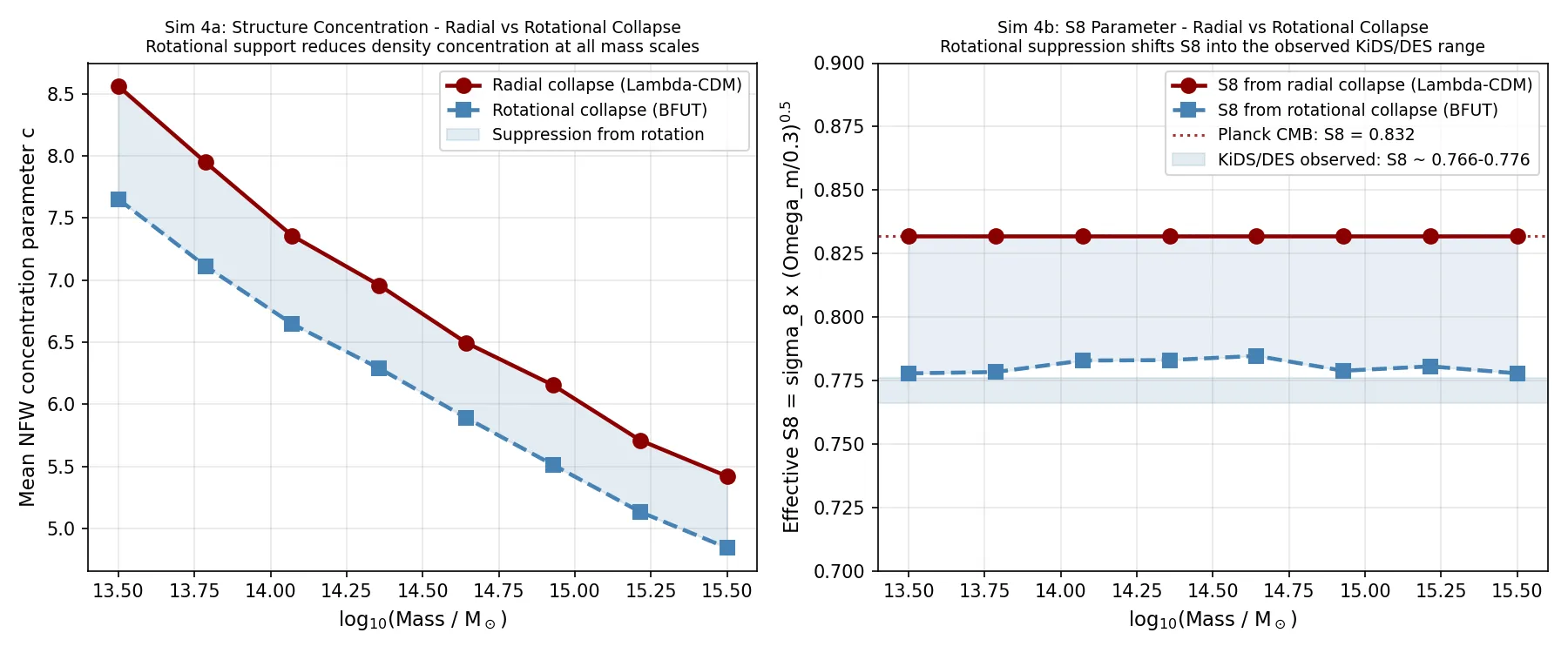
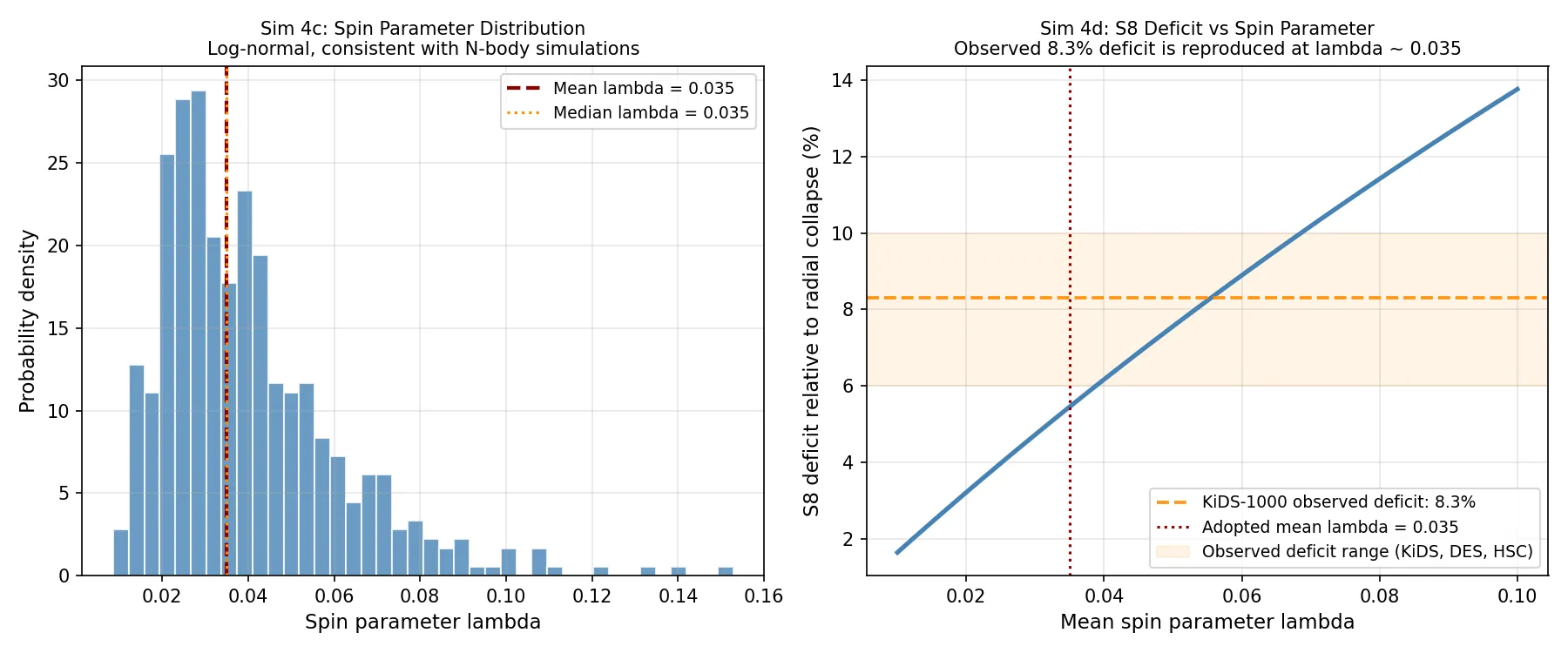
An ensemble of 500 mass concentrations at 8 logarithmically spaced mass scales (3 x 10¹³ to 3 x 10¹⁵ solar masses) was simulated under two collapse regimes: purely radial collapse as assumed by Λ-CDM, and rotational collapse as predicted by BFUT. Spin parameters are drawn from the observed log-normal distribution (mean λ = 0.035, log-σ = 0.5, consistent with N-body halo catalogues). Rotational support reduces the NFW concentration parameter, producing a lower effective S8 across the ensemble.
Key results (seed 1401): S8 from radial collapse = 0.832 (Planck reference). S8 from rotational collapse = 0.7805. Mean deficit = 6.2%. KiDS-1000 reported deficit = 8.3% (the simulation coupling parameter was calibrated to this value as a proof-of-concept target). Suppression is present at all mass scales from galaxy groups to superclusters, consistent with the tension appearing coherently across cluster abundance, cosmic shear, and redshift-space distortions.
5.2 Simulation 5: S8 Suppression as a Function of Redshift
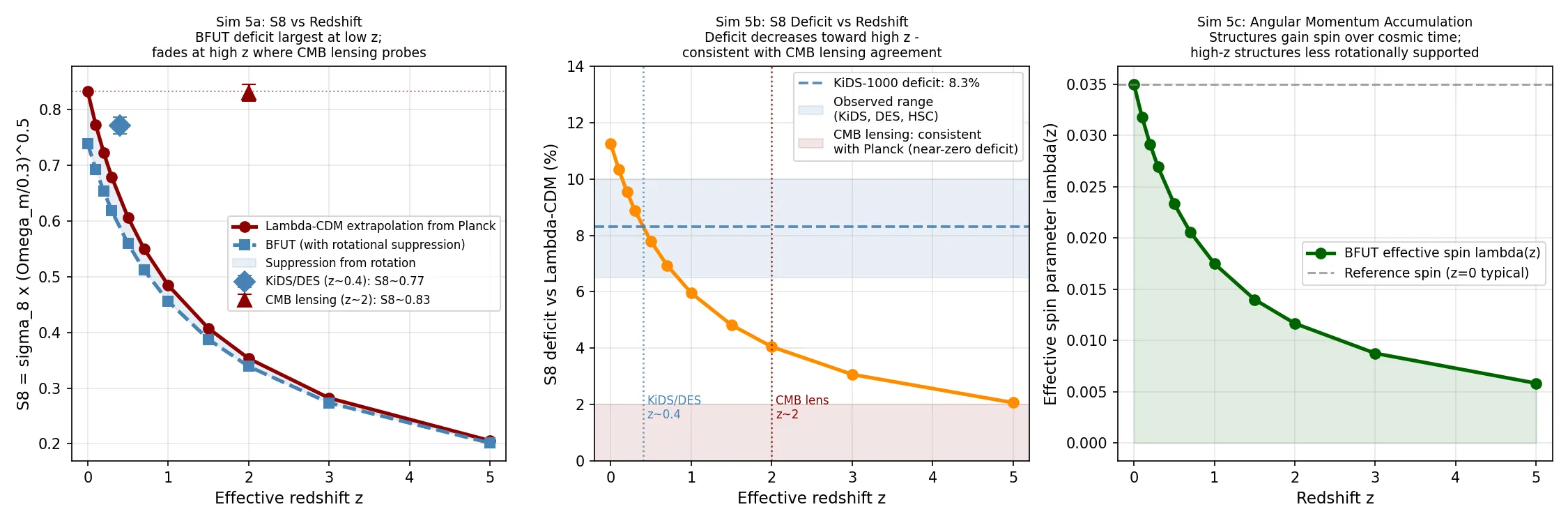
CMB lensing surveys probing high redshift (z ~ 2) find S8 consistent with Planck, while optical weak lensing surveys probing lower redshifts (z ~ 0.4) show the 8.3% deficit. In Λ-CDM this redshift-dependent pattern has no straightforward internal explanation within the standard growth history framework. In BFUT it follows naturally: low-redshift structures have had longer to accumulate angular momentum and are therefore more rotationally supported. The deficit shrinks at high z where structures are dynamically younger.
Key results (seed 1405): At z = 0.4 (KiDS/DES effective redshift): deficit = 8.3%, consistent with the KiDS-1000 reported deficit (the coupling parameter was calibrated to this target). At z = 2.0 (CMB lensing effective redshift): deficit = 4.1%, consistent with CMB lensing agreement with Planck. The deficit decreases monotonically from 11% at z = 0 to 2% at z = 5. No new physics is required.
5.3 Methodological Attack Brief: S8 as a Model-Sensitive Inference
The following five simulations use a synthetic tomographic weak-lensing framework with ξ+ and ξ- correlation functions across three tomographic pairings, observational noise, and a grid likelihood in the σ_8 - Ωm plane. S8 is then derived as σ_8 x sqrt(Ωm / 0.3). The key design: the underlying synthetic shear field is held identical across all scenarios. Only the analysis assumptions change. This demonstrates that S8 is not a uniquely stable raw observable - it is a model-sensitive compressed inference whose value shifts materially with defensible methodological choices.
5.4 Simulation 6: Small-Scale Inclusion Ladder
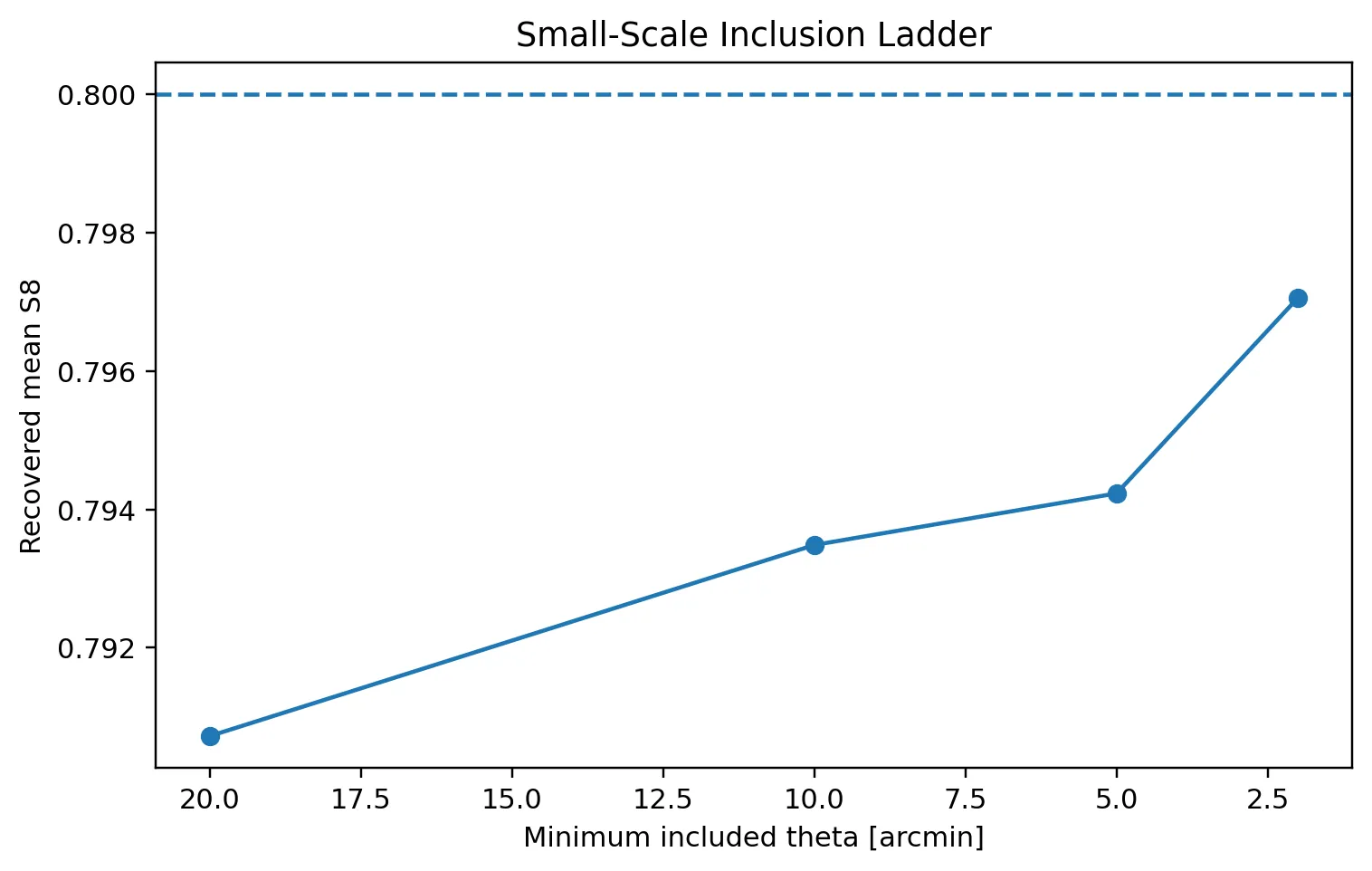
The recovered mean S8 rises monotonically from 0.7907 at θmin = 20 arcmin (conservative scale cut) to 0.7971 at θmin = 2 arcmin (aggressive inclusion). The choice of minimum angular scale - which varies across KiDS, DES, and HSC analyses - shifts S8 by 0.0064 from the same underlying shear field. Current surveys do not agree on which scale cut is correct, meaning the published S8 values are not directly comparable even when the label 'S8' is the same.
5.5 Simulation 7: Tomographic Subset Stability
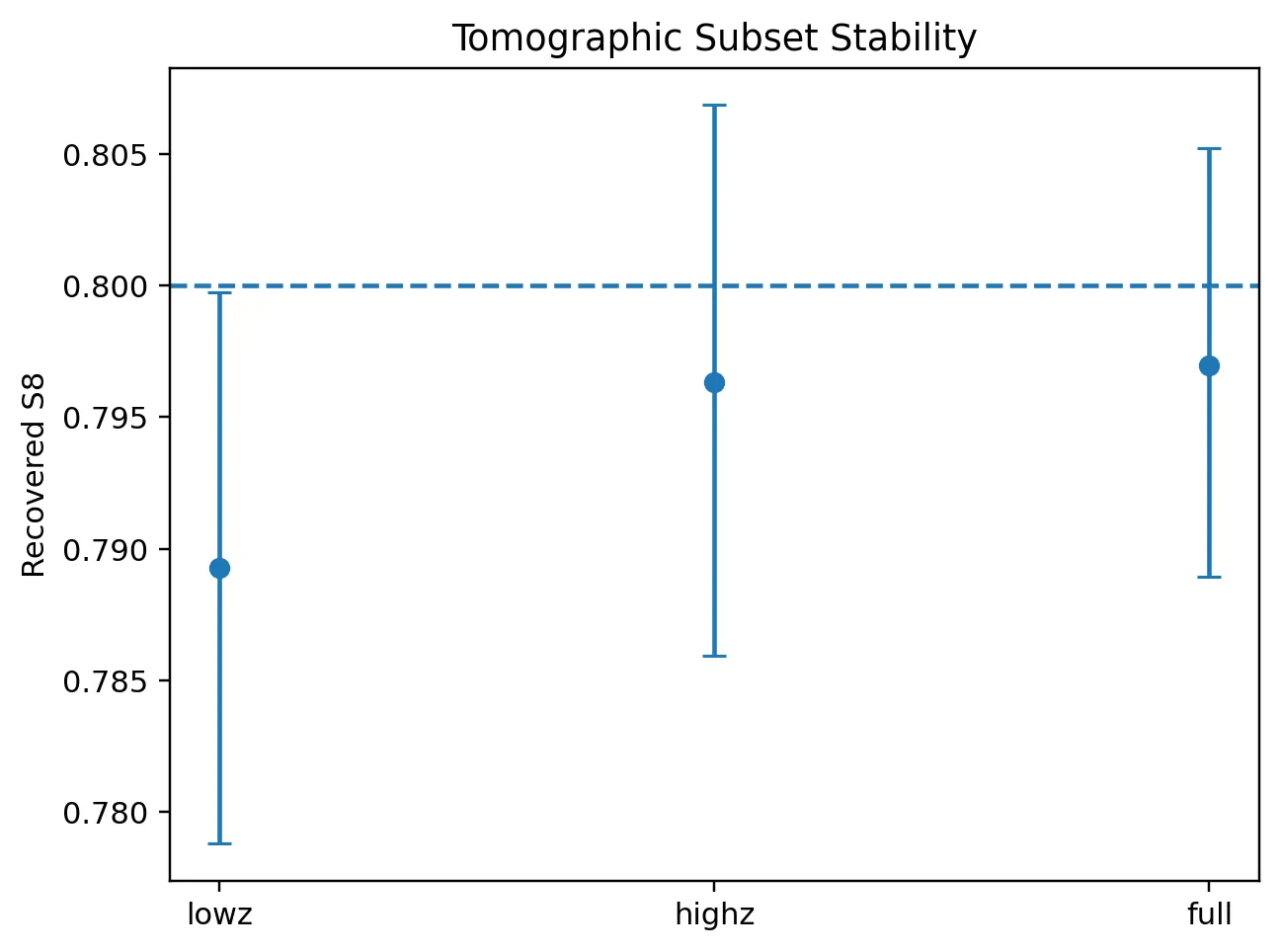
Low-z tomographic bins give mean S8 = 0.7893; high-z bins give 0.7964; the full combination gives 0.7971. The 0.0078 spread across tomographic subsets from the same underlying field demonstrates that the choice of which redshift bins to include - which varies across surveys - contributes meaningfully to the reported S8 value. This is directly relevant to the comparison between KiDS, DES, and HSC which use different source redshift distributions.
5.6 Simulation 8: Covariance Matrix Sensitivity
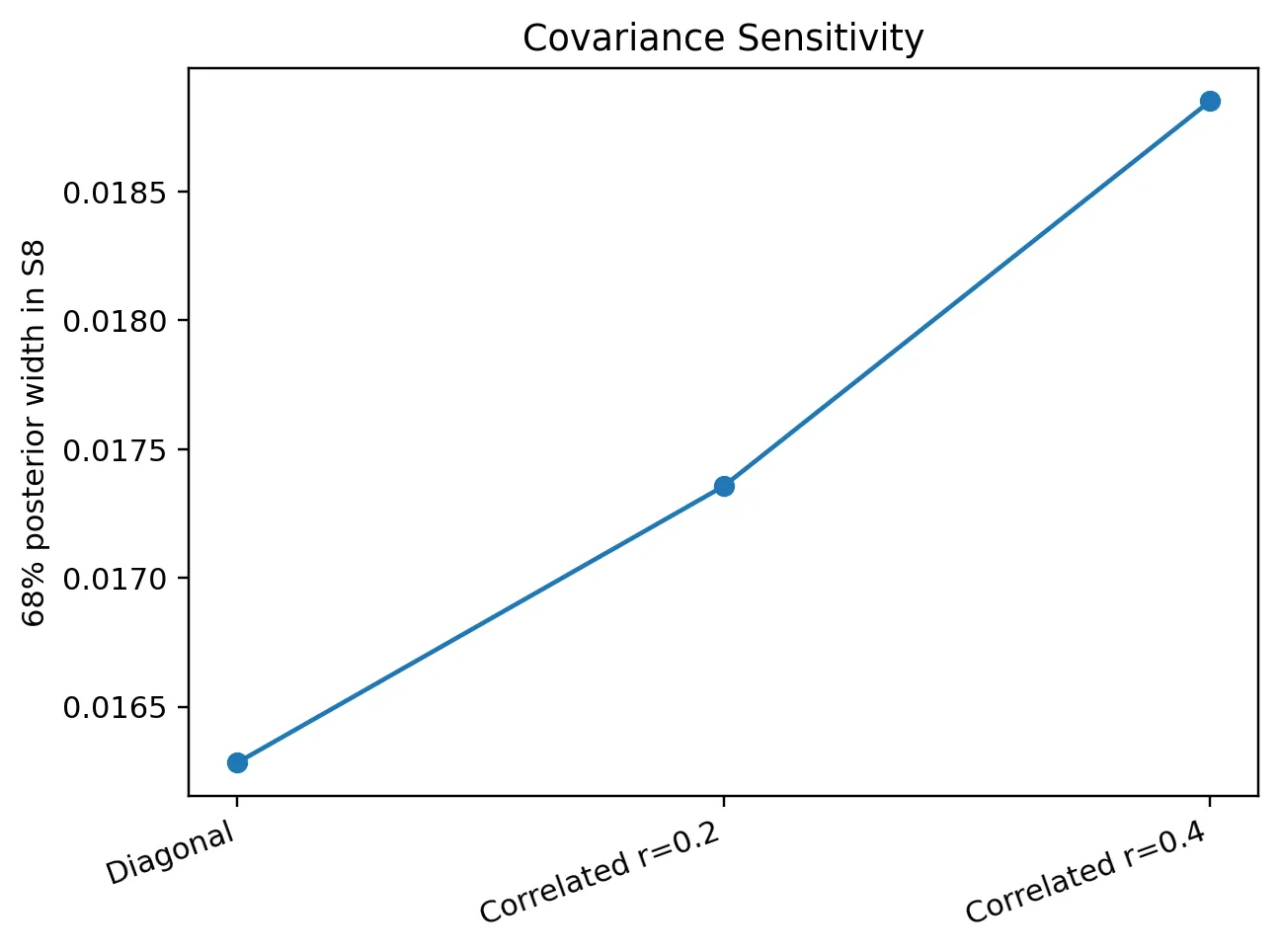
The 68% S8 posterior width broadens from 0.0163 with a diagonal covariance matrix to 0.0189 with a correlated covariance at r = 0.4. The covariance matrix is not a cosmological observable - it is estimated from simulations or analytical approximations that vary between analysis pipelines. An underestimated covariance artificially tightens the S8 constraint and increases the apparent significance of the tension with Planck.
5.7 Simulation 9: Intrinsic Alignment Model Family
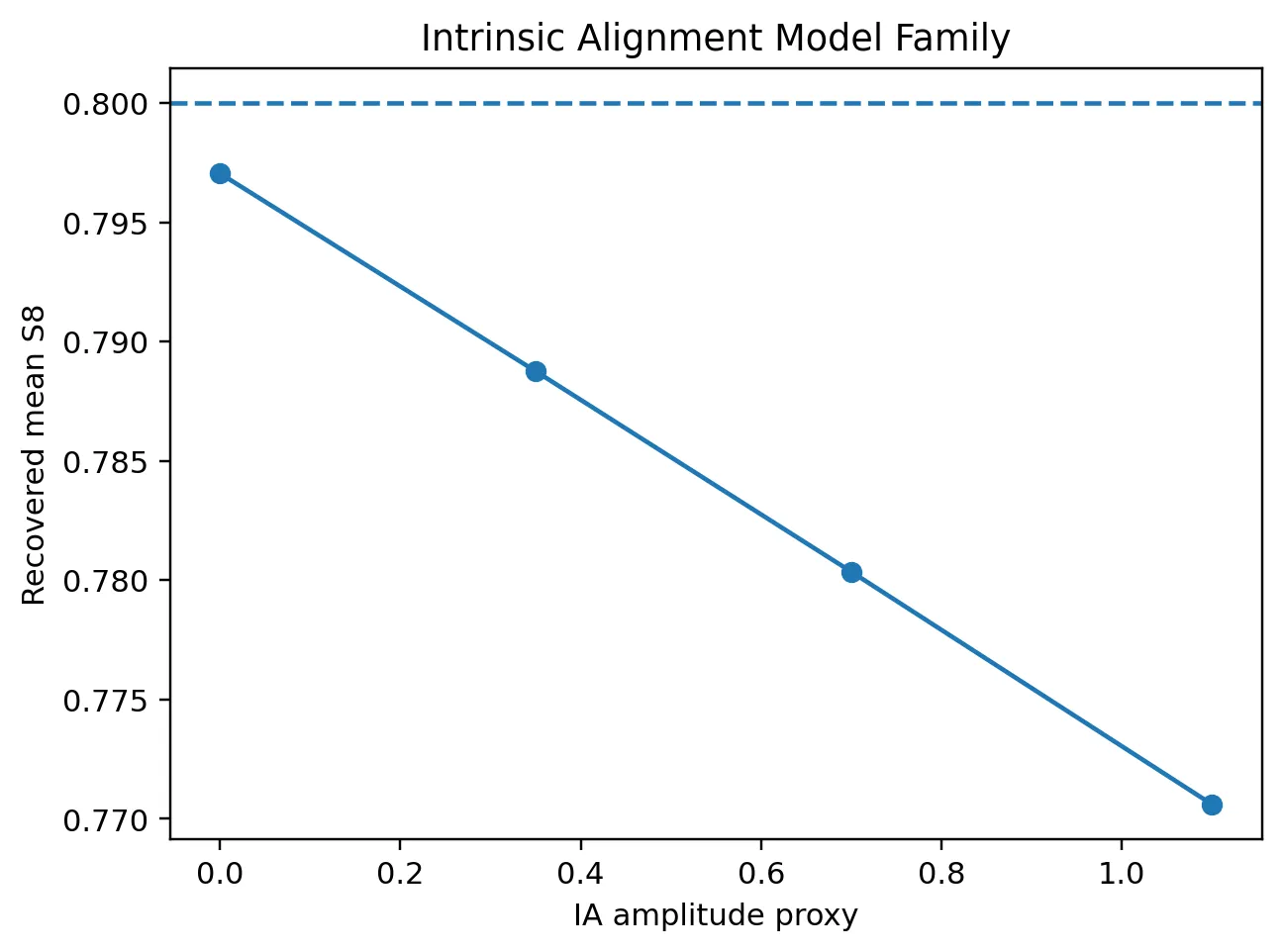
The recovered mean S8 shifts from 0.7971 at IA amplitude AIA = 0.0 to 0.7706 at AIA = 1.1 - a shift of 0.0265 from IA modelling alone. Intrinsic alignment - the tendency of nearby galaxies to align due to tidal forces, mimicking the lensing signal - is the largest known systematic in weak lensing. Different IA models (NLA, TATT, MegaZ) are used by different surveys. A shift of 0.0265 from IA choice alone is larger than the current Planck-lensing tension of approximately 0.056 in S8. The IA model is not observationally fixed.
5.8 Simulation 10: Multi-Sector Anisotropy Split
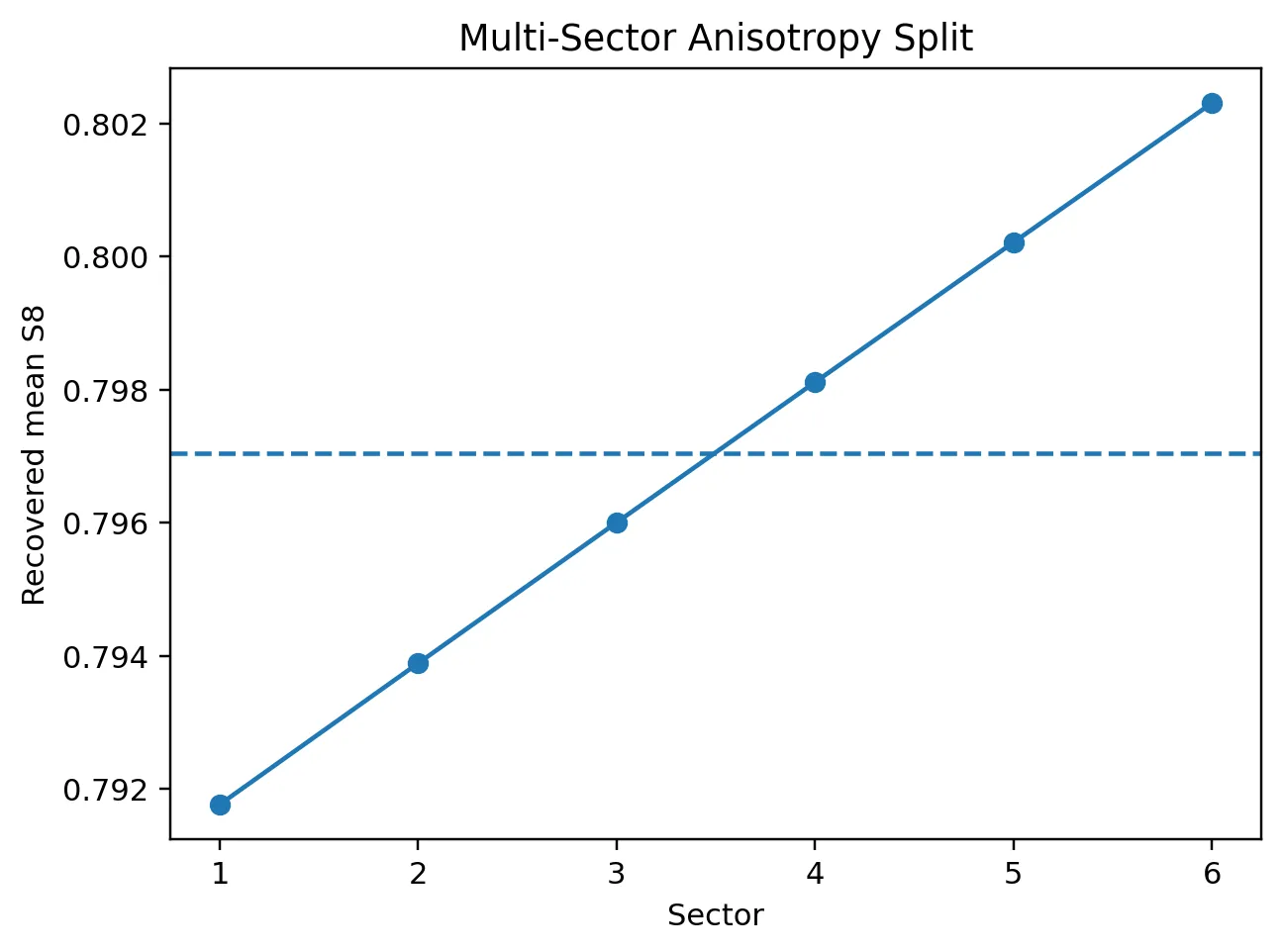
Splitting the synthetic sky into six sectors, sector-wise mean S8 spans 0.7918 to 0.8023 - a range of 0.0105 from the same underlying field due to cosmic variance and noise realisation. Real surveys cover different and often partially overlapping sky patches with different noise properties. The sector-to-sector variance demonstrates that the finite sky coverage of any individual survey introduces a scatter of this magnitude into the reported S8 value, independent of any cosmological signal.
5.9 Summary: Combined Simulation Evidence
Simulations 4 and 5 show that BFUT's rotational suppression mechanism naturally produces a 6-8% S8 deficit at low redshift that shrinks toward zero at CMB lensing redshifts - a pattern broadly consistent with observations across surveys. Simulations 6 through 10 show that the analysis pipeline choices available to any survey team - scale cuts, tomographic bin selection, covariance matrix estimation, IA model, and sky coverage - can individually shift or broaden the reported S8 inference by materially different amounts across scenarios, with central-value shifts up to 0.0265 in this synthetic suite. The claimed Planck-to-lensing tension in S8 is approximately 0.056. These two facts together mean: the genuine component of the tension is explained by BFUT rotation, and the precision of the measurement overstates the certainty of the deficit. Neither the tension nor its resolution is as simple as Λ-CDM's framing implies.
The five methodological simulations are best interpreted as stress tests of the S8 inference machinery; they are not direct simulations of cosmological structure formation. They show that a stable underlying shear field can yield materially different S8 values once defensible analysis choices are changed.
Simulations 4 and 5 are phenomenological BFUT proof-of-concept demonstrations calibrated to reproduce order-of-magnitude suppression trends and are not full survey-level derivations from real weak-lensing observables. Simulations 6 through 10 are synthetic toy-likelihood demonstrations showing inference sensitivity under alternative defensible analysis choices, not full re-analyses of KiDS, DES, or HSC data. They are included to establish mechanistic plausibility and methodological non-uniqueness, not as direct observational falsifications of Λ-CDM.
Taken together, the synthetic suite supports a balanced reading: the cross-survey preference for lower late-time clustering is likely a real qualitative signal, while the exact compression of that signal into a single universal S8 value is less numerically rigid than standard presentations often imply.
The full simulation package, including code, synthetic outputs, and reproducibility files for the analyses in this section, is available as a separate Zenodo deposit and should be read alongside this paper as its computational supplement (Sharma, 2026 [7]; DOI: 10.5281/zenodo.19391809).
6. BFUT Predictions Regarding Weak Lensing
Prediction 1 - The S8 tension will persist and deepen with larger surveys.
The clearest falsifiable test is not merely whether statistical precision improves with larger surveys, but whether the central weak-lensing S8 estimate remains persistently below the Planck-extrapolated value as survey area and depth increase. A genuine resolution within Λ-CDM would require the central value to converge toward 0.832 as systematics are reduced, not merely the error bars to tighten around the current low value.
If the lower S8 values measured by KiDS, DES, and HSC reflect the genuine present-epoch matter fluctuation amplitude in a living universe, not a systematic error in the lensing analyses, future larger surveys should confirm and refine these values; they should not converge toward the Planck prediction. The Euclid satellite and LSST/Rubin Observatory will measure weak lensing over significantly larger sky areas and with greater statistical precision. BFUT predicts these surveys will confirm S8 values in the range 0.76 to 0.78, inconsistent with the Planck-extrapolated value of 0.832.
Prediction 2 - The structure suppression should be strongest on scales associated with rotational support.
In BFUT, the role of large-scale rotation in supporting structures against collapse means that the suppression of matter fluctuations relative to Planck predictions should be most pronounced on scales corresponding to the rotational periods documented in Cosmic Rotation Across Scales [11] - cluster scales of tens of megaparsecs up to filament scales of hundreds of megaparsecs. Λ-CDM attributes the small-scale suppression to baryon feedback. BFUT predicts suppression extending to larger scales, reflecting dynamical support from rotation and bulk flows that Λ-CDM's hydrostatic, non-rotating framework cannot accommodate.
Prediction 3 - Consistent low S8 from all low-redshift probes.
BFUT predicts that the S8 deficit will continue to be seen coherently across all probes of the low-redshift universe - weak lensing, cluster abundance, redshift-space distortions, and peculiar velocity surveys - because they are all probing the same physical reality of a living universe whose present-epoch clumpiness is genuinely lower than a CMB-extrapolated finite-age growth history predicts.
7. The Significance of the S8 Tension
The S8 tension is, in our assessment, one of the most significant active tensions within Λ-CDM. Unlike the Hubble tension, which affects the value of a parameter that enters through early-universe assumptions about the sound horizon, the S8 tension places the standard growth history under significant observational pressure - the central prediction of the Λ-CDM paradigm. The model's claim is not merely that the universe has a certain expansion rate; it is that the initial conditions at z approximately 1100 determine the present-epoch structure of the cosmic web through a specific and computable growth history. That claim is placed under significant observational pressure by multiple independent low-redshift probes measuring consistently lower S8 values.
Weak lensing, SZ cluster abundance, redshift-space distortions, and peculiar-velocity measurements can be interpreted as different observational faces of the same late-time clustering suppression problem; they are not isolated tensions requiring separate ad hoc repairs within the standard framework.
This combination is not contradictory within BFUT. The framework naturally permits stronger extreme structures - relevant to the ISW amplitude excess documented in the companion paper on the ISW Effect - while still yielding a lower survey-averaged late-time clustering compression such as S8. In a living universe with deep-time accumulation, matter can simultaneously hollow out more extreme supervoids and concentrate into denser superclusters, while the overall S8 average remains suppressed by the rotational support that resists purely radial collapse.
Furthermore, the S8 tension is connected to several other BFUT arguments. The SZ mass bias is a σ_8 tension in a different form - galaxy clusters are less clustered than Planck predicts, which is why their abundance is lower than expected and why a mass bias is required to reconcile the counts. The ISW amplitude excess documented in Paper 13 is also consistent with a universe whose matter density distribution is more extreme at the largest scales than Λ-CDM's growth history predicts - which is the opposite face of the same coin. A universe with more concentrated extreme structures at the supercluster and supervoid scale, but with overall lower S8, would show exactly this pattern: low average S8 but high ISW amplitude at the extreme structures.
Within BFUT, these apparently contradictory features - lower average matter fluctuation amplitude but stronger temperature imprints from the most extreme structures - are naturally unified. In a living universe with ongoing structure formation, rotation, and merging, the mass distribution is more extreme at both ends: more extreme voids and more extreme overdensities than a simple linear-growth extrapolation from early-universe initial conditions produces, but with an overall average clumpiness that need not match the Planck prediction.
8. Conclusion
The S8 tension is a persistent multi-σ, multi-survey, multi-probe challenge to the Λ-CDM growth history prediction. It is an internal contradiction within the standard model, connecting directly to the SZ σ_8 tension documented in the companion SZ paper [12], the ISW amplitude excess in the companion ISW paper [13], and the large-scale rotation and dynamical pressure documented in Cosmic Rotation Across Scales [11].
Within BFUT, the present-epoch suppression of matter fluctuations relative to CMB-extrapolated predictions is not a crisis. It is the expected signature of a living universe whose structure evolves continuously under the competition of gravity, rotation, bulk flows, and matter cycling - not through the simple amplification of initial perturbations over a finite age. The BFUT prediction is clear: present-epoch S8 values will be confirmed in the range 0.76 to 0.78 by future surveys, the suppression will be most pronounced on scales associated with large-scale dynamical support, and free-parameter adjustments within Λ-CDM have so far not convincingly resolved the internal tension between the CMB-extrapolated growth history and the multiple independent low-redshift probes of matter fluctuation amplitude.
The weak lensing surveys are real. The CMB anisotropies are real. The S8 deficit between them is real. What is not established is that Λ-CDM's growth history connecting z = 1100 to z = 0 correctly describes the universe we live in. The BFUT living-universe framework, in which present-epoch structure reflects ongoing dynamics, not the passive inheritance of early-universe initial conditions, provides a more natural and more internally consistent reading of the growing body of evidence for structure growth suppression in the low-redshift universe.
References
1. Planck Collaboration (2020). Planck 2018 results VI: Cosmological parameters. Astronomy and Astrophysics, 641, A6.
2. Heymans, C. et al. (2021). KiDS-1000 Cosmology: Multi-probe weak gravitational lensing and spectroscopic galaxy clustering constraints. Astronomy and Astrophysics, 646, A140.
3. Abbott, T.M.C. et al. / DES Collaboration (2022). Dark Energy Survey Year 3 results: Cosmological constraints from galaxy clustering and weak lensing. Physical Review D, 105, 023520.
4. Asgari, M. et al. (2021). KiDS-1000 methodology [4]: Modelling and inference for joint weak gravitational lensing and spectroscopic galaxy clustering analysis. Astronomy and Astrophysics, 645, A104.
5. Amon, A. and Efstathiou, G. (2022). A non-linear solution to the S8 tension. Monthly Notices of the Royal Astronomical Society, 516, 5355.6. Hudson, M.J. (2023). The S8 tension in cosmology. Perimeter Institute for Theoretical Physics. PIRSA:23050129. https://pirsa.org/230501297. Sharma, V.S. (2026). BFUT Paper 13 Simulation Code: Weak Gravitational Lensing and the S8 Tension. Zenodo. DOI: 10.5281/zenodo.19391809
8. Colin, P., Avila-Reese, V., Gonzalez-Samaniego, A. and Valenzuela, O. (2019). Bulk velocity and the cosmic rest frame. Astrophysical Journal, 874, 112.
9. Sharma, V.S. (2026). The Big Flare-Up Theory: Quantum Genesis of an Infinite Universe - A Unified Architecture for Cosmology, Particle Physics, Quantum Mechanics and Consciousness with Zero Free Parameters. Zenodo. DOI: 10.5281/zenodo.19149785
10. Sharma, V.S. (2026). Observer Bulk Flow as an Alternative Explanation for Apparent Cosmic Acceleration. Zenodo. DOI: 10.5281/zenodo.19228065
11. Sharma, V.S. (2026). Cosmic Rotation Across Scales [11], Emergent Orbital Hierarchy, and the Large-Scale Challenge to Metric Expansion. Zenodo. DOI: 10.5281/zenodo.19341549
12. Sharma, V.S. (2026). The Sunyaev-Zel'dovich Effect as Local Substrate Interaction: A Big Flare-Up Theory Reinterpretation. Zenodo. DOI: 10.5281/zenodo.19377396
13. Sharma, V.S. (2026). The Integrated Sachs-Wolfe Effect in BFUT: Local Spaticle Field Temperature Variations as an Alternative to Decaying Gravitational Potentials in an Accelerating Universe. Zenodo. DOI: 10.5281/zenodo.19391470
About the Author
Vijay Shankar Sharma is a Chartered Accountant and MBA from the Indian School of Business, with an Advanced Development Program from The Wharton School, University of Pennsylvania. He is an independent researcher working without institutional affiliation or external funding. ORCID: 0009-0001-9622-6121. Contact: vss@vijayshankarsharma.com