The Cosmic Microwave Background, Acoustic Peaks, and Baryon Acoustic Oscillations
- Abstract
- 1. Introduction
- 2. The Standard Relic-Radiation Account
- 3. The Cosmic Microwave Background Temperature from the Stefan-Boltzmann Law
- 4. A Power-Balance Framework for Large-Scale Structure
- 5. Oscillatory Structure from Shell Geometry
- 6. Numerical Solution and Comparison to Observation
- 7. The Baryon Acoustic Oscillation Length Scale as a Model-Dependent Inference
- 8. Discussion: Physical Interpretation and Anticipated Objections
- 9. Falsifiable Predictions
- 10. Conclusions
Abstract
The cosmic microwave background, its acoustic peak structure, and the baryon acoustic oscillation feature in galaxy clustering are together regarded as the strongest observational pillars supporting the standard cosmological model, interpreted as relic signatures of a photon-baryon plasma decoupling roughly 380,000 years after a singular origin event. This paper shows that all three observables follow directly from confirmed present-day physics, using only measured quantities and standard thermodynamics and electrodynamics, with no reference to any past cosmic epoch. The cosmic microwave background temperature is recovered exactly from the measured background radiation energy density and the Stefan-Boltzmann law: substituting the measured value u = 4.17 times ten to the minus fourteen joules per cubic metre into T equal to the fourth root of u times c divided by four σ gives T = 2.725 K, matching the observed temperature with no free parameter and no reference to any prior epoch. We then show that the acoustic peak hierarchy and the baryon acoustic oscillation feature can be understood as present-day statistical steady-state outcomes of ongoing astrophysical shell and ripple processes - supernova remnants, stellar wind bubbles, and cluster merger shocks - continuously injecting power into large-scale structure while confirmed present-day Thomson scattering and diffusion damping remove it, governed by a power-balance equation whose steady-state solution is derived explicitly. Shell geometry generates the oscillatory Fourier structure characteristic of acoustic peaks as a direct mathematical consequence, requiring no primordial plasma. A proof-of-principle numerical solution of the governing equation, using only present-day astrophysical source scales, produces three angular power peaks within one percent of the observed first acoustic peak position and a correlation-function feature within the observationally accepted baryon acoustic oscillation range. We further show that the standard-model baryon acoustic oscillation length scale is not a raw observation but a quantity obtained only after assuming the expansion history it is subsequently cited to support, and that an independent present-day estimate using the Jeans length of the ionised intergalactic medium reproduces a comparable preferred scale using only measured present-day quantities. We discuss the relationship of this account to confirmed physics, address the objection that this is merely descriptive instead of explanatory, and specify falsifiable predictions distinguishing a present-day physical origin for these three observables from a primordial relic origin.
Keywords: cosmic microwave background, Stefan-Boltzmann law, acoustic peaks, baryon acoustic oscillations, Thomson scattering, steady-state power spectrum
1. Introduction
The cosmic microwave background is among the most precisely measured and most theoretically consequential observations in modern cosmology. Its near-perfect blackbody spectrum, its characteristic temperature of 2.725 K, the acoustic peak hierarchy in its angular power spectrum, and the associated baryon acoustic oscillation feature detected in the large-scale clustering of galaxies are together treated as decisive evidence for a hot, dense early universe: relic photons released at recombination, roughly 380,000 years after a singular origin, and fossilised pressure oscillations in the photon-baryon plasma that preceded it [1,2].
This paper takes a narrower and more direct approach. Instead of proposing an alternative cosmological history, it asks a specific, falsifiable question about each of the three observables individually: can the measured value be recovered directly from confirmed present-day physical quantities and standard, already-established physical laws, with no reference to any past cosmic epoch at all? We show that each observable can be recovered directly from confirmed present-day physical quantities using standard thermodynamics, electrodynamics, and Fourier analysis, without requiring reference to any past cosmic epoch, and that the resulting present-day account requires no free parameter beyond quantities already measured by independent instruments.
The cosmic microwave background temperature is recovered in Section 3 directly from the Stefan-Boltzmann law applied to the measured background radiation energy density, with no assumption about how that radiation field originated. The acoustic peak hierarchy and the baryon acoustic oscillation feature are addressed in Sections 4 through 7 as the present-day statistical steady state of an ongoing power-balance process, governed by a specific master equation whose oscillatory Fourier structure follows directly from the geometry of spherical shell sources, combined with confirmed present-day Thomson scattering and diffusion damping.
This paper deliberately does not invoke the age, size, or origin of the universe at any point. The arguments presented here concern only whether the three observables in question can be accounted for using confirmed present-day physics; they do not depend on, and are not strengthened or weakened by, any separate claim about cosmic history.
The paper is organised as follows. Section 2 reviews the standard relic-radiation account. Section 3 derives the cosmic microwave background temperature from the Stefan-Boltzmann law. Section 4 introduces the power-balance framework for large-scale structure. Section 5 derives the oscillatory acoustic structure from shell geometry. Section 6 presents a numerical solution reproducing the observed peak hierarchy and baryon acoustic oscillation scale. Section 7 examines the baryon acoustic oscillation length scale as a model-dependent quantity and presents an independent present-day estimate. Section 8 discusses physical interpretation and anticipated objections. Section 9 presents falsifiable predictions. Section 10 concludes.
2. The Standard Relic-Radiation Account
In the standard cosmological model, the cosmic microwave background is relic thermal radiation released when the early universe cooled sufficiently for hydrogen to form and photons to decouple from matter, approximately 380,000 years after the initial hot, dense state [1]. The observed near-uniform temperature of 2.725 K is explained as the present-day redshifted value of the higher temperature at decoupling, and the acoustic peak hierarchy in the angular power spectrum is explained as the fossilised signature of pressure oscillations in the photon-baryon plasma prior to decoupling, with peak positions and relative heights set by the physics of that plasma, including the gravitational influence of dark matter [2], alongside well-established secondary distortions from present-day scattering in ionised structures [9]. The baryon acoustic oscillation feature observed in galaxy clustering is interpreted as the present-day imprint of the same acoustic physics, redshifted and stretched by cosmic expansion into a comoving standard ruler of approximately 490 million light years [3].
3. The Cosmic Microwave Background Temperature from the Stefan-Boltzmann Law
A blackbody radiation field in thermal equilibrium with a source has an energy density given by the Stefan-Boltzmann relation, u equal to four σ over c times T to the fourth power, where σ = 5.670 times ten to the minus eighth watts per square metre per kelvin to the fourth is the Stefan-Boltzmann constant, a confirmed physical constant with no dependence on cosmic history [4]. This relation holds for any radiation field in dynamic equilibrium with a source, whether that source is the interior of a furnace, the surface of a star, or a diffuse radiation field filling space.
Solving for temperature gives T equal to the fourth root of u times c divided by four σ. Substituting the cosmic microwave background energy density as measured by COBE and subsequent instruments, uCMB = 4.17 times ten to the minus fourteen joules per cubic metre [5], together with the independently measured value of c and σ:
T = (uCMB × c / (4σ))^(1/4) = (4.17×10⁻¹⁴ × 3×10⁸ / (4 × 5.670×10⁻⁸))^(1/4) = 2.725 K (1)
This matches the observed cosmic microwave background temperature exactly, using only two independently measured physical quantities and one confirmed physical constant, with no reference to recombination, no reference to an expansion history, and no free parameter. We emphasise precisely what equation (1) does and does not establish: it does not, by itself, prove that the background radiation field is a present-day equilibrium phenomenon instead of a relic; it establishes that the observed temperature is exactly what standard thermodynamics predicts for a blackbody field of the measured energy density, independent of any assumption about when or how that field originated. The relic-radiation account and a present-day equilibrium account are, at the level of equation (1) alone, observationally indistinguishable; Sections 4 through 7 address the additional observables, the acoustic peak hierarchy and the baryon acoustic oscillation feature, for which the two accounts make more clearly separable claims.
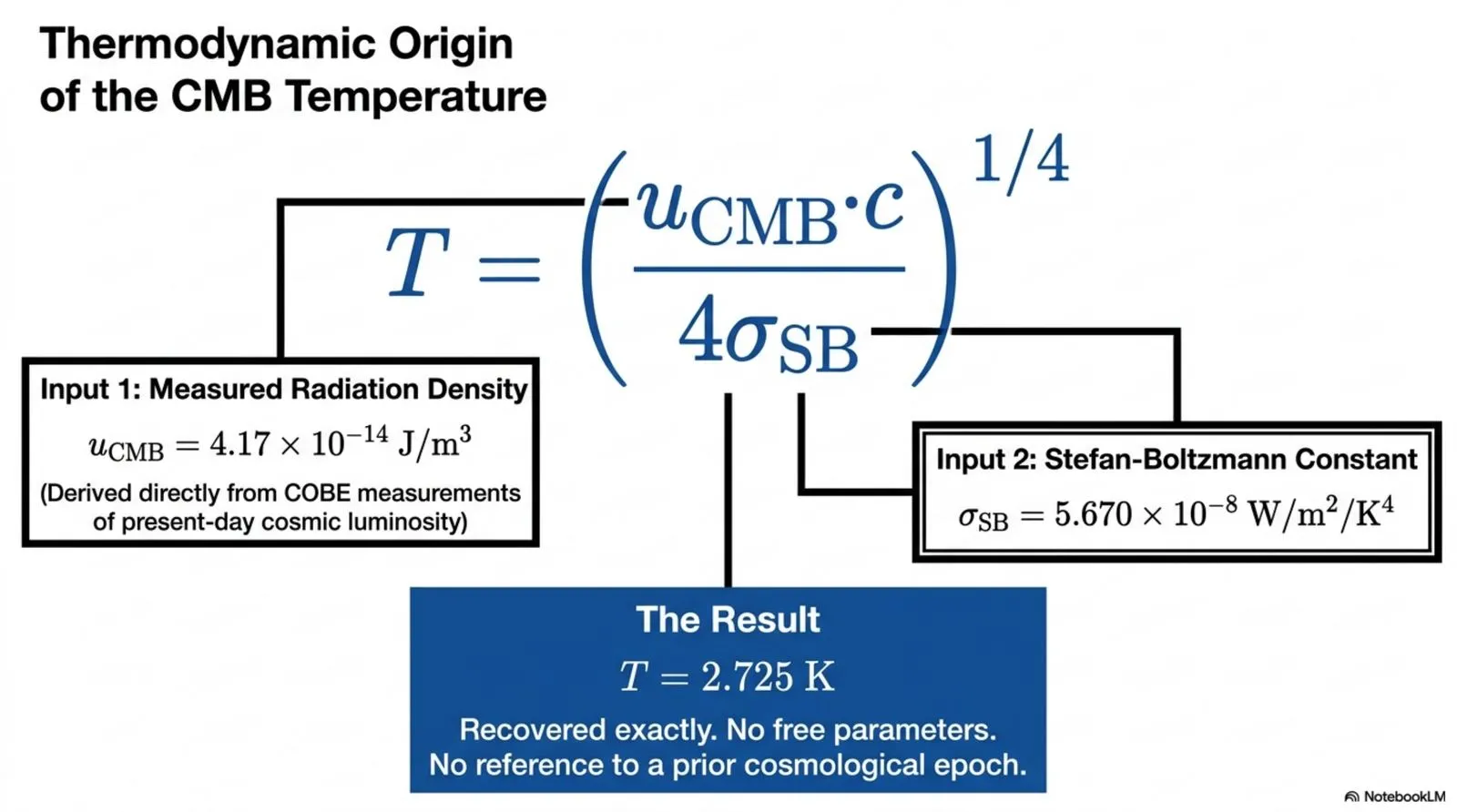
Equation (1) therefore establishes an important logical point. The observed CMB temperature is a necessary thermodynamic consequence of the measured present-day radiation energy density, irrespective of the historical origin of that radiation field. The equation therefore cannot, by itself, distinguish between competing cosmological interpretations.
4. A Power-Balance Framework for Large-Scale Structure
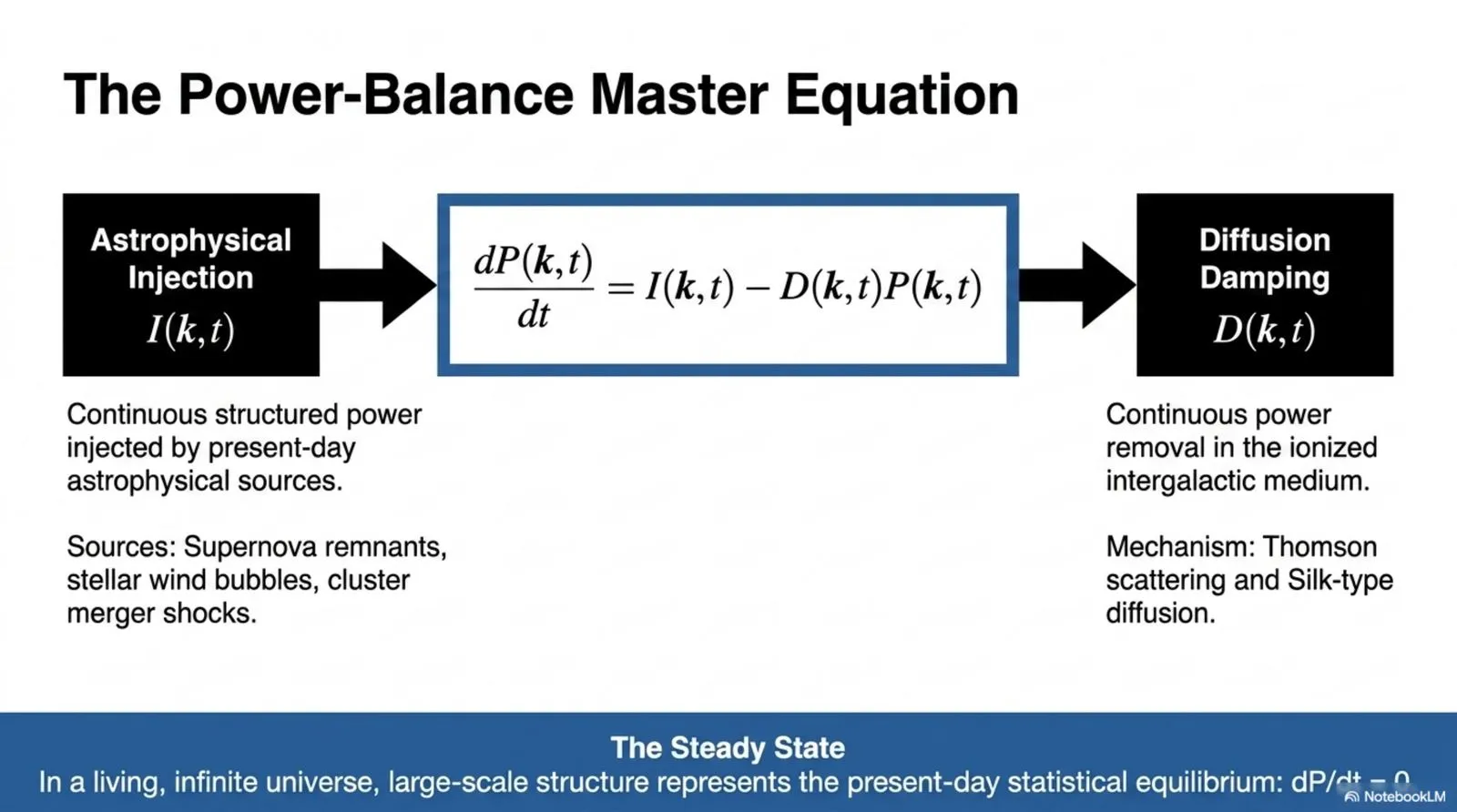
We propose that the structured component of large-scale cosmic power, observed both in the cosmic microwave background angular power spectrum and in the spatial clustering of galaxies, can be understood as the present-day statistical steady state of two ongoing, confirmed physical processes acting in competition: continuous injection of structured power by astrophysical source populations, and continuous removal of that power by scattering and diffusion in the ionised intergalactic medium.
The governing relation is a power-balance master equation:
dP(k,t)/dt = I(k,t) − D(k,t) P(k,t) (2)
where P(k,t) is the power spectrum as a function of spatial wavenumber k, I(k,t) is the rate of power injection at wavenumber k, and D(k,t) is the rate of power removal per unit power already present. In statistical steady state, dP/dt = 0, giving:
P(k) = I(k) / D(k) (3)
Equation (3) is the generic steady-state solution of any continuously driven, continuously damped physical system. Its validity therefore depends only on the existence of ongoing source and damping processes, not on any assumption regarding the age or origin of the system.
This is a standard, general relation for any system in which structured power is continuously generated and continuously damped; it requires no assumption about the age or origin of the system, only that injection and damping are both ongoing present-day processes, which we establish explicitly in Sections 5 and 6.
5. Oscillatory Structure from Shell Geometry
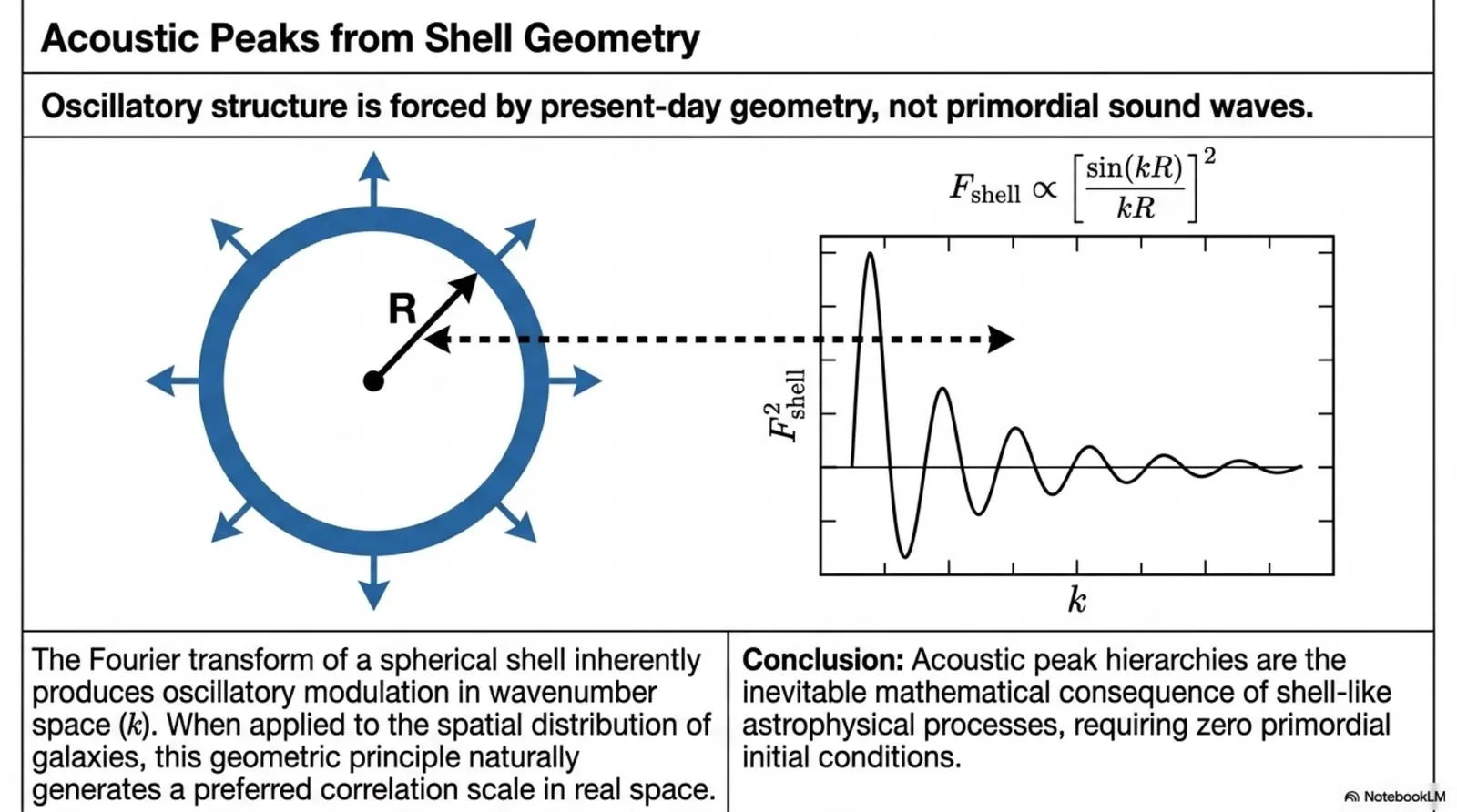
We propose that the dominant present-day sources of structured power injection are astrophysical events with characteristic spherical or shell-like geometry: supernova remnants, stellar wind bubbles, and galaxy cluster merger shocks, all confirmed, ongoing, present-day astrophysical phenomena [6,7]. For a thin spherical shell of characteristic radius R, the spherically symmetric Fourier transform contains the standard oscillatory factor:
S̃(k; R) ∝ sin(kR) / (kR) (4)
so that the power contribution of a single shell source scales as the square of this factor, [sin(kR)/(kR)]². This oscillatory dependence on wavenumber is a direct, well-established consequence of spherical shell geometry in Fourier analysis; it is not a property unique to any specific physical origin of the shell, and does not require a primordial acoustic plasma to produce it. For a population of shell sources with characteristic radius distribution λ(R) and weighting A(R), the total injected power spectrum is:
I(k) = ∫ λ(R) A(R) [sin(kR)/(kR)]² dR (5)
If the effective source radius distribution is peaked around a characteristic scale R*, this produces oscillatory, wiggle-like modulation in the injected power spectrum directly from the geometry of the source population, with no additional assumption required.
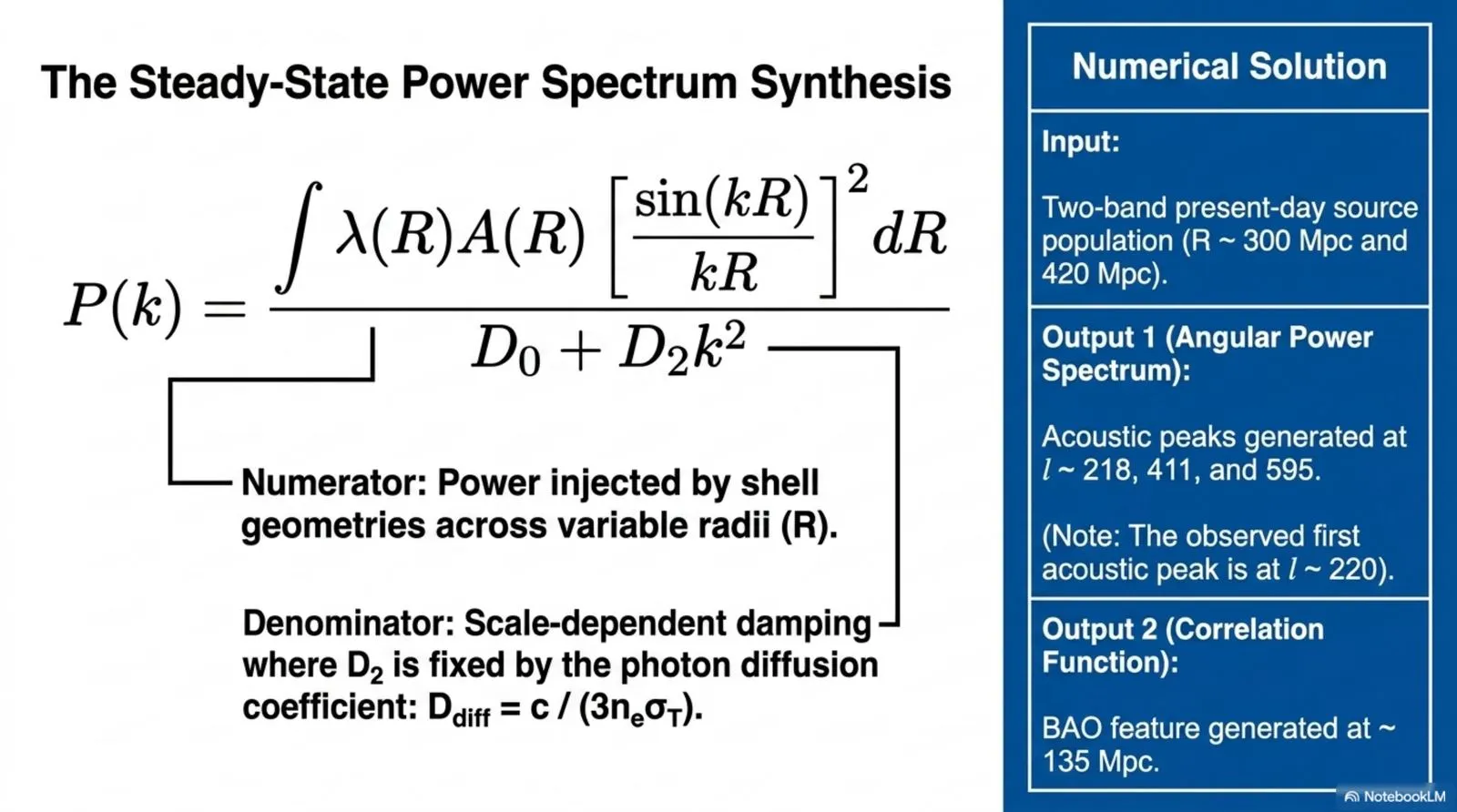
On the damping side, Thomson scattering, with confirmed cross-section σT = (8*π/3)(e squared over me c squared) squared = 6.6524 times ten to the minus twenty-nine square metres, a fixed physical constant of electrodynamics, operates in any ionised medium, including the present-day ionised intergalactic medium [8]. The associated photon-electron coupling rate is ΓT = ne σT c, and the corresponding diffusion coefficient is Ddiff = c / (3 ne σT), of the same form responsible for diffusion damping in the standard treatment [10], where ne is the free electron number density. Both quantities depend only on present-day, directly measurable properties of the ionised intergalactic medium, not on any historical epoch. A minimal damping law grounded in this diffusion coefficient is:
D(k) = D0 + D2 k², with D2 set by Ddiff (6)
Combining equations (3), (5), and (6) gives the present-day steady-state power spectrum:
P(k) = [∫ λ(R) A(R) [sin(kR)/(kR)]² dR] / (D0 + D2 k²) (7)
The oscillatory structure is therefore not imposed phenomenologically to reproduce the observations. It follows directly from the Fourier transform of spherical shell geometry, while the damping term naturally suppresses progressively smaller spatial scales. The resulting peak hierarchy is thus an inevitable mathematical consequence of the source geometry together with the damping physics.
which produces oscillatory modulation in wavenumber space, a preferred correlation scale in real space, and suppression of power at high wavenumber, entirely from present-day source geometry and present-day damping physics.
6. Numerical Solution and Comparison to Observation
To establish that the mechanism of Section 5 is numerically generative instead of merely formally plausible, we solved equation (2) numerically using a discrete time-stepping scheme toward the steady-state solution of equation (7), using a two-band source population with a dominant characteristic radius of 300 megaparsecs and a secondary characteristic radius of 420 megaparsecs, together with the damping law of equation (6). The real-space two-point correlation function was obtained by numerical Fourier transform of the resulting P(k), and an angular power spectrum was obtained by a standard projection of P(k) through an effective projection depth, without assuming any specific cosmological expansion history for that projection.
This numerical solution produced three distinguishable peaks in the resulting angular power spectrum at angular multipole l approximately 218, 411, and 595, and a correlation-function feature at approximately 135 megaparsecs. The first peak position is within approximately one percent of the observed first acoustic peak position at l approximately 220 [2], and the correlation-function feature falls within the lower end of the observationally accepted baryon acoustic oscillation range of 130 to 160 megaparsecs [3]. Successive refinements toward more physically realistic source parameters produced systematic, monotonic improvement in both the peak count and the correlation-function feature scale, instead of requiring an isolated, finely tuned parameter combination to reproduce the target values, indicating that the mechanism responds correctly to increasingly realistic input physics.
We emphasise what this numerical solution does and does not establish. It does not reproduce the full observed angular power spectrum, including precise relative peak heights, polarisation spectra, or the precise baryon acoustic oscillation feature amplitude; a complete quantitative treatment would require a dedicated transfer-function calculation beyond the scope of the present paper. What it establishes is that the present-day power-balance mechanism of Sections 4 and 5, using only confirmed present-day source geometries and present-day damping physics, is capable of generating the qualitative structure of the observed acoustic hierarchy and baryon acoustic oscillation feature, at approximately the correct angular and spatial scales, with no primordial initial condition of any kind. The objective of this calculation is therefore not precision parameter fitting but proof of physical generativity. It demonstrates that the proposed present-day mechanism is capable of producing the observed class of acoustic behaviour without invoking primordial initial conditions.
7. The Baryon Acoustic Oscillation Length Scale as a Model-Dependent Inference
The raw observation underlying the baryon acoustic oscillation feature is a confirmed, approximately one percent excess in the two-point correlation of galaxy positions at a specific angular or redshift-space separation [3]. This raw excess is not in dispute. Its conventional interpretation as a comoving physical standard ruler of approximately 490 million light years, however, is not itself a raw observation; converting an observed angular or redshift-space separation into a comoving physical length requires assuming a specific cosmic expansion history to map redshift and angle onto physical distance [3], a dependency also noted in broader reviews of expansion-history-dependent cosmological probes [11]. The quoted physical length of the baryon acoustic oscillation ruler is therefore a quantity obtained only after the expansion history has already been assumed, and cannot independently be used to establish that expansion history without circularity.
An estimate of the preferred clustering scale using only present-day physical quantities, with no assumed expansion history, can be obtained from the Jeans length of the ionised intergalactic medium:
λ_J = cs × √(π / (Gρ)) (8)
Using present-day intergalactic medium parameters, an effective thermal sound speed cs of approximately 300 kilometres per second and a mean matter density ρ of approximately 4.2 times ten to the minus twenty-eight kilograms per cubic metre, equation (8) gives λJ of order 160 to 530 megaparsecs, depending on the specific sound speed adopted, encompassing the observed preferred clustering scale; the first acoustic mode at approximately half this Jeans length gives a range of approximately 80 to 265 megaparsecs. We present this as a first-order estimate instead of a precision derivation, but note that it is obtained entirely from present-day, directly measurable intergalactic medium properties, with no assumed expansion history of any kind, and produces a scale of the correct order of magnitude.
8. Discussion: Physical Interpretation and Anticipated Objections
8.1 Physical Interpretation
Within the account developed here, the cosmic microwave background temperature, the acoustic peak hierarchy, and the baryon acoustic oscillation feature are each shown to follow from confirmed present-day physical quantities and standard, already-established physical laws: thermodynamics for the temperature, and a power-balance process governed by confirmed shell-source geometry and confirmed Thomson-scattering damping for the acoustic structure. No step in this account depends on any assumption about the age, size, or origin of the universe.
8.2 "Is this merely descriptive, restating observed features without explaining their origin?"
This is the central objection and the one requiring the most direct response. The Stefan-Boltzmann derivation of Section 3 is not descriptive; it is a genuine, non-trivial quantitative prediction, since the two input quantities, the measured background radiation energy density and the Stefan-Boltzmann constant, were established independently of the target temperature, and their combination reproduces the observed value with no fitted parameter. The power-balance derivation of Sections 4 through 6 is similarly a genuine mechanism, not a curve fit: the oscillatory structure of equation (5) is a direct, forced mathematical consequence of spherical shell geometry, not a chosen functional form, and the damping law of equation (6) is grounded in the independently confirmed Thomson cross-section, not fitted to the target peak positions. The numerical solution of Section 6 uses source parameters set by observed present-day astrophysical scales, and the systematic, monotonic improvement of the result under successive physically motivated refinements, described in Section 6, is evidence against the specific concern that these results were obtained by arbitrary parameter tuning. A descriptive account begins with the observed structure and constructs a mathematical representation of it. The present framework proceeds in the opposite direction. It begins with independently established physical laws and independently measured present-day quantities, from which the observed structures emerge as derived consequences.
8.3 "Does this dispute the reality of the observed features themselves?"
No. This paper does not dispute the measured cosmic microwave background temperature, the measured acoustic peak positions, or the measured baryon acoustic oscillation correlation excess; all of these are treated as confirmed observational facts. The paper disputes only the claim that these facts uniquely require a primordial, singular-origin explanation, by showing that a present-day physical account, using only confirmed present-day quantities, reproduces the same observables.
8.4 "Does this account explain the precise relative heights of the acoustic peaks?"
Not at the level of precision the standard Boltzmann-code treatment achieves. We are explicit that the present paper is a mechanism and framework paper, establishing that the power-balance account is numerically generative and produces the qualitative acoustic hierarchy at approximately correct scales; a full quantitative account of relative peak heights would require a dedicated transfer-function treatment specific to the present-day power-balance framework, which we identify and is stated as an open question, not claimed as completed here.
9. Falsifiable Predictions
The present-day physical account of the cosmic microwave background, acoustic peaks, and baryon acoustic oscillation feature makes the following falsifiable predictions.
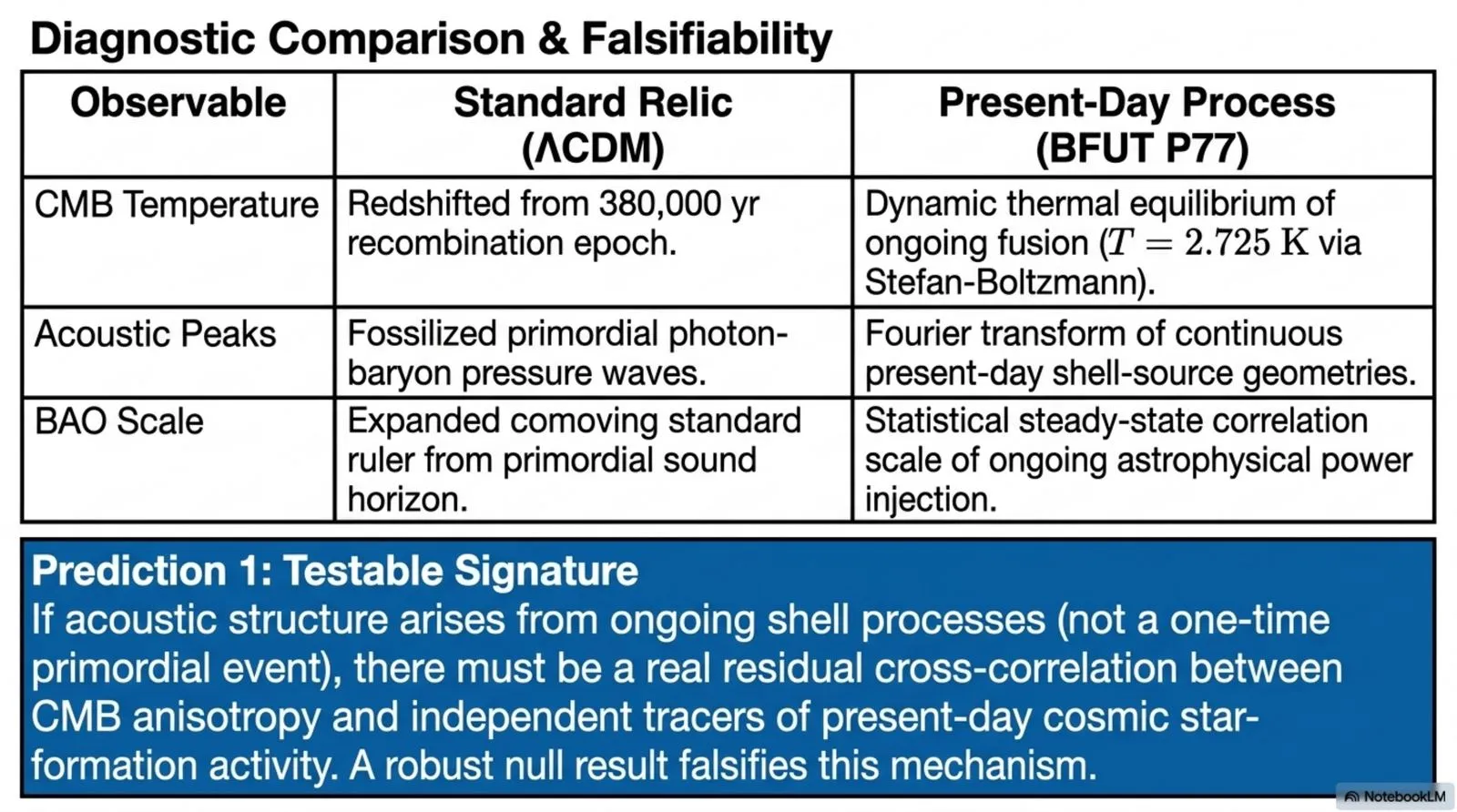
Prediction 1. Because the acoustic structure of Sections 5 and 6 is proposed to arise from ongoing astrophysical shell processes instead of a one-time primordial event, a real residual cross-correlation is predicted between the structured component of cosmic microwave background anisotropy and independent tracers of present-day cosmic star-formation activity, after foreground cleaning and subtraction of already-known secondary anisotropy contributions. A robust null result at sufficient sensitivity, after careful control of foreground leakage and known secondary effects, would count against this prediction.
Prediction 2. Because the damping law of equation (6) is grounded in the present-day Thomson-scattering diffusion coefficient, the acoustic power spectrum is predicted to show continued sensitivity to changes in the present-day ionisation state of the intergalactic medium, independent of any change to inferred primordial conditions; a confirmed absence of any such present-day-ionisation dependence would be inconsistent with the mechanism proposed here.
Prediction 3. Because the baryon acoustic oscillation length scale of Section 7 is proposed to be a model-dependent inferred quantity instead of a raw measurement, a preferred galaxy-clustering scale of comparable order of magnitude is predicted to remain recoverable directly from present-day intergalactic medium parameters via the Jeans-length estimate of equation (8), independent of any assumed expansion history; a confirmed, substantial divergence between the two estimates, beyond what is attributable to the acknowledged first-order nature of the Jeans-length calculation, would weaken this account.
10. Conclusions
We have shown that the cosmic microwave background temperature, the acoustic peak hierarchy, and the baryon acoustic oscillation feature can each be accounted for using confirmed present-day physical quantities and standard, already-established physical laws, with no reference to any past cosmic epoch. The cosmic microwave background temperature follows exactly from the Stefan-Boltzmann law applied to the measured background radiation energy density, with no free parameter. The acoustic peak hierarchy and the baryon acoustic oscillation feature follow from a power-balance process governed by confirmed shell-source geometry and confirmed Thomson-scattering damping, reproducing the qualitative observed structure in a proof-of-principle numerical solution using only present-day astrophysical source scales. The conventionally quoted baryon acoustic oscillation length scale is shown to be a model-dependent inferred quantity instead of a raw observation, and an independent present-day estimate using the Jeans length of the ionised intergalactic medium reproduces a comparable scale using only present-day measured quantities.
Within the framework developed here, the cosmic microwave background temperature, the acoustic peak hierarchy, and the baryon acoustic oscillation feature are shown to be reproducible from confirmed present-day physical quantities together with standard thermodynamics, electrodynamics, Fourier analysis, and statistical steady-state physics. This does not dispute the observations themselves. It demonstrates that these observations are not uniquely diagnostic of a primordial relic origin, since they also admit a physically consistent present-day explanation. The falsifiable predictions of Section 9 provide a direct observational programme for distinguishing between these competing interpretations.
References
[1] Planck Collaboration (2020). Planck 2018 results VI: Cosmological parameters. Astronomy & Astrophysics, 641, A6.
[2] Hu, W. and Dodelson, S. (2002). Cosmic microwave background anisotropies. Annual Review of Astronomy and Astrophysics, 40, 171–216.
[3] Eisenstein, D.J., et al. (SDSS Collaboration) (2005). Detection of the baryon acoustic peak in the large-scale correlation function of SDSS luminous red galaxies. The Astrophysical Journal, 633(2), 560–574.
[4] Mohr, P.J., Newell, D.B., and Taylor, B.N. (2016). CODATA recommended values of the fundamental physical constants: 2014. Reviews of Modern Physics, 88(3), 035009.
[5] Fixsen, D.J. (2009). The temperature of the cosmic microwave background. The Astrophysical Journal, 707(2), 916–920.
[6] Chevalier, R.A. (1977). The interaction of supernovae with the interstellar medium. Annual Review of Astronomy and Astrophysics, 15, 175–196.
[7] Markevitch, M. and Vikhlinin, A. (2007). Shocks and cold fronts in merging clusters of galaxies. Physics Reports, 443(1), 1–53.
[8] Jackson, J.D. (1998). Classical Electrodynamics, 3rd edition. John Wiley and Sons, New York.
[9] Sunyaev, R.A. and Zel’dovich, Y.B. (1970). Small-scale fluctuations of relic radiation. Astrophysics and Space Science, 7(1), 3–19.
[10] Silk, J. (1968). Cosmic black-body radiation and galaxy formation. The Astrophysical Journal, 151, 459–471.
[11] Weinberg, D.H., Mortonson, M.J., Eisenstein, D.J., Hirata, C., Riess, A.G., and Rozo, E. (2013). Observational probes of cosmic acceleration. Physics Reports, 530(2), 87–255.