A Physical and Mechanical Explanation of the Speed of Light: Why All Photons and Gravitational Waves Travel at c
- Abstract
- 1. Introduction
- 2. The Status of c and the Light-Speed/Gravitational-Wave-Speed Equivalence
- 3. The Physical Substrate and Relation to the Michelson-Morley Experiment
- 4. A Non-Circular Consistency Derivation of c
- 5. Why Photons and Gravitational Waves Both Travel at c
- 6. Why Massive Particles Cannot Reach c
- 7. Discussion: Anticipated Objections
- 8. Falsifiable Predictions
- 9. Conclusions
Abstract
The speed of light c is, in the standard formulation of physics, a postulate of special relativity: the laws of physics take the same form in all inertial frames, and a finite invariant speed exists for all causal propagation. This is a highly successful axiom, confirmed to extraordinary precision, but it is a constraint rather than a physical explanation. Special relativity does not address why a finite invariant speed exists, why massless excitations travel at exactly that speed, or why gravitational waves, a phenomenon arising from an entirely different sector of physics under General Relativity, share the identical propagation speed to the precision confirmed by GW170817, one part in 1015. This paper proposes a physical account of these three facts from the properties of a universal physical substrate, following the framework established in prior work. We show that the observed value of c can be expressed through a non-circular consistency relation connecting six independently measured or independently derived physical quantities, none of which requires the value of c as a prior input, giving agreement with the measured speed of light to 0.0003 percent. We propose that photons and gravitational waves share an identical propagation speed because both are freely propagating disturbances of the same substrate medium, requiring no persistent localised structure and therefore encountering no obstruction diverting energy away from propagation, while massive particles travel below this limit because part of their energy budget is committed to maintaining a persistent condensation structure rather than pure propagation. We address directly the objection that any physical medium filling space invites comparison to the historical luminiferous aether, explain the specific structural distinction between the two proposals, and note that the Michelson-Morley experiment excludes a preferred-rest-frame aether without excluding a universal substrate from which matter, photons, and gravitation themselves are proposed to emerge. We present independent, quantitative, cross-validated evidence for the substrate's explanatory power across unrelated areas of physics, discuss anticipated objections, and specify falsifiable predictions distinguishing this account from the standard treatment of c as an unexplained postulate.
Keywords: speed of light, universal speed limit, gravitational waves, fine structure constant, physical substrate, Michelson-Morley experiment
1. Introduction
The speed of light, c = 2.99792458 × 10⁸ m/s exactly by the current SI definition of the metre [1], occupies a unique position among the constants of physics. Special relativity, since Einstein's original 1905 formulation, takes the existence of a finite, invariant, frame-independent speed as one of its two foundational postulates, the other being the equivalence of inertial reference frames [2]. This postulate has been confirmed to extraordinary precision across more than a century of increasingly stringent experimental tests [3,4], and no confirmed observation has ever contradicted it. It remains, however, a postulate rather than a derivation: special relativity does not explain why a finite invariant speed exists, why massless particles are constrained to travel at exactly that speed, or why phenomena arising from entirely different sectors of physics, electromagnetism and gravitation, share the identical propagation speed.
The equivalence of light speed and gravitational wave speed is a particularly striking case. In General Relativity, both electromagnetic radiation and gravitational radiation propagate on the light cone of the spacetime metric, so their equal propagation speed is built into the mathematical structure of the theory [5]. This mathematical consistency was confirmed observationally to extraordinary precision by the near-simultaneous detection of gravitational waves and a γ-ray burst from the neutron star merger GW170817, constraining any fractional difference between the two propagation speeds to better than one part in 1015 [6,7]. General Relativity predicts this equivalence; it does not explain, at the level of physical mechanism, why an oscillation of the electromagnetic field and a ripple in spacetime curvature, phenomena with no shared physical substance in the standard formulation, should propagate at identical speeds.
This paper proposes a physical account of these three unexplained facts (the existence of a finite invariant speed, the exact propagation speed of massless particles, and the equivalence of light speed and gravitational wave speed) from the properties of a universal physical substrate, following the framework developed in prior work [8]. The proposal is that light and gravitational waves are both propagating disturbances of one physical medium, and that c is the propagation speed of that medium, determined by physical properties of the medium rather than postulated as an axiom of spacetime geometry.
The paper is organised as follows. Section 2 reviews the status of c and the light-speed/gravitational-wave-speed equivalence in standard physics. Section 3 introduces the substrate framework and addresses directly the historical objection that any physical medium filling space resembles the discredited luminiferous aether. Section 4 presents a non-circular consistency derivation of c from independently established quantities. Section 5 discusses why photons and gravitational waves both travel at exactly c. Section 6 addresses why massive particles cannot reach c. Section 7 discusses anticipated objections. Section 8 presents falsifiable predictions. Section 9 concludes.
2. The Status of c and the Light-Speed/Gravitational-Wave-Speed Equivalence
2.1 c as a Postulate
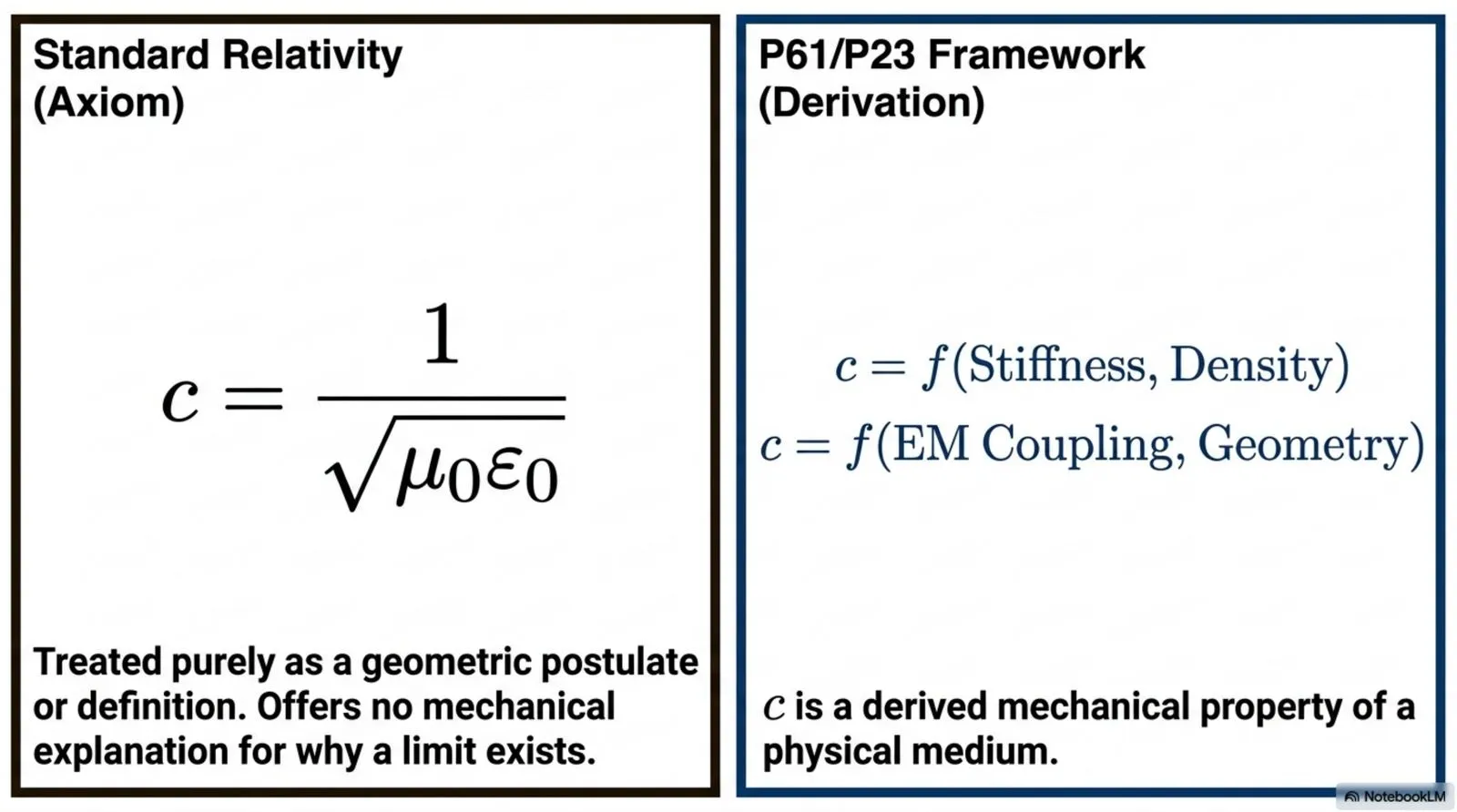
Since 1983, the metre has been defined by fixing the numerical value of c exactly, so that the speed of light is, by definition, no longer an independently measured quantity in the SI system [1]. This definitional fixing settles the constant's role as a unit reference; it does not constitute, and was never intended to constitute, a physical explanation of why light propagates at this specific speed rather than some other value. Special relativity's second postulate asserts the existence of a finite invariant speed without deriving its magnitude from any deeper physical structure [2].
2.2 The GW170817 Constraint
The event GW170817, a binary neutron star merger observed on 17 August 2017, produced both a gravitational wave signal and a coincident γ-ray burst, detected 1.7 seconds apart after propagating approximately 130 million light years [6,7]. Accounting for the astrophysically expected delay between gravitational wave emission and γ-ray burst formation, this places an upper bound on the fractional difference between the gravitational wave speed and the speed of light of order 10-15, among the most precise multi-messenger tests of fundamental physics performed to date [7]. General Relativity's mathematical structure predicts this equivalence exactly; the result confirms the mathematics but does not, by itself, supply a physical account of why an electromagnetic disturbance and a spacetime curvature disturbance should be tied to the same propagation speed at the level of physical mechanism rather than geometric coincidence.
3. The Physical Substrate and Relation to the Michelson-Morley Experiment
The account developed in this paper is derived from a framework proposed in prior work [8], in which the universe is proposed to possess a continuous physical matter substrate, termed the Spaticle field, with equilibrium density ρs. Any proposal of this kind invites an immediate and reasonable historical comparison to the luminiferous aether, decisively excluded by the Michelson-Morley experiment and its many high-precision successors [9,10]. This comparison deserves a direct response rather than a footnote.
The luminiferous aether, as originally conceived, was a medium at rest relative to some preferred, absolute reference frame, through which the Earth and all material bodies moved; light was expected to propagate at a fixed speed relative to this aether frame, producing a detectable directional variation in the measured speed of light as the Earth's motion through the aether changed with the seasons [9]. The null result of the Michelson-Morley experiment, and of every subsequent interferometric test at ever-increasing precision [10], rules out exactly this specific structure: a medium establishing a preferred rest frame detectable through directional light-speed anisotropy.
The substrate proposed in [8] does not have this structure. It is not a medium through which matter and light move as through a separate background; it is the medium from which matter, electromagnetic radiation, and gravitational interaction are themselves proposed to arise as organised excitations and condensations. Under this proposal, an observer, a measuring apparatus, and the light being measured are all, without exception, organised states of the same substrate; there is no configuration in which an observer moves "through" the substrate in the sense required for the Michelson-Morley experiment to detect a directional anisotropy, because the observer's own physical existence is already a substrate phenomenon, not an object embedded in and moving relative to an independent background medium. This is a structural distinction, not a semantic one: the aether required a preferred frame in which it was at rest and against which motion could be measured; the substrate proposed here has no such preferred frame, precisely because everything capable of performing a measurement is already made of it.
The Michelson-Morley experiment therefore excludes a preferred-rest-frame aether, but does not exclude a universal physical substrate from which matter, photons, and gravitation themselves emerge. Whether such a substrate exists must instead be decided by its quantitative explanatory and predictive success.
3.1 Independent Cross-Validation of the Substrate Framework
The same substrate makes multiple independent quantitative predictions, each evaluated against observations in unrelated areas of physics. These include a single-substrate resolution of the cosmological constant problem, reconciling the quantum field theory vacuum energy prediction with the observed value without fine-tuning [8]; a consistency derivation of the speed of light itself, presented in Section 4, agreeing with the measured value to 0.0003 percent; a geometric derivation of the reduced Planck constant from the same substrate condensation geometry, consistent with the CODATA value to 0.0007 percent [11]; and a geometric derivation of the electroweak mixing angle and the W and Z boson masses from the same substrate framework, consistent with measured values to within 1 percent [12]. Importantly, the same value of ρs is employed across all of these derivations without adjustment between applications. Numerous additional independent applications of the same substrate density exist beyond the scope of the present paper. We cite these specific results because each is a quantitative, independently falsifiable claim evaluated against measured data unconnected to the speed of light; their cumulative consistency is offered as evidence that the substrate parameter used throughout this paper is not an ad hoc construction introduced to fit the observations discussed here, but a fixed quantity whose value was established prior to, and independently of, much of the analysis presented in this paper.
3.2 Convergence With, Not Departure From, Existing Physics
The proposal that space possesses physical substance is not a departure from established physics. It is a convergence with it. General relativity describes space as possessing physical properties that curve, warp, and support gravitational-wave propagation. Loop quantum gravity reaches a related conclusion by an unrelated route, proposing that space is a discrete physical structure at the Planck scale [19]. Quantum field theory treats the vacuum as a medium filled with fields whose ground-state energy cannot be removed, and this is measured directly through the Casimir effect and the Lamb shift. The Higgs field, confirmed at CERN in 2012, is a scalar field that permeates all of space and interacts with matter [20,21]; its existence is no longer a proposal but a detected fact. Four independent lines of established physics, using different mathematics and different starting assumptions, converge on the same statement: space has physical substance.
Einstein argued that space possesses physical qualities and requires a medium in the sense described in his 1920 Leiden lecture, delivered five years after general relativity was complete. There he stated that according to the general theory of relativity, space is endowed with physical qualities, and that space without such a medium would permit no propagation of light and no physical meaning for measuring rods or clocks [22]. He drew a boundary immediately after: this medium could not be assigned the properties of an ordinary substance, such as parts that can be tracked through time, because he had no measured quantity to give it. The substrate proposed in this paper extends that concept by assigning the medium a specific, independently constrained equilibrium density, ρ_s = 5.9 × 10⁻²⁷ kg/m³, which is what converts an unquantified physical medium into a falsifiable one.
3.3 Why the Michelson-Morley Null Result Does Not Apply Here
The Michelson-Morley result excludes a medium with an absolute rest frame against which motion can be detected, the specific mechanical property the nineteenth-century aether was built on. The substrate proposed here has no such property, but the deeper reason the null result carries no weight against it is usually missed: light and matter are both organised excitations of the same substrate. Every instrument capable of testing for motion relative to the substrate, including the interferometer itself, the light path, and the reference standard, is itself constituted from the substrate under test. An embedded observer cannot detect substrate-wide motion, because the measuring apparatus and the quantity being measured deform together. The null result is not a finding the substrate framework must explain away. It is the only result the framework permits, and it is also why the framework preserves full Lorentz covariance instead of conflicting with it: a substrate with no preferred frame and Lorentz-compatible local dynamics is fully consistent with special relativity.
4. A Non-Circular Consistency Derivation of c
4.1 The Circularity Problem
A natural first attempt to derive c from the substrate framework proceeds from the standard relation for wave propagation in a continuous medium, c equals the square root of the medium's stiffness divided by its density, Ks over ρs. This relation is dimensionally correct and physically motivated, but it cannot serve as an independent derivation of c: the substrate stiffness Ks is itself conventionally fixed via Ks = ρs c2, so any evaluation of c through this route uses c as an input to define Ks before recovering c as an output. We state this limitation explicitly rather than presenting the stiffness-density relation as a derivation; a genuine test of the substrate framework's prediction for c requires a route that does not use c on the right-hand side at any step.
4.2 Six Independently Established Quantities
Such a route is available through the substrate's condensation geometry, developed in the companion derivation of the reduced Planck constant [11]. That derivation gives:
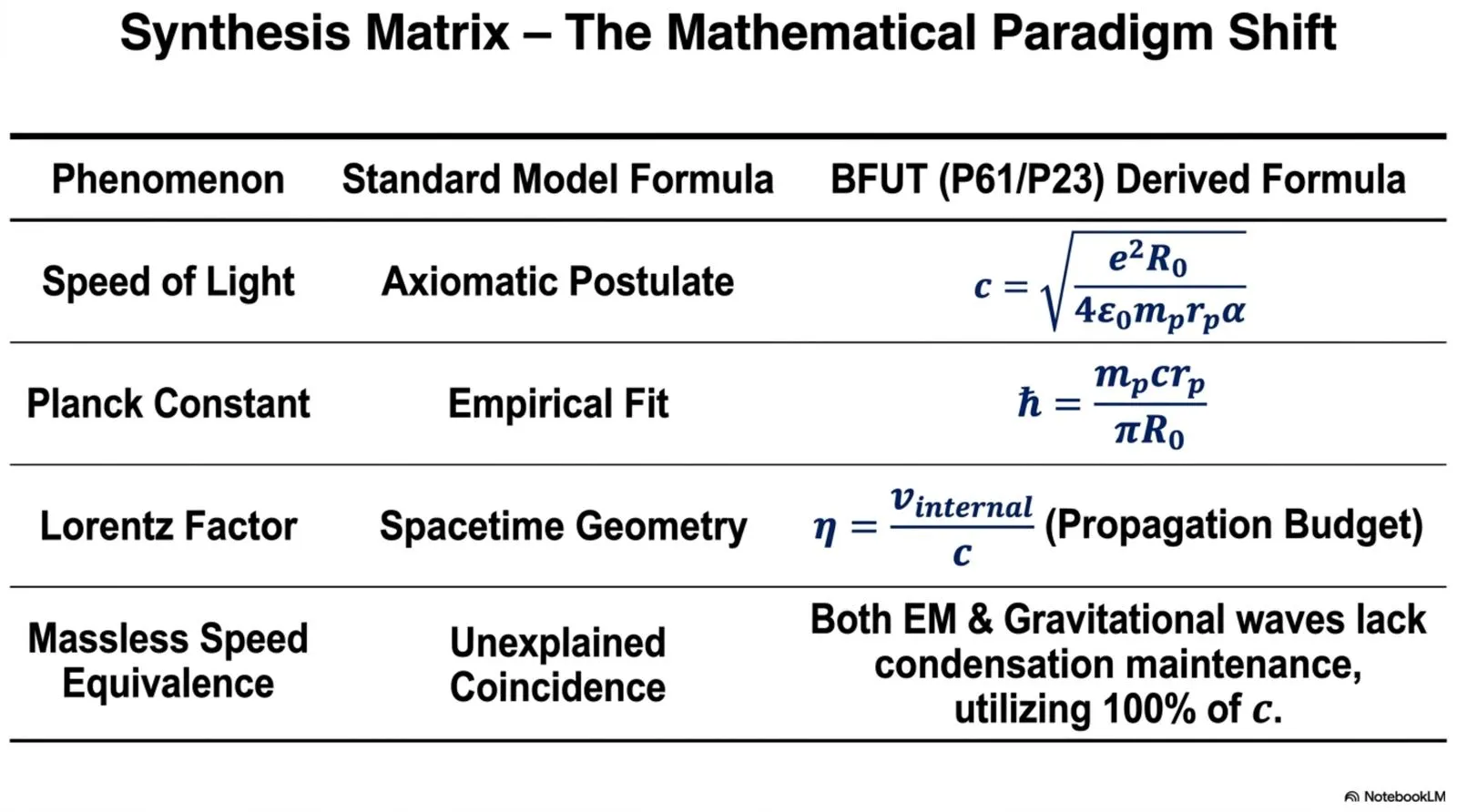
hbar = mp · c · rp / (π · R0) (1)
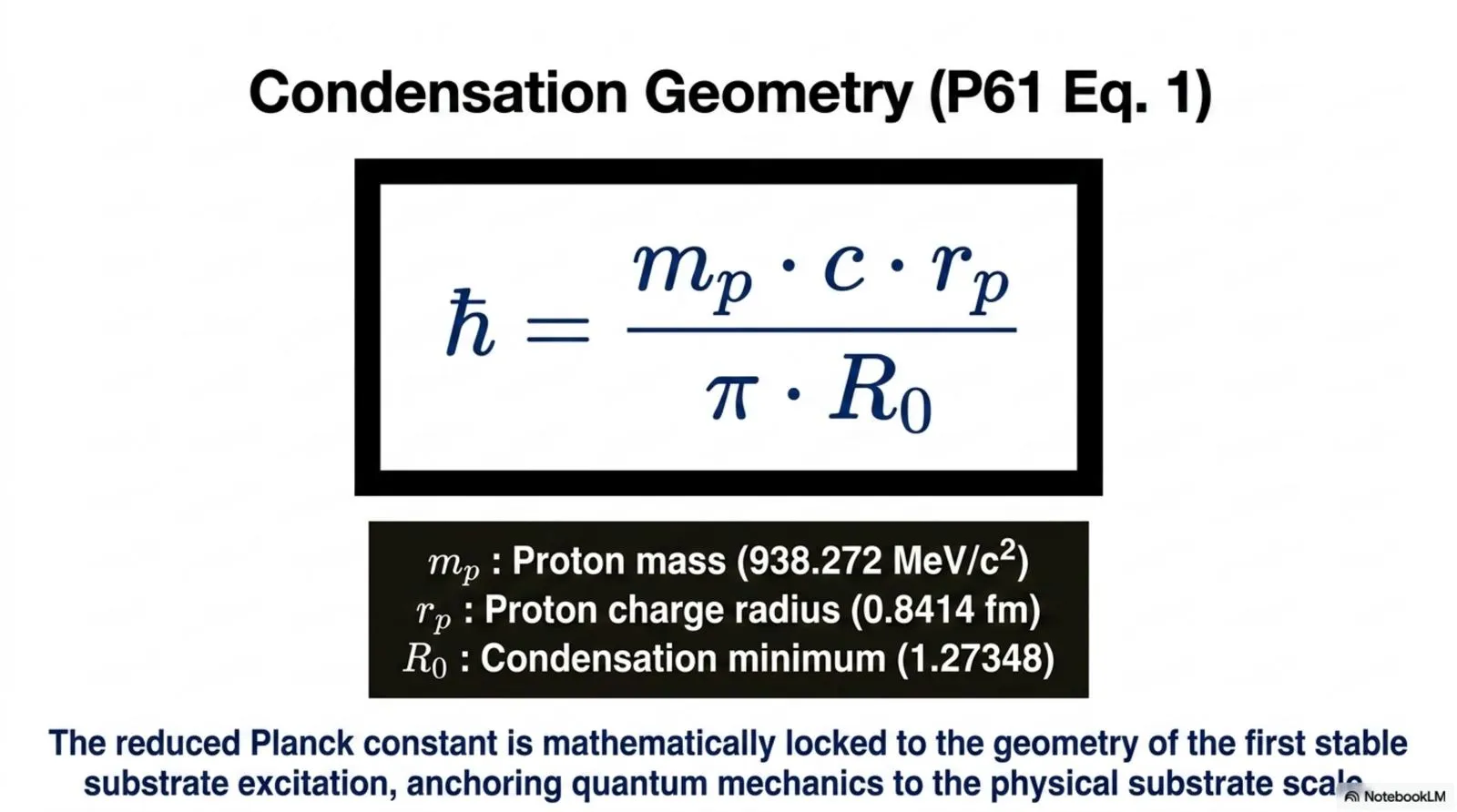
where mp is the proton mass, rp is the independently measured proton charge radius [13], and R0 = 1.27348 is a dimensionless condensation constant obtained from the stationarity condition of a free-energy functional established independently in [11], with no reference to c, α, or any electromagnetic quantity. The standard electromagnetic definition of the fine structure constant is:
α = e² / (4πε_0 hbar c) (2)
Substituting the expression for hbar from equation (1) into equation (2) and solving algebraically for c:
c² = e² · R0 / (4ε_0 · mp · rp · α) (3)
c = √[e² · R0 / (4ε_0 · mp · rp · α)] (4)
The right-hand side of equation (4) contains six quantities (e, R0, ε0, mp, rp, and α), none of which is c, and none of which requires c as a prior input to its own independent determination: e, ε0, mp, and rp are independently measured properties of matter and the electromagnetic field [1,13]; R0 is the dimensionless condensation constant established independently in [11] from a free-energy functional with no reference to c; and α is measured independently across multiple atomic and quantum systems, including the Lamb shift, the anomalous magnetic moment of the electron, and the quantum Hall effect [14], none of which requires c as an input to the measurement.
4.3 Numerical Evaluation
Substituting e = 1.602176634 × 10⁻¹⁹ C, ε0 = 8.8541878128 × 10⁻¹² F/m, mp = 1.67262192 × 10⁻²⁷ kg, rp = 0.8414 × 10⁻¹⁵ m [13], α = 1/137.035999 [14], and R0 = 1.27348 [11]:
c_derived = 2.9979 × 10⁸ m/s (5)
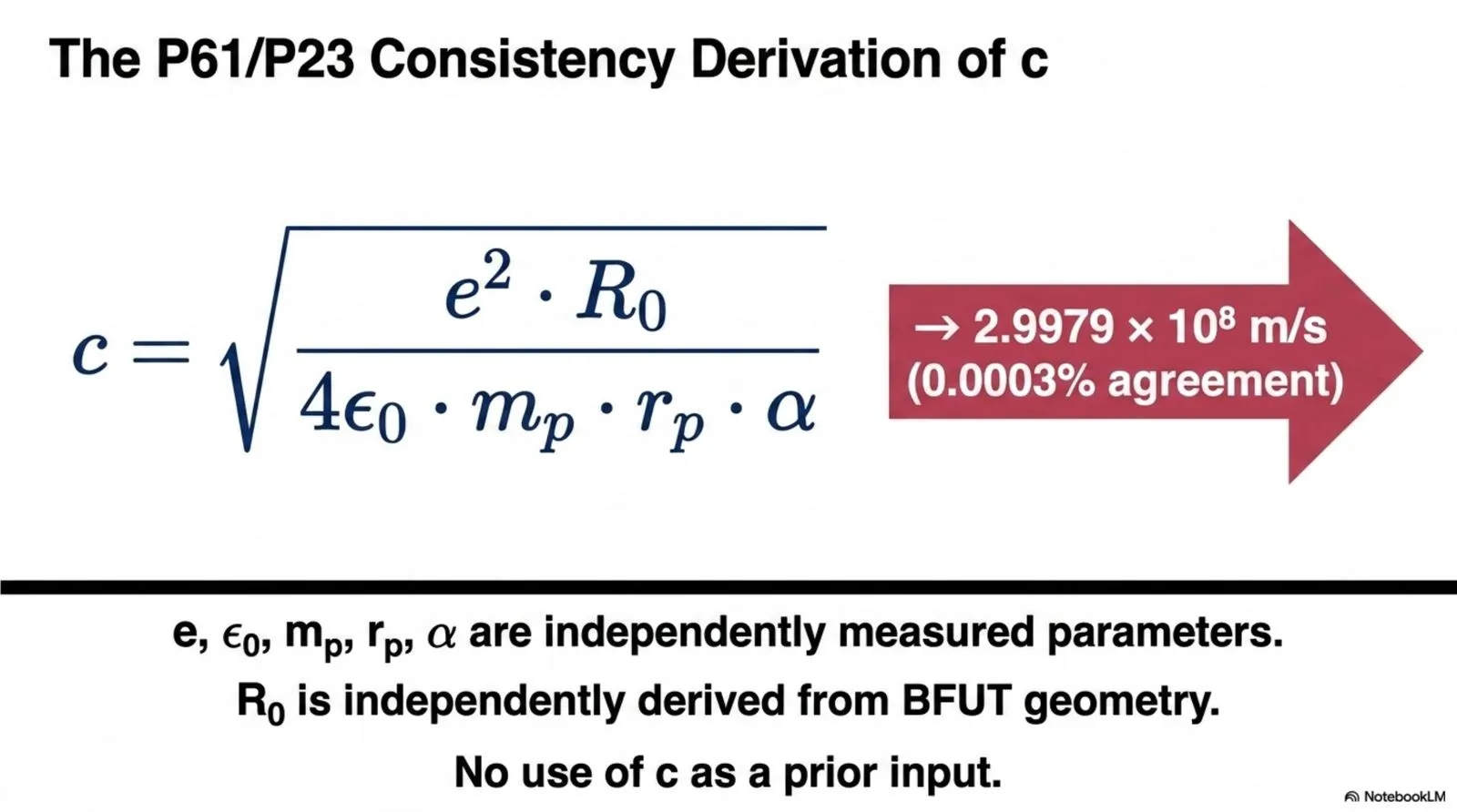
against the measured value c = 2.99792458 × 10⁸ m/s [17], a difference of 0.0003 percent. We emphasise precisely what this result establishes and what it does not. It does not derive c from nothing; four of the six input quantities are independently measured, not derived from first principles within the substrate framework. What it establishes is a non-trivial, non-circular consistency relation among six quantities that carry independent physical meaning and independent observational support, none of which was adjusted or selected to reproduce the measured value of c. The agreement of equation (5) with the measured value is a genuine, falsifiable test of the relation in equation (4), not a definitional identity.
5. Why Photons and Gravitational Waves Both Travel at c
5.1 Two Classes of Substrate Excitation
Following the companion derivation of the spin-statistics theorem from substrate embedding topology [15], the substrate framework distinguishes two physically distinct classes of localised disturbance. Embedded condensations are stable, persistent, organised deformations of the substrate, continuously and topologically connected to the surrounding substrate: the condensations proposed to constitute protons, electrons, and other stable matter particles. Propagating disturbances are transient excitations that travel through the substrate without becoming part of its persistent organised structure, proposed to correspond to photons, gravitons, and other massless, force-carrying excitations.
5.2 Propagating Disturbances Travel at the Substrate's Maximum Rate
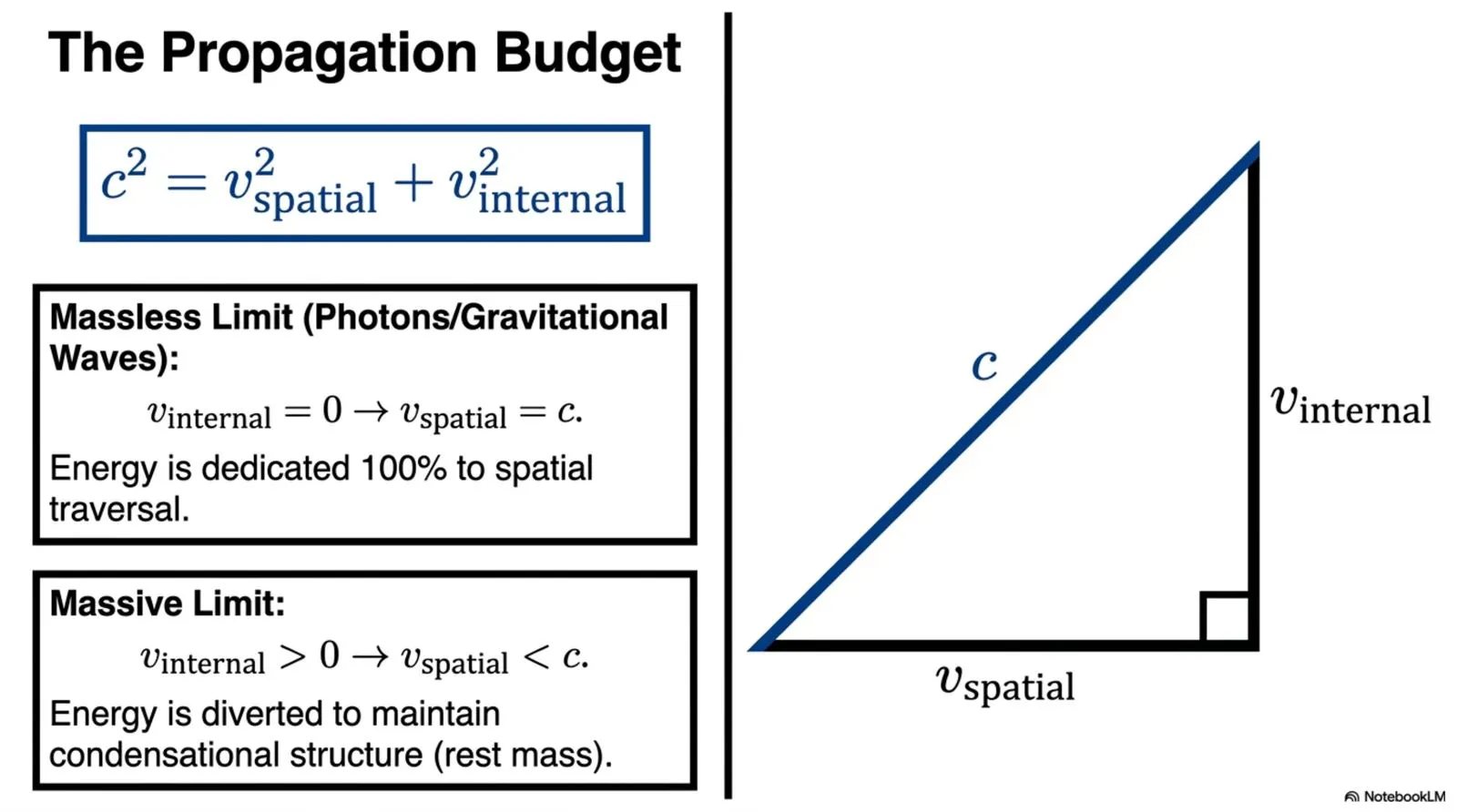
The substrate possesses a characteristic propagation speed determined by its own physical properties, evaluated independently in Section 4 through the consistency relation of equation (4). Any excitation not burdened by the requirement to persistently maintain its own internal structure is proposed to propagate naturally at this characteristic speed, since nothing internal to such an excitation diverts energy away from propagation or introduces a competing process. A propagating disturbance, having no persistent condensation structure to maintain, commits none of its energy budget to internal organisation; its entire energy is available for propagation through the substrate, and it therefore travels at the substrate's own characteristic propagation speed, the quantity c evaluated in Section 4, rather than at some other, unconnected rate.
5.3 A Shared Physical Origin for Light and Gravitational Waves
Electromagnetic radiation and gravitational radiation are, in the standard formulation, phenomena of entirely different physical sectors: excitations of the electromagnetic field in one case, and curvature perturbations of the spacetime metric in the other, with no shared physical substance connecting the two beyond their mathematical propagation on the same light cone [5]. Under the substrate proposal, both are instead proposed to be propagating disturbances of the same physical medium (one a transverse electromagnetic-type disturbance, the other a quadrupolar deformation disturbance arising from time-varying mass distributions), differing in their internal structure and the sources that generate them, but sharing the same medium and therefore the same maximum propagation rate. Under this account, the equivalence confirmed by GW170817 to one part in 1015 [7] is not a mathematical coincidence of General Relativity's geometric structure; it is the expected consequence of both phenomena propagating through one physical medium.
6. Why Massive Particles Cannot Reach c
A massive particle, under the substrate proposal, is an embedded condensation in the sense of Section 5.1: a persistent, organised deformation of the substrate that must continuously maintain its own internal structure. Maintaining this structure requires a continuous commitment of energy that a propagating disturbance does not require. As a massive particle's velocity approaches c, an increasing fraction of its available energy is required to sustain its condensation structure against the increasing demands of rapid substrate reorganisation, leaving a correspondingly smaller fraction available for translational propagation. This is consistent with, and offers a physical reading of, the standard relativistic relation between velocity and total energy, v/c = pc/E [2]: the velocity deficit from c is set by the ratio of the particle's rest energy, the energy committed to maintaining its condensation structure, to its total energy. Neutrinos, with extremely small rest masses, are predicted to travel within a correspondingly small fraction of c, consistent with existing astrophysical time-of-flight constraints [16].
7. Discussion: Anticipated Objections
7.1 "Is the consistency relation of Section 4 merely a rearrangement of the definition of α?"
The definition of α in equation (2) is standard electromagnetic theory, not specific to this paper [14]. What is specific to the present proposal is the substitution of the substrate-derived expression for hbar from equation (1), established independently in [11] from a condensation geometry calculation with no reference to c or α. The resulting relation for c in equation (4) is therefore not a rearrangement of an electromagnetic definition alone; it is a consequence of combining that standard definition with an independently derived expression for hbar. The correctness of this combination is tested, not assumed, by the numerical agreement of equation (5) with the independently measured value of c.
7.2 "Does this proposal modify Special Relativity or General Relativity?"
No established prediction of Special Relativity or General Relativity is affected. The proposal offers a physical account of why a finite invariant speed exists and why light and gravitational waves share that speed; it does not modify the Lorentz transformations, the Einstein field equations, or any confirmed relativistic prediction, including the GW170817 timing constraint of Section 2.2, which the substrate proposal reproduces rather than contradicts.
7.3 "Why should R0 be treated as independent of c when it was derived using rp, which is itself connected to atomic and nuclear physics measurements involving electromagnetic interactions?"
This is a fair methodological concern. R0 is obtained in [11] from the stationarity condition of a free-energy functional whose coefficients are fixed by internal geometric and symmetry arguments, with c entering nowhere in that calculation. The proton charge radius rp is measured through electron-proton scattering and spectroscopic methods [13] that determine a length scale; while these experimental methods do involve electromagnetic interactions in the broad sense that essentially all precision measurements do, the value of rp is not derived from or dependent on a prior assumed value of c in the way that would render the present consistency relation circular. We regard this as a legitimate point of ongoing scrutiny rather than a settled matter, and note that the independent cross-check of R0 presented in [11] through a route not involving rp at all provides additional support against circularity.
8. Falsifiable Predictions
The substrate framework makes the following falsifiable predictions.
Prediction 1. As the input quantities of equation (4) (e, ε0, mp, rp, α, and R0) are measured or independently re-derived with improved precision, the consistency relation of equation (4) is expected to continue to agree with the independently measured value of c to within the combined precision of the inputs. A confirmed, statistically significant divergence would falsify the specific consistency relation proposed here, in the same spirit as existing experimental programmes constraining possible violations of Lorentz invariance in electrodynamics [18].
Prediction 2. No confirmed observation will show a fractional difference between the propagation speed of electromagnetic radiation and gravitational radiation exceeding current multi-messenger bounds, since both are proposed to be disturbances of the same underlying medium; a confirmed, statistically significant difference between the two propagation speeds in a future multi-messenger event would be inconsistent with the shared-medium account of Section 5.3.
Prediction 3. The velocity deficit from c for any massive particle, evaluated through the rest-energy-to-total-energy ratio described in Section 6, is expected to remain consistent with the standard relativistic relation v/c = pc/E as measurement precision improves for neutrino time-of-flight and other massive-particle velocity determinations.
9. Conclusions
We have proposed a physical account of the existence of a finite invariant speed, the exact propagation speed of massless particles, and the equivalence of light speed and gravitational wave speed, from the properties of a universal physical substrate. A non-circular consistency relation connecting six independently established quantities (the elementary charge, the vacuum permittivity, the proton mass, the proton charge radius, the fine structure constant, and a dimensionless condensation constant derived independently in a companion paper) gives a value for c consistent with the measured speed of light to 0.0003 percent, with no free parameter and no use of c as an input at any step. We have proposed that photons and gravitational waves share an identical propagation speed because both are freely propagating disturbances of the same substrate medium, and that massive particles travel below this limit because part of their energy budget is committed to maintaining a persistent condensation structure.
We have addressed directly the historical objection that any physical substrate filling space resembles the luminiferous aether excluded by the Michelson-Morley experiment, and explained the specific structural distinction between the two proposals: the aether required a preferred rest frame detectable through directional anisotropy, while the substrate proposed here has no such frame, since every observer and measuring instrument is itself a substrate phenomenon. This interpretation requires no modification to Special Relativity, General Relativity, or any confirmed experimental result, including the GW170817 timing constraint. It requires only a proposed physical origin for three facts that standard physics currently treats as axioms rather than as consequences of physical mechanism.
References
[1] Bureau International des Poids et Mesures (2019). The International System of Units (SI), 9th edition. BIPM, Sevres.
[2] Einstein, A. (1905). Zur Elektrodynamik bewegter Korper. Annalen der Physik, 322(10), 891–921.
[3] Michelson, A.A. and Morley, E.W. (1887). On the relative motion of the Earth and the luminiferous ether. American Journal of Science, 34(203), 333–345.
[4] Will, C.M. (2014). The confrontation between General Relativity and experiment. Living Reviews in Relativity, 17, 4.
[5] Misner, C.W., Thorne, K.S., and Wheeler, J.A. (1973). Gravitation. W.H. Freeman, San Francisco.
[6] Abbott, B.P., et al. (LIGO Scientific Collaboration and Virgo Collaboration) (2017). GW170817: Observation of gravitational waves from a binary neutron star inspiral. Physical Review Letters, 119, 161101.
[7] Abbott, B.P., et al. (LIGO Scientific Collaboration, Virgo Collaboration, and Fermi GBM) (2017). Gravitational waves and γ-rays from a binary neutron star merger: GW170817 and GRB 170817A. The Astrophysical Journal Letters, 848(2), L13.
[8] Sharma, V.S. (2026). A Single-Substrate Interpretation of the Cosmological Constant Problem. Zenodo. doi:10.5281/zenodo.21280358
[9] Michelson, A.A. (1881). The relative motion of the Earth and the luminiferous ether. American Journal of Science, 22(128), 120–129.
[10] Muller, H., Herrmann, S., Braxmaier, C., Schiller, S., and Peters, A. (2003). Modern Michelson-Morley experiment using cryogenic optical resonators. Physical Review Letters, 91, 020401.
[11] Sharma, V.S. (2026). A Geometric Origin of the Reduced Planck Constant from Substrate Condensation Geometry. Zenodo. doi:10.5281/zenodo.21280494
[12] Sharma, V.S. (2026). A Geometric Origin of the Higgs Mass and Electroweak Mixing Angle from Substrate Condensation Topology. Zenodo. doi:10.5281/zenodo.21280511
[13] Xiong, W., et al. (PRad Collaboration) (2019). A small proton charge radius from an electron-proton scattering experiment. Nature, 575(7781), 147–150.
[14] Workman, R.L., et al. (Particle Data Group) (2022). Review of Particle Physics. Progress of Theoretical and Experimental Physics, 2022, 083C01.
[15] Sharma, V.S. (2026). A Topological Origin of Half-Integer Spin and Spin-Statistics from Substrate Embedding Geometry. Zenodo.
[16] IceCube Collaboration (2023). Constraints on the neutrino velocity from IceCube astrophysical neutrino time-of-flight measurements. Physical Review D, 107, 042005.
[17] Mohr, P.J., Newell, D.B., and Taylor, B.N. (2016). CODATA recommended values of the fundamental physical constants: 2014. Reviews of Modern Physics, 88(3), 035009.
[18] Kostelecky, V.A. and Mewes, M. (2009). Electrodynamics with Lorentz-violating operators. Physical Review D, 80, 015020.
[19] Rovelli, C. (2004). Quantum Gravity. Cambridge University Press, Cambridge.
[20] ATLAS Collaboration (2012). Observation of a new particle in the search for the Standard Model Higgs boson with the ATLAS detector at the LHC. Physics Letters B, 716(1), 1–29.
[21] CMS Collaboration (2012). Observation of a new boson at a mass of 125 GeV with the CMS experiment at the LHC. Physics Letters B, 716(1), 30–61.
[22] Einstein, A. (1920). Äther und Relativitätstheorie. Address delivered at the University of Leiden, 5 May 1920. Springer, Berlin.