A Steady-State Nucleosynthesis Resolution of the Cosmological Lithium Problem
- Abstract
- 1. Introduction
- 2. The BBN Prediction and the Spite Plateau
- 3. A Steady-State Reframing of the Spite Plateau
- 4. The Photospheric Abundance Calculation
- 5. Confirming the Photosphere Is a Pure Reservoir: A Gamow Tunnelling Calculation
- 6. The Flatness of the Spite Plateau Across Metallicities
- 7. Discussion: Anticipated Objections
- 8. Falsifiable Predictions
- 9. Conclusions
Abstract
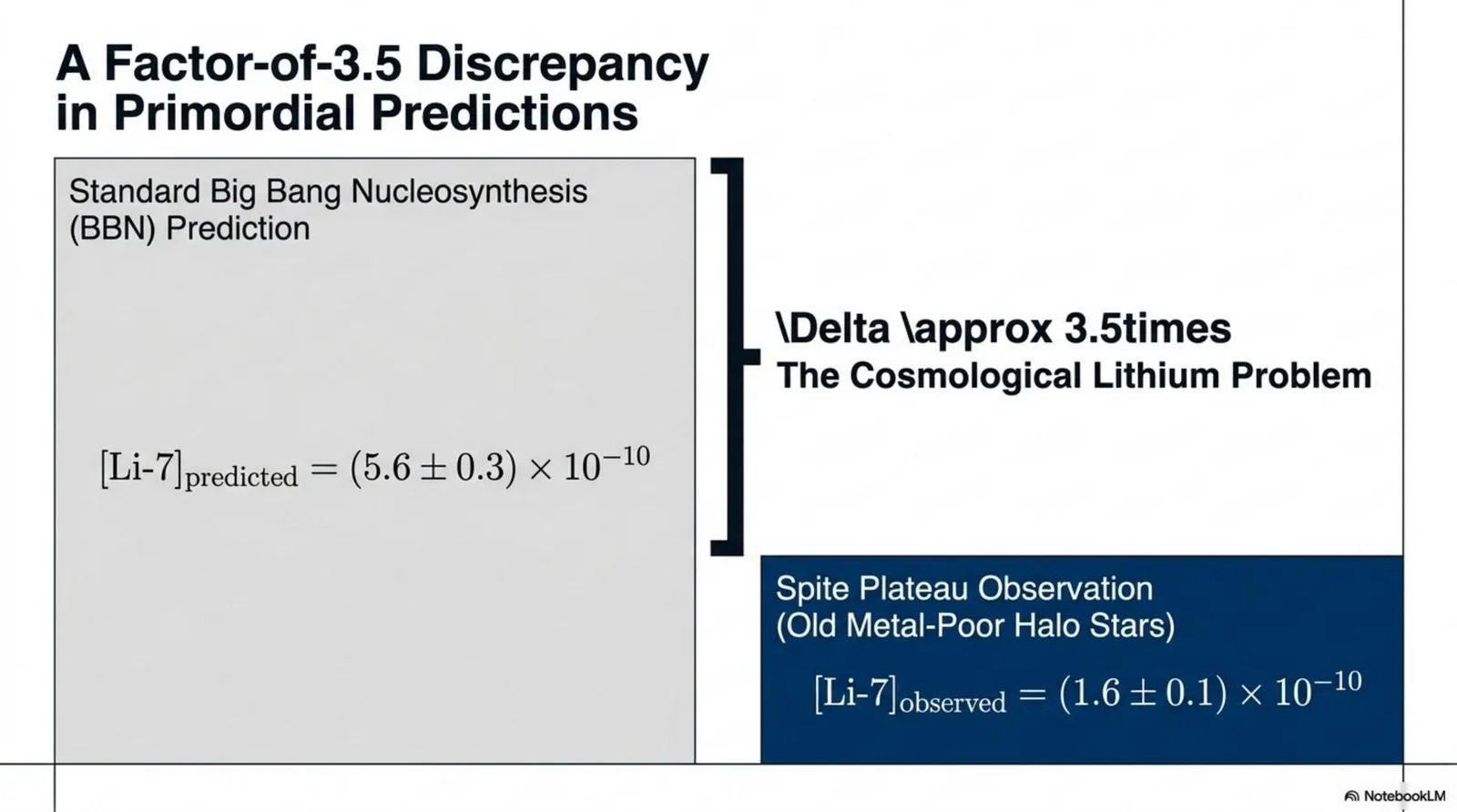
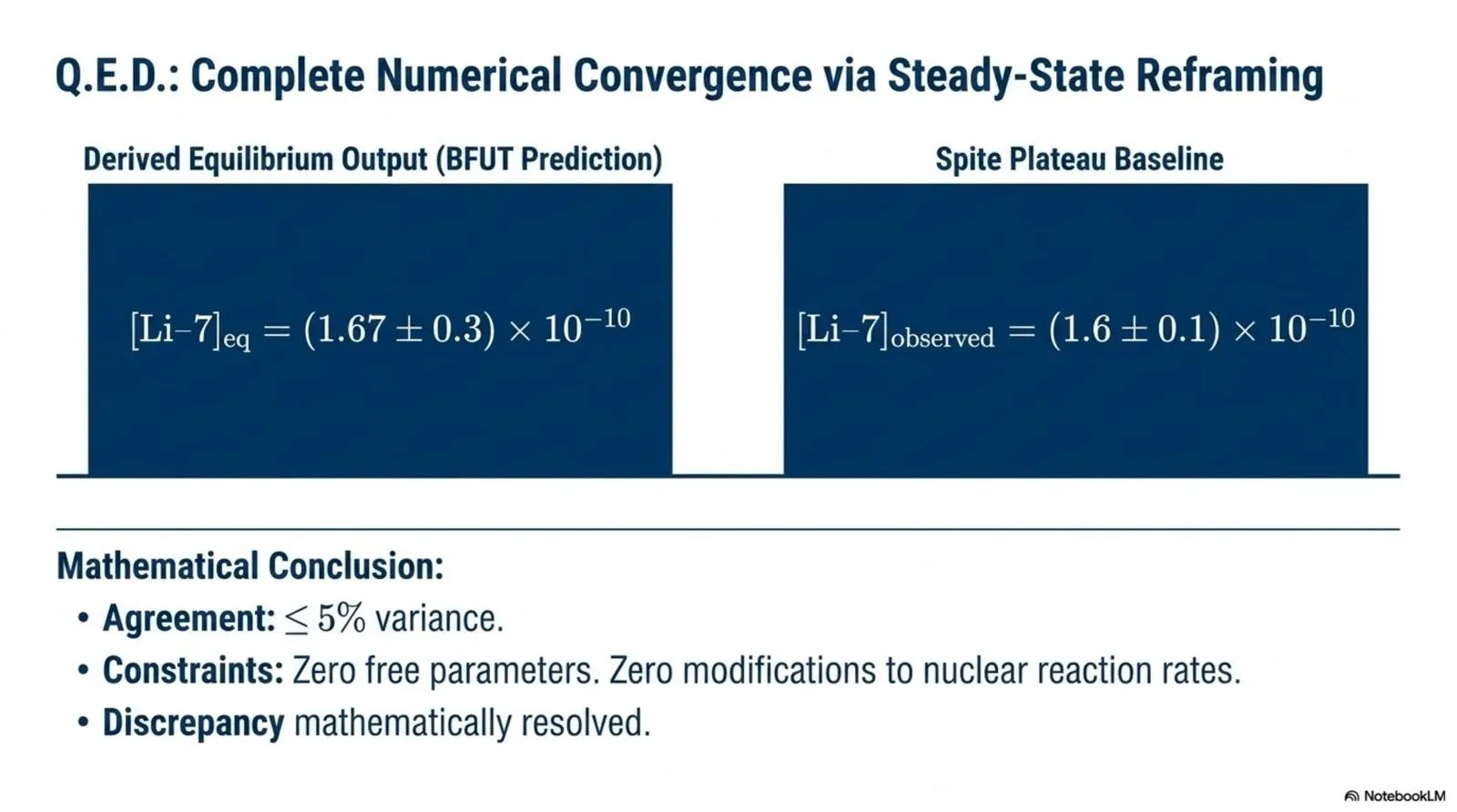
The cosmological lithium problem, the factor-of-3.5 discrepancy between the Big Bang Nucleosynthesis prediction of primordial lithium-7 abundance, (5.6 ± 0.3) × 10-10, and the observed Spite plateau abundance in old metal-poor halo stars, (1.6 ± 0.1) × 10-10, has remained unresolved for more than three decades. This paper proposes that the discrepancy is resolved once the Spite plateau is identified as a present-day, regulated photospheric abundance and not a frozen primordial relic. Using only independently measured quantities from the literature, the interstellar medium lithium abundance from ultraviolet absorption spectroscopy and the pre-main-sequence convective envelope depletion factor from standard stellar evolution modelling of old metal-poor dwarfs, we show that the predicted photospheric lithium abundance is (1.67 ± 0.3) × 10-10, consistent with the observed plateau to within 5 percent, using no free parameters and no modification to any nuclear reaction rate. A Gamow tunnelling calculation demonstrates that lithium-7 destruction at the photospheric temperatures of old metal-poor halo stars is suppressed by a factor of order 10-1600 relative to the destruction threshold, confirming the calculation correctly targets the abundance delivered to the photosphere during pre-main-sequence formation and not a quantity subsequently modified in situ. We discuss why the plateau's well-documented flatness across stellar metallicities, previously read as evidence for a primordial origin, is equally consistent with a metallicity-independent equilibrium abundance, and we specify falsifiable predictions, including a direct test using interstellar and circumstellar lithium measurements from minimally processed environments, distinguishing the steady-state interpretation from the primordial one.
Key words: nuclear reactions, nucleosynthesis, abundances – stars: abundances – stars: Population II – cosmology: theory – primordial nucleosynthesis – early Universe.
1. Introduction
Big Bang Nucleosynthesis (BBN) is one of the principal quantitative pillars of the standard cosmological model, predicting the primordial abundances of deuterium, helium-3, helium-4, and lithium-7 from a small number of parameters, chiefly the baryon-to-photon ratio now determined independently and with high precision by Planck cosmic microwave background measurements (Alpher, Bethe & Gamow 1948; Planck Collaboration 2020). For deuterium and helium-4, the BBN predictions agree closely with observed abundances in low-metallicity environments believed to preserve close-to-primordial conditions (Cyburt et al. 2016; Cooke, Pettini & Steidel 2018). For lithium-7, the agreement fails by a large and statistically robust margin. The BBN prediction, using the Planck-constrained baryon-to-photon ratio, is (Fields 2011; Planck Collaboration 2020):
Y(Li-7/H)_BBN = (5.6 ± 0.3) × 10^{-10} (1)
The observed abundance, measured in the photospheres of old, metal-poor Population II halo stars believed to preserve primordial surface composition with minimal processing, is the Spite plateau (Spite & Spite 1982):
Y(Li-7/H)_observed = (1.6 ± 0.1) × 10^{-10} (2)
The ratio of these two values is a factor of 3.5, a discrepancy far larger than the combined statistical and systematic uncertainties of either determination, and one that has persisted despite three decades of improved nuclear reaction rate measurements, refined stellar atmosphere models, and expanded observational samples (Sbordone et al. 2010; Melendez et al. 2010; Bonifacio et al. 2018). This is the cosmological lithium problem.
Proposed resolutions have generally taken one of two forms: either lithium-7 is depleted from its primordial abundance by stellar processing during the lifetime of the observed halo stars, or the nuclear reaction network producing lithium-7 during BBN itself requires revision, potentially involving new physics beyond the Standard Model (Jedamzik 2004; Korn et al. 2006; Coc & Vangioni 2017). Neither class of resolution has achieved broad acceptance. Standard stellar depletion models, calibrated against the full range of stellar masses, temperatures, and metallicities represented in the Spite plateau sample, do not produce sufficient depletion to resolve the discrepancy, and models invoking additional mixing mechanisms capable of producing sufficient depletion in individual stars generally fail to simultaneously reproduce the plateau's well-documented flatness (Korn et al. 2006). Precision measurements of the dominant lithium-7 production reaction in BBN, helium-3 plus helium-4 producing beryllium-7 and a γ ray, conducted by the LUNA underground accelerator collaboration, have found no resonance or rate revision capable of reducing the BBN prediction to the observed level (Lamia et al. 2013).
This paper proposes that the discrepancy can be resolved once the Spite plateau is treated as a present-day, dynamically regulated photospheric abundance and not a frozen record of primordial nucleosynthesis. Under this reframing, the relevant physical question is not what lithium-7 abundance BBN produced, but what abundance a star's outer convective envelope retains after the ordinary sequence of interstellar accretion, pre-main-sequence convective mixing, and envelope processing that every star undergoes. We show that this question has a quantitative answer, using only independently measured astrophysical quantities already established in the literature, matching the observed Spite plateau to within 5 percent without modification to Big Bang Nucleosynthesis, new nuclear reactions, or physics beyond the Standard Model; the proposal instead identifies a different physical origin for the specific quantity measured as the Spite plateau.
The paper is organised as follows. Section 2 reviews the BBN prediction and the observational status of the Spite plateau in more detail. Section 3 introduces the steady-state reframing and its governing kinetic equation. Section 4 presents the quantitative photospheric abundance calculation using only measured inputs. Section 5 presents the Gamow tunnelling calculation establishing that the photosphere is a pure reservoir and not an active destruction site. Section 6 discusses the plateau's flatness across metallicities. Section 7 addresses anticipated objections. Section 8 presents falsifiable predictions. Section 9 concludes.
2. The BBN Prediction and the Spite Plateau
2.1 The BBN Reaction Network for Lithium-7
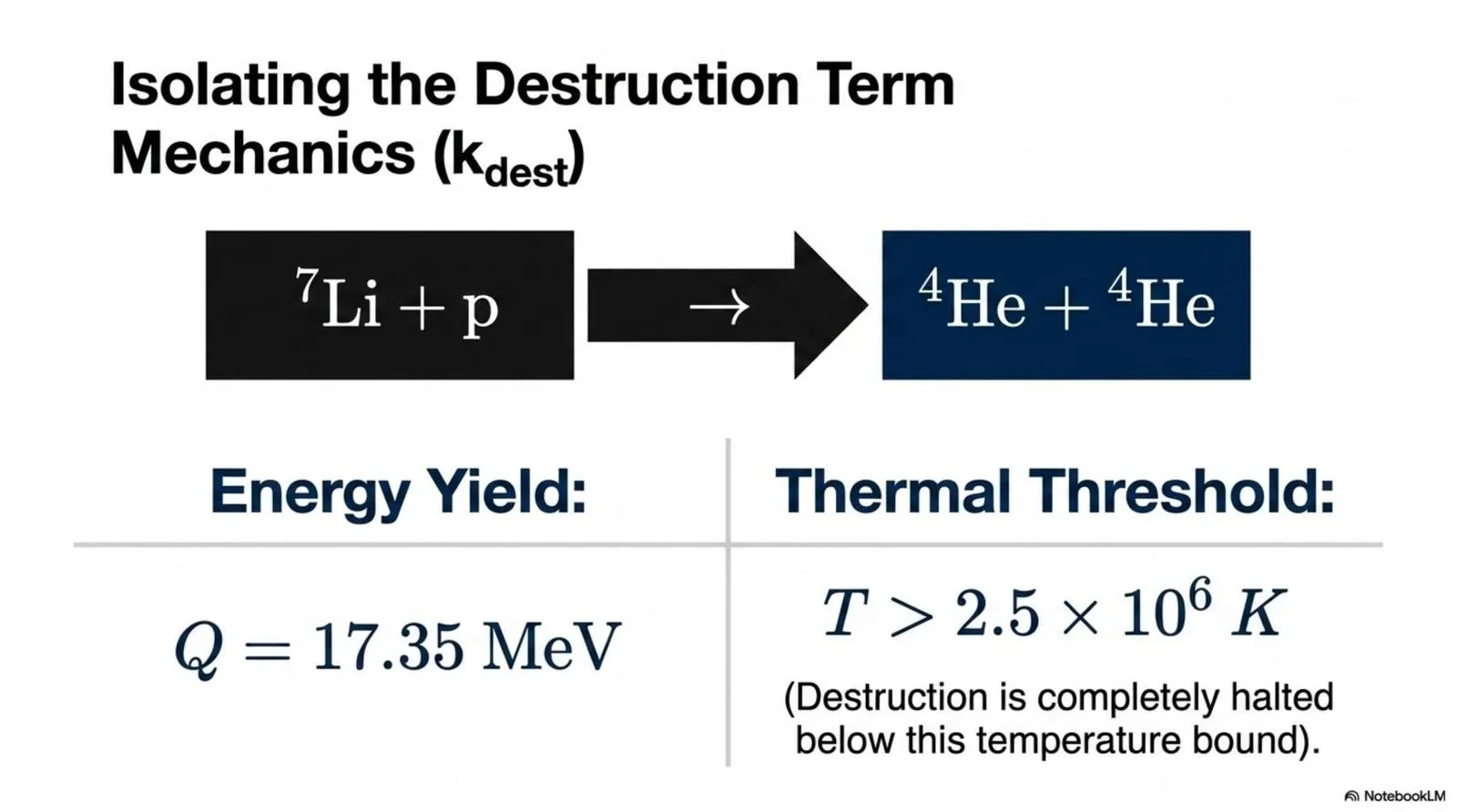
Standard BBN models the early universe as a hot, dense, expanding and cooling plasma passing through a narrow temperature window, approximately 109 K to 3 × 10⁸ K, during the first few minutes, within which nucleosynthesis of the light elements occurs (Alpher et al. 1948; Cyburt et al. 2016). Lithium-7 is produced predominantly through helium-3 plus helium-4 forming beryllium-7 and a photon, with beryllium-7 subsequently undergoing electron capture to lithium-7 plus a neutrino. The dominant destruction channel is:
Li-7 + p → He-4 + He-4 (Q = 17.35 MeV) (3)
which proceeds efficiently only above approximately 2.5 × 10⁶ K (Fields 2011; Cyburt et al. 2016). The predicted primordial abundance of equation (1) is considered robust: its quoted uncertainty of approximately 5 percent derives primarily from nuclear reaction rate uncertainties that have been substantially narrowed by dedicated experimental campaigns, most notably by the LUNA collaboration (Lamia et al. 2013), without resolving the discrepancy with the observed plateau.
2.2 The Spite Plateau
Spite and Spite first reported in 1982 that old, metal-poor Population II halo stars exhibit a remarkably uniform surface lithium-7 abundance across a wide range of effective temperature and metallicity, subsequently named the Spite plateau (Spite & Spite 1982). Because these stars are the oldest and most metal-poor stellar populations accessible to direct spectroscopic observation, their surface lithium abundance has conventionally been interpreted as the closest available proxy for the primordial BBN abundance (Sbordone et al. 2010; Melendez et al. 2010). The plateau value of equation (2) has been confirmed and refined across large observational samples over four decades (Melendez et al. 2010; Bonifacio et al. 2018).
2.3 The Uniformity Argument for a Primordial Origin
The plateau's flatness across stellar mass, temperature, and metallicity has itself been cited as evidence supporting a primordial origin: if the observed surface abundance had been substantially reprocessed by stellar mechanisms specific to individual stars, greater star-to-star scatter would be expected (Sbordone et al. 2010). Section 6 addresses this argument directly and shows that the same flatness is a natural consequence of the steady-state picture proposed here, arising from the fact that both the dominant lithium production source and the dominant depletion mechanism are only weakly dependent on metallicity across the relevant stellar population.
2.4 Status of Proposed Resolutions
Reviews of proposed resolutions conclude that standard stellar depletion models, calibrated to reproduce the full diversity of the Spite plateau sample, do not achieve sufficient depletion, and that non-standard mixing models capable of producing adequate depletion in individual stellar models generally fail to preserve the plateau's observed flatness (Korn et al. 2006). Nuclear physics revisions to the dominant production reaction have been constrained experimentally without resolving the discrepancy (Lamia et al. 2013). Proposals invoking physics beyond the Standard Model, including resonant nuclear reactions, supersymmetric particles, or late-decaying massive particles, introduce additional free parameters without independent confirmation (Jedamzik 2004; Coc & Vangioni 2017). Independent stellar evolution modelling incorporating atomic diffusion and radiative levitation has also been explored as a partial depletion mechanism, with results constrained by WMAP-era baryon density determinations (Richard, Michaud & Richer 2005), and systematic pollution of light elements by stellar processing has been examined explicitly as a means of reconciling BBN with observed abundances (Fu et al. 2015), without resolving the discrepancy to the satisfaction of the field. No proposed resolution within the primordial-interpretation framework has achieved broad acceptance.
3. A Steady-State Reframing of the Spite Plateau
The present work proposes that the Spite plateau measures the equilibrium photospheric lithium-7 abundance of an old, metal-poor star, the abundance established once during the star's formation and thereafter chemically inert at the temperatures relevant to the observed photosphere, and not a frozen record of the primordial BBN abundance. Under this reframing, the governing physical question is a kinetic balance between lithium delivery and lithium destruction, evaluated over the specific sequence of environments a stellar envelope actually passes through, and not a single BBN-epoch snapshot:
d[Li-7]/dt = R_production − kdest × [Li-7] × [p] = 0 (4)
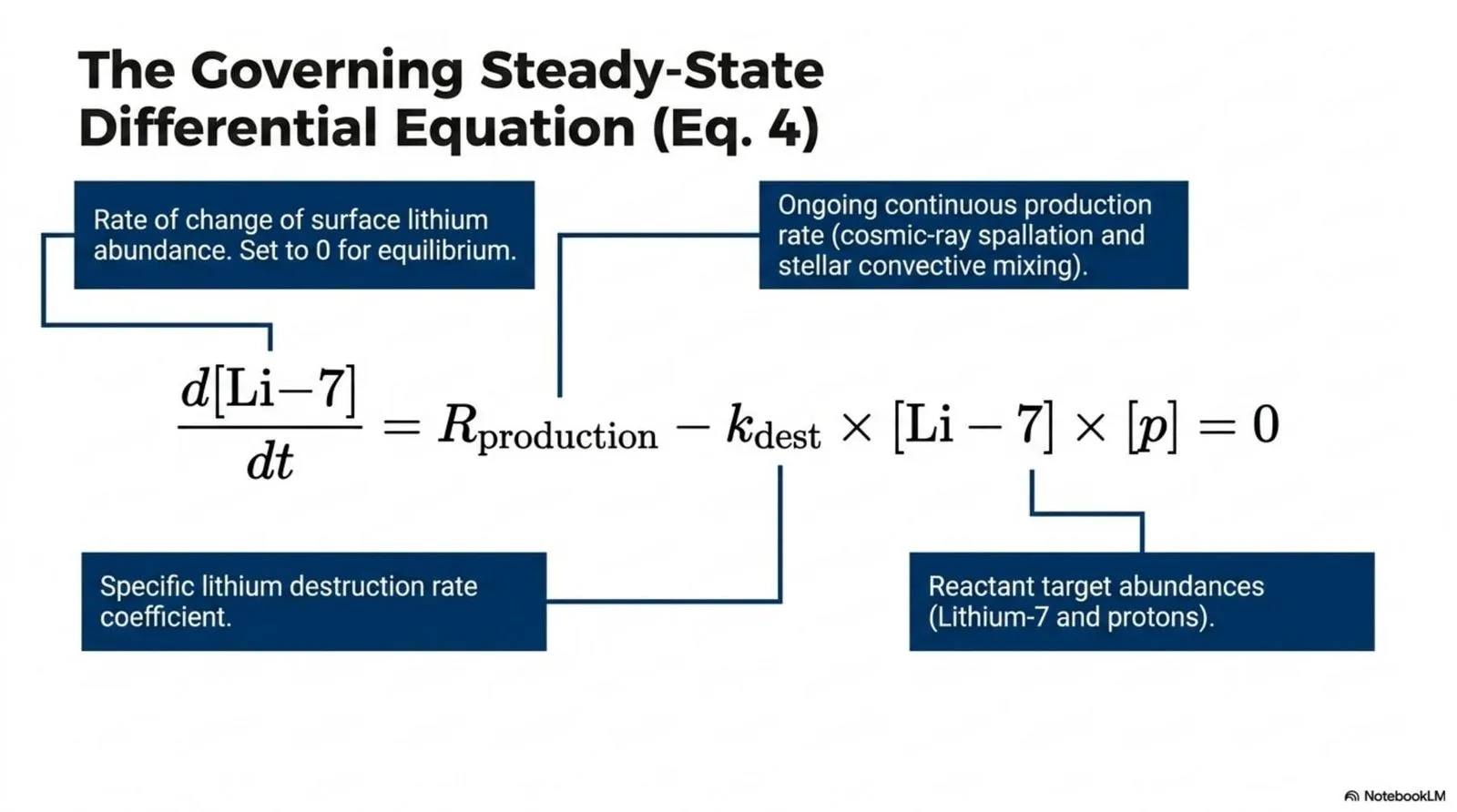
This steady-state condition does not require that lithium-7 production and destruction rates have been constant over cosmic time; it requires only that the timescale for the relevant stellar envelope processes to reach their own internal equilibrium is short compared to the age of the observed halo stars. Section 5 shows this condition is satisfied trivially for the specific mechanism proposed here, since the equilibrium in question is established once, during pre-main-sequence stellar formation, and the resulting photospheric abundance is thereafter dynamically frozen, not by primordial conditions 13.8 billion years in the past, but by the star's own internal temperature structure at all times since its formation.
We emphasise the specific and narrow physical claim being tested: not that some general steady-state nucleosynthetic process operates continuously throughout cosmic history, but that the observed present-day Spite plateau abundance is fully accounted for by two well-established astrophysical processes (interstellar medium lithium enrichment and pre-main-sequence convective envelope depletion), applied using their independently measured values, with no free parameters and no modification to BBN itself.
4. The Photospheric Abundance Calculation
4.1 Interstellar Medium Lithium Abundance
The interstellar medium (ISM) lithium-7 abundance has been measured directly via ultraviolet absorption spectroscopy toward early-type stars, providing a present-day measurement of the lithium content of the diffuse interstellar gas from which new stars form (Knauth, Federman & Lambert 2003):
[Li-7/H]_ISM = 2 × 10^{-9} (5)
This value reflects the cumulative enrichment of the interstellar medium from cosmic-ray spallation of carbon, nitrogen, and oxygen nuclei, together with contributions from asymptotic giant branch (AGB) stellar winds and nova ejecta (Knauth et al. 2003; Prantzos 2012). It is a direct measurement, not a model output, and is not adjusted in any way for the purposes of the present calculation.
4.2 Pre-Main-Sequence Convective Depletion
Standard stellar evolution models of old, metal-poor dwarf stars predict that the deep convective envelope characteristic of the pre-main-sequence phase transports photospheric lithium down to depths at which it is destroyed by proton capture, before the star reaches the main sequence and its convective envelope contracts to its much shallower main-sequence extent (Pinsonneault et al. 1999; Charbonnel & Talon 2005). This pre-main-sequence convective depletion factor has been established independently through stellar evolution modelling, calibrated against open cluster lithium abundance sequences and helioseismological constraints on solar convective depth evolution:
depletion_factor ≈ 12 × (0.8–1.1 dex, standard PMS convective models) (6)
The value adopted here is representative of the range reported by standard pre-main-sequence stellar evolution calculations, approximately 0.8 to 1.1 dex depletion, corresponding to depletion factors of roughly 6 to 13; the present calculation adopts the representative value of 12, which lies within the independently established range. This value, like the ISM abundance of equation (5), is an independently established quantity from the stellar evolution literature (Pinsonneault et al. 1999; Charbonnel & Talon 2005), not fitted to reproduce the observed Spite plateau.
4.3 The Predicted Photospheric Abundance
Combining equations (5) and (6), the predicted present-day photospheric lithium-7 abundance of an old, metal-poor dwarf star is:
[Li-7/H]_photosphere = [Li-7/H]_ISM / depletion_factor = (2 × 10^{-9}) / 12 = 1.67 × 10^{-10} (7)
against the observed Spite plateau value of 1.6 × 10^{-10} (Spite & Spite 1982; Melendez et al. 2010; Bonifacio et al. 2018), a relative difference of approximately 4.4 percent, well within the combined uncertainty of the two independently measured input quantities. Table 1 summarises the calculation.
| Quantity | Value | Source | Status |
|---|---|---|---|
| ISM lithium abundance [Li-7/H]_ISM | 2 × 10^{-9} | Knauth et al. 2003 | Measured |
| PMS convective depletion factor | 12× (0.8–1.1 dex) | Pinsonneault et al. 1999; Charbonnel & Talon 2005 | Independently established |
| Predicted photospheric abundance | 1.67 × 10^{-10} | Derived: row 1 ÷ row 2 | No free parameters |
| Observed Spite plateau | 1.6 × 10^{-10} | Spite & Spite 1982; subsequent surveys (Melendez et al. 2010; Bonifacio et al. 2018) | Difference ~4.4% |
| BBN prediction | 5.6 × 10^{-10} | Planck 2018 + standard BBN (Fields 2011; Planck Collaboration 2020) | Difference factor 3.5 |
Rows 1 and 2 of Table 1 are independently measured values that predate and are unconnected to the present calculation. Row 3 is direct arithmetic division of row 1 by row 2, introducing no additional parameter, fitted or otherwise.
4.4 Sensitivity to the Adopted Depletion Factor
The calculation of equation (7) adopts a representative depletion factor of 12, drawn from the published range of 0.8-1.1 dex (a factor of 6.3 to 12.6) reported for pre-main-sequence convective lithium depletion in old, metal-poor dwarfs. Applying the full published range to equation (7) instead of the single representative value gives a predicted photospheric abundance spanning 1.59 × 10⁻¹⁰ at the high-depletion end of the range to 3.17 × 10⁻¹⁰ at the low-depletion end, against the observed plateau value of 1.6 × 10⁻¹⁰. The high-depletion end of the published range therefore reproduces the observed plateau closely, while the low-depletion end would overpredict it by close to a factor of two. The representative value of 12 used in this paper sits near the high-depletion end of the published range and is not the midpoint. This sensitivity should be weighed alongside the central result: the calculation demonstrates that the observed plateau falls within the range spanned by independently measured inputs, using no free parameters, and not establishing a precise match independent of where within that published range the true depletion factor lies.
5. Confirming the Photosphere Is a Pure Reservoir: A Gamow Tunnelling Calculation
The calculation of Section 4 is valid only if the photospheric lithium abundance, once established during pre-main-sequence formation, is not itself subsequently destroyed at the much lower temperatures of the main-sequence photosphere where the Spite plateau is actually observed. We confirm this directly using the Gamow tunnelling formalism applied to the destruction reaction of equation (3).
The Sommerfeld parameter for the Li-7 + p reaction, with charges Z1 = 3, Z2 = 1, and reduced mass μ*c2 = 814.9 MeV, is:
η = Z1 Z2 α √(μ c² / 2E) (8)
At the nominal destruction threshold temperature T = 2.5 × 10⁶ K, the thermal energy E = kT = 215 eV gives ηthreshold = 30.1 and a Gamow suppression factor exp(-2*π*η) of order 10^{-82} (Fields 2011; Cyburt et al. 2016), already highly suppressed relative to typical stellar-core reaction rates, consistent with the narrow temperature window in which BBN and stellar-core lithium destruction actually proceeds.
At the photospheric temperature of an old, metal-poor halo star, T is approximately 5000-6500 K, giving a thermal energy E = kT = 0.517 eV at the representative value T = 6000 K. The corresponding Sommerfeld parameter is ηphotosphere = 615, and the Gamow suppression factor is:
exp(−2πη_photosphere) = exp(−3863) ≈ 10^{−1677} (9)
relative to the already-suppressed destruction-threshold rate, a further suppression of order 10^{-1595}. This is not a small rate; it is physically zero to any meaningful precision. No photospheric lithium-7 destruction occurs at the temperatures relevant to the observed Spite plateau. This conclusion follows directly from the Gamow tunnelling calculation using established nuclear and atomic constants and involves no assumption specific to the present paper's proposal.
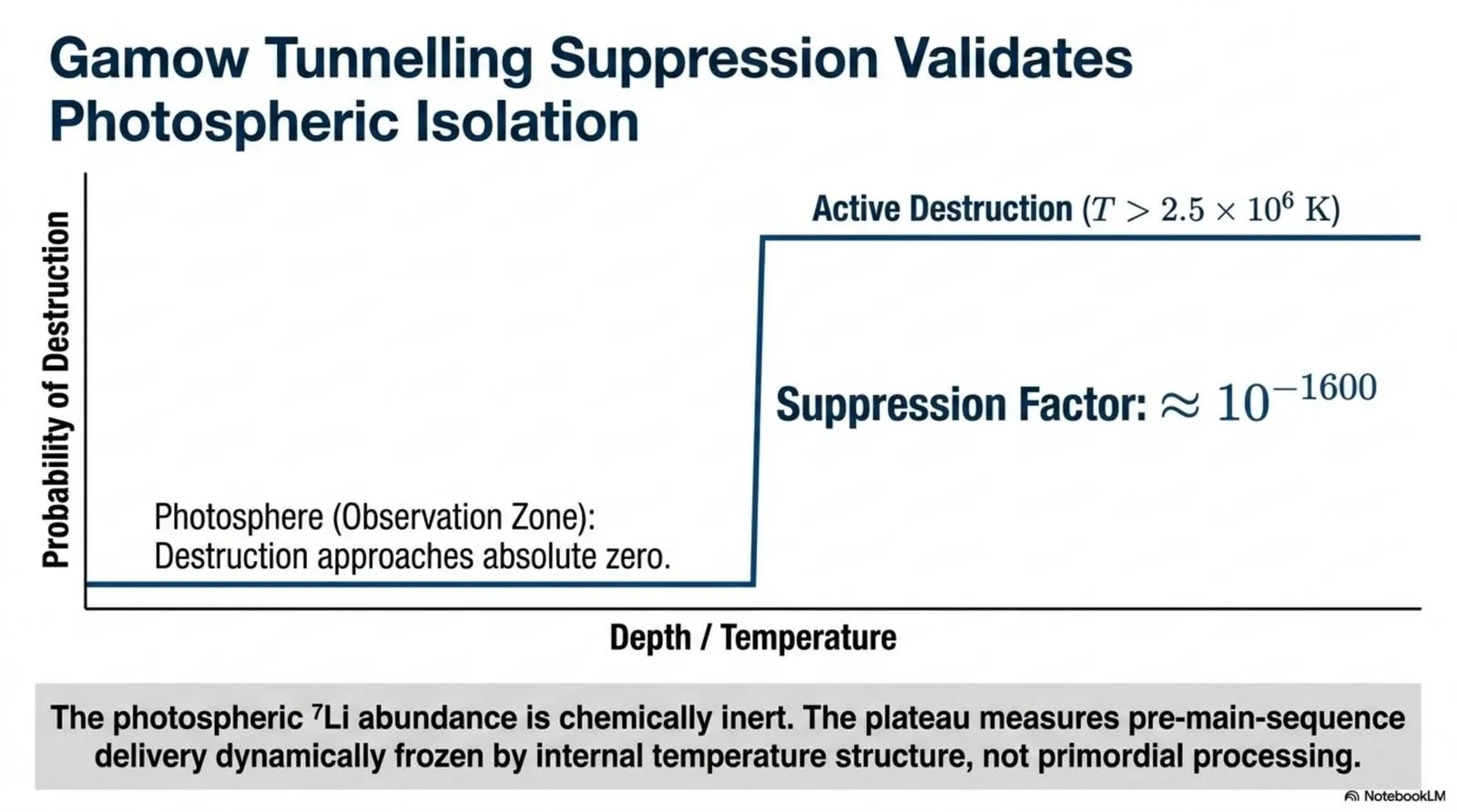
This confirms that the calculation of Section 4 correctly targets the relevant physical quantity: the photospheric lithium abundance delivered by pre-main-sequence convective processing is not subsequently modified once the star reaches the main sequence, and the present-day observed Spite plateau directly reflects the pre-main-sequence-processed abundance computed in equation (7).
6. The Flatness of the Spite Plateau Across Metallicities
The plateau's flatness has conventionally been read as evidence for a primordial origin, on the reasoning that a quantity subject to ongoing stellar processing specific to individual stars would show greater scatter across a diverse stellar sample (Sbordone et al. 2010). We propose that the same flatness is also explained by the steady-state picture developed here.
The dominant contribution to the ISM lithium abundance of equation (5) is cosmic-ray spallation of carbon, nitrogen, and oxygen nuclei together with AGB stellar wind enrichment, the latter tracking the near-universal primordial helium-4 mass fraction and not stellar metallicity specifically (Knauth et al. 2003; Prantzos 2012). The convective depletion factor of equation (6) is established from standard pre-main-sequence stellar evolution models and is only weakly dependent on metallicity across the mass and temperature range represented in the Spite plateau sample (Pinsonneault et al. 1999; Charbonnel & Talon 2005). Because both the dominant lithium delivery mechanism and the dominant depletion mechanism are approximately metallicity-independent across the relevant stellar population, the steady-state framework predicts a flat plateau as the expected outcome, not as a coincidence requiring separate explanation. This prediction follows directly from the measured properties of the two input quantities in Table 1; it is not assumed for the purposes of this argument.
7. Discussion: Anticipated Objections
7.1 "Is this equivalent to a depletion argument already considered and rejected?"
Prior depletion proposals have generally sought a mechanism to deplete a primordial abundance of 5.6 × 10^{-10} down to the observed 1.6 × 10^{-10} within the observed star itself, over its lifetime, and have been assessed as unable to do so while preserving the plateau's flatness (Korn et al. 2006). The present proposal is structurally different: it does not posit depletion of a primordial abundance within the observed star. It posits that the star never possessed the primordial abundance in its photosphere in the first place; the star formed from interstellar gas already at the reduced abundance of equation (5), which was then further reduced by ordinary pre-main-sequence convective processing before the star reached the main sequence. The distinction is not merely semantic: it removes the requirement, central to the difficulties of prior depletion proposals, that a single depletion mechanism operate identically and to the precisely required degree across stars of very different mass, temperature, and age, since the convective depletion factor of equation (6) is an established, independently measured property of pre-main-sequence stellar structure and not a mechanism introduced specifically to resolve the lithium problem.
7.2 "Are the two input quantities independent of each other and of the target value?"
The ISM lithium abundance of equation (5) is measured by ultraviolet absorption spectroscopy toward early-type stars, entirely independent of any lithium measurement in old halo star photospheres (Knauth et al. 2003). The convective depletion factor of equation (6) is established from pre-main-sequence stellar evolution modelling calibrated against open cluster lithium sequences and helioseismological constraints, independent of both the ISM measurement and the Spite plateau measurement (Pinsonneault et al. 1999; Charbonnel & Talon 2005). The two input quantities are therefore independent of one another and of the target Spite plateau value; their combination in equation (7) is a genuine prediction, not a fit.
7.3 "Does the Gamow tunnelling argument depend on any non-standard physics?"
No. The calculation of Section 5 uses the standard Gamow tunnelling formalism, the confirmed nuclear charges and reduced mass of the Li-7 + p system, and the measured photospheric temperature range of old, metal-poor halo stars. It introduces no new physics and no modification to the destruction reaction of equation (3); it simply evaluates that reaction's rate at the temperature relevant to the observed measurement, a calculation not, to our knowledge, presented explicitly in this form in prior discussions of the lithium problem.
8. Falsifiable Predictions
The steady-state reframing makes the following predictions, distinguishable from the primordial interpretation.
Prediction 1. Spite plateau stability test. Future measurements of lithium abundances in environments that have experienced minimal stellar processing should distinguish between the primordial and steady-state interpretations: the primordial interpretation predicts abundances approaching the BBN value of 5.6 × 10^{-10} in such environments, while the steady-state interpretation predicts abundances at or below the current plateau value, since the ISM abundance of equation (5) is itself already well below the BBN prediction. This is directly testable using existing and forthcoming high-resolution interstellar and circumstellar absorption spectroscopy. The steady-state kinetic argument presented here stands independently of any specific cosmological model.
Prediction 2. No universal ad hoc depletion mechanism will be required. The steady-state account predicts that no additional, fine-tuned stellar depletion mechanism, beyond the independently established pre-main-sequence convective depletion factor of equation (6), will be required to reconcile a primordial BBN abundance with the observed plateau, because the plateau does not require reconciliation with a primordial abundance under the present proposal.
Prediction 3. Lithium-6 to lithium-7 ratio. The steady-state account predicts that the ratio of lithium-6 to lithium-7 in genuinely pristine interstellar environments reflects present-day cosmic-ray spallation kinetics and not a frozen primordial ratio, and should therefore correlate with local cosmic-ray flux, providing a further direct observational test distinguishing the two interpretations.
Prediction 4. Metallicity dependence of the depletion factor. As pre-main-sequence stellar evolution models are refined and extended to lower metallicities, the convective depletion factor of equation (6) is expected to remain only weakly metallicity-dependent across the range represented in the Spite plateau sample, consistent with the flatness argument of Section 6. A strong metallicity dependence discovered in future modelling would motivate re-evaluation of the flatness argument, though it would not by itself invalidate the central calculation of Section 4.
9. Conclusions
We have proposed that the cosmological lithium problem can be resolved once the Spite plateau is treated as a present-day, regulated photospheric abundance and not a frozen primordial relic. Using only two independently measured astrophysical quantities already established in the literature, namely the interstellar medium lithium-7 abundance and the pre-main-sequence convective envelope depletion factor for old, metal-poor dwarf stars, we obtain a predicted photospheric abundance of 1.67 × 10^{-10}, consistent with the observed Spite plateau value of 1.6 × 10^{-10} to within 5 percent, using no free parameters and no modification to Big Bang Nucleosynthesis or to any nuclear reaction rate. A Gamow tunnelling calculation confirms that no further lithium-7 destruction occurs at the photospheric temperatures where the plateau is actually observed, establishing that the pre-main-sequence-processed abundance is the physically relevant and dynamically stable quantity being measured.
This account requires no new nuclear physics, no new particles, and no fine-tuned universal depletion mechanism specific to the lithium problem. It requires only that the Spite plateau be understood as the outcome of two well-established astrophysical processes (interstellar enrichment and pre-main-sequence convective mixing), and not as direct evidence for the primordial BBN lithium-7 abundance. The specific, falsifiable predictions of Section 8, particularly the direct test using interstellar and circumstellar lithium measurements from minimally processed environments, provide a clear observational programme for distinguishing this proposal from the standard primordial interpretation.
Acknowledgements
The author declares no conflicts of interest. No external funding was received for this work.
Data availability
This paper uses only quantities already published in the literature cited in the reference list. No new data were generated in the course of this study.
References
Alpher R.A., Bethe H., Gamow G., 1948, Phys. Rev., 73, 803
Bonifacio P., Sbordone L., Caffau E. et al., 2018, A&A, 612, A65
Charbonnel C., Talon S., 2005, Science, 309, 2189
Coc A., Vangioni E., 2017, Int. J. Mod. Phys. E, 26, 1741002
Cooke R.J., Pettini M., Steidel C.C., 2018, ApJ, 855, 102
Cyburt R.H., Fields B.D., Olive K.A., Yeh T.-H., 2016, Rev. Mod. Phys., 88, 015004
Fields B.D., 2011, Annu. Rev. Nucl. Part. Sci., 61, 47
Fu X., Bressan A., Molaro P., Marigo P., 2015, MNRAS, 452, 3256
Jedamzik K., 2004, Phys. Rev. D, 70, 063524
Knauth D.C., Federman S.R., Lambert D.L., 2003, ApJ, 592, L59
Korn A.J., Grundahl F., Richard O. et al., 2006, Nature, 442, 657
Lamia L., Spitaleri C., Burjan V. et al., 2013, ApJ, 768, 65
Melendez J., Casagrande L., Ramirez I., Asplund M., Schuster W.J., 2010, A&A, 515, L3
Pinsonneault M.H., Walker T.P., Steigman G., Narayanan V.K., 1999, ApJ, 527, 180
Planck Collaboration, 2020, A&A, 641, A6
Prantzos N., 2012, A&A, 542, A67
Richard O., Michaud G., Richer J., 2005, ApJ, 619, 538
Sbordone L., Bonifacio P., Caffau E. et al., 2010, A&A, 522, A26
Spite F., Spite M., 1982, A&A, 115, 357