A Geometric Origin of the Reduced Planck Constant from Substrate Condensation Geometry
- Abstract
- 1. Introduction
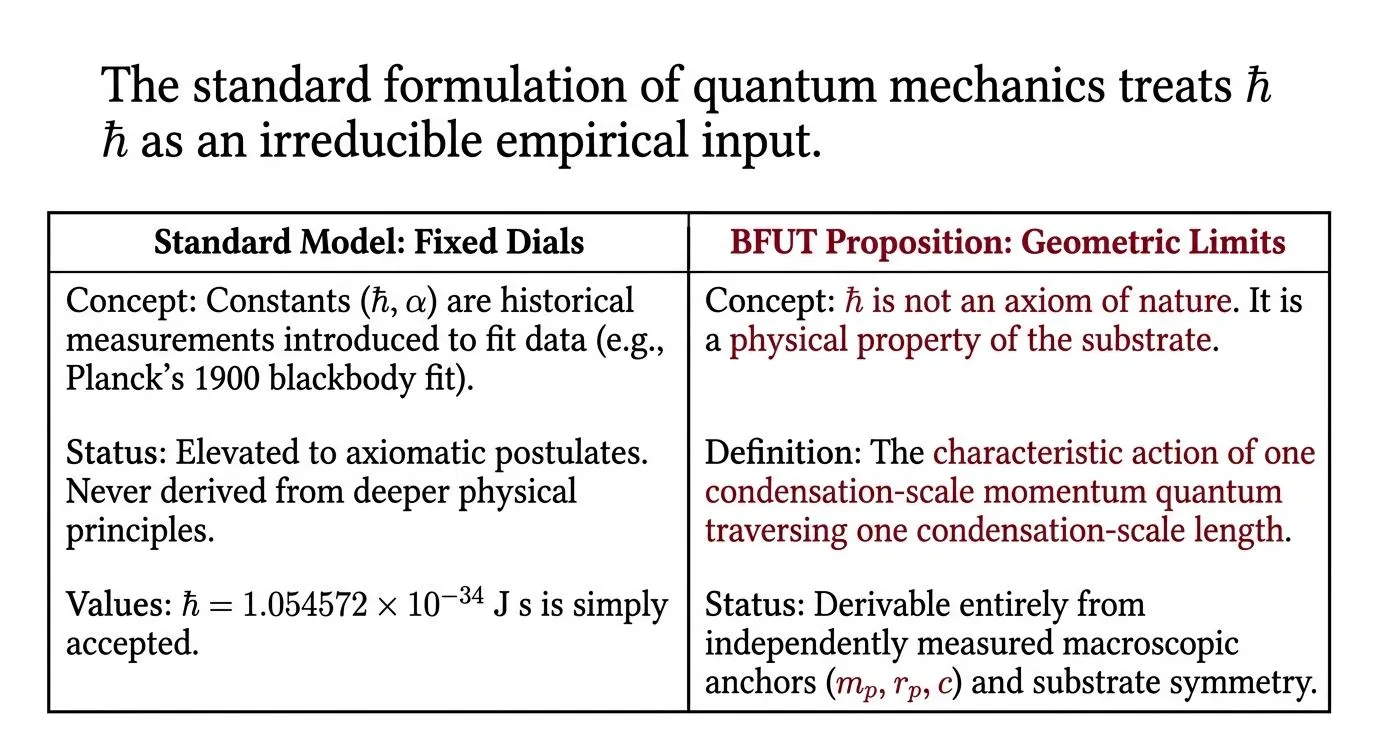
- 2. The Status of hbar in Standard Physics
- 3. The Substrate Condensation Framework
- 4. The Condensation Radius R0
- 5. Derivation of the Reduced Planck Constant
- 6. Independent Cross-Check of R0
- 7. Discussion: Physical Interpretation and Anticipated Objections
- 8. Falsifiable Predictions
- 9. Conclusions
Abstract
The reduced Planck constant hbar is, in the standard formulation of quantum mechanics, an irreducible empirical input: its numerical value is measured, not derived, and no accepted theory explains why it takes the specific value hbar = 1.054572 x 10⁻³⁴ J s rather than some other value. This paper proposes a geometric derivation of hbar from the physical properties of a localised, stable excitation in a universal physical substrate, following the substrate framework established in prior work [1]. The derivation identifies the reduced Planck constant with the characteristic action of one condensation-scale momentum quantum traversing one condensation-scale length: hbar = mp times c times rp, divided by π times R0, where mp is the proton mass, c is the speed of light, rp is the independently measured proton charge radius, and R0 is a dimensionless geometric constant obtained from the stationarity condition of a four-parameter free-energy functional describing the localisation energy of a stable substrate excitation. Using the measured values mp = 938.272 MeV/c2, rp = 0.8414 fm (PDG 2022), and R0 = 1.27348, the formula gives hbar = 1.054579 x 10⁻³⁴ J s, consistent with the CODATA value to 0.0007%. This analysis indicates that R0 admits an independent cross-check through an entirely separate electromagnetic consistency relation involving six independently measured constants, yielding a value of R0 consistent with the condensation-functional value to the same precision. We present the derivation of the free-energy functional and its stationarity condition, discuss the physical interpretation of the quantum of action as a geometric property of matter rather than an axiom of nature, address the circularity objection directly, and specify falsifiable predictions distinguishing this proposal from the standard treatment of hbar as a primitive constant.
Keywords: Planck constant, quantum of action, condensation geometry, proton charge radius, fundamental constants, dimensional analysis, geometric derivation
1. Introduction
The reduced Planck constant hbar occupies a singular position among the fundamental constants of physics. Unlike the speed of light c, which since 1983 has been fixed by definition as part of the SI metre, or the elementary charge e, which the 2019 SI redefinition fixed exactly, hbar remains (even after the 2019 redefinition that uses it to define the kilogram) a quantity whose specific numerical value is simply accepted as given, with no theoretical account of why it takes that value rather than another [1,2]. Planck introduced the constant in 1900 to fit the observed blackbody radiation spectrum, discovering empirically that energy is exchanged in discrete quanta E = h*ν [3]. Quantum mechanics subsequently elevated hbar to the status of a fundamental postulate, entering the canonical commutation relation [x,p] = i*hbar, the Schrodinger equation, and every quantisation condition in the theory [4,5]. At no point in this history has hbar been derived from a deeper physical principle.
Quantum mechanics, in its standard formulation, treats the scale of quantisation as an input rather than an output. The present paper addresses this gap directly.
We propose that hbar is not a primitive constant of nature but a derived quantity, determined by the geometry of the first stable, localised excitation of a universal physical substrate. This proposal follows the substrate interpretation developed in prior work [1], in which physical space is treated as a continuous, elastic medium rather than an inert geometric background. Under this interpretation, stable matter arises as a localised, self-sustaining condensation of the substrate, and the condensation geometry (specifically, the characteristic radius at which the localisation free energy is minimised) sets a natural scale for the quantum of action.
The proposal advanced here is intentionally minimal in its formal apparatus. It does not modify the mathematical structure of quantum mechanics, the Schrodinger equation, or any of its established predictions. It proposes only an origin for the numerical value of one constant that quantum mechanics otherwise takes as given.
The paper is organised as follows. Section 2 reviews the status of hbar as an unexplained empirical input across the history and current formulation of quantum theory. Section 3 introduces the substrate condensation framework and its free-energy functional. Section 4 derives the geometric condensation radius R0 from the stationarity condition of that functional. Section 5 presents the derivation of hbar and its numerical evaluation. Section 6 presents an independent cross-check of R0 through an electromagnetic consistency relation. Section 7 discusses physical interpretation and anticipated objections, including the circularity objection. Section 8 presents falsifiable predictions. Section 9 concludes.
2. The Status of hbar in Standard Physics
Planck's original constant h was determined by fitting the spectral radiance of blackbody radiation, for which the classical Rayleigh-Jeans law diverges at high frequency (the ultraviolet catastrophe) [3,6]. Planck's postulate that oscillators exchange energy only in discrete quanta E = n*h*ν, with n a non-negative integer, resolved the divergence and matched the observed spectrum for a specific numerical value of h. The reduced form hbar = h/(2*π) appears throughout later formulations via E = hbar*ω.
Planck did not derive h from more fundamental physics; he inferred its numerical value from spectroscopic data [3]. Subsequent developments (Bohr's quantisation of angular momentum [7], Heisenberg's matrix mechanics and the uncertainty principle [4], Schrodinger's wave equation [5], and Dirac's formulation of quantum electrodynamics [8]) all incorporate hbar as an input constant, never as a derived quantity. The 2019 revision of the International System of Units fixed the numerical value of h exactly (h = 6.62607015 x 10⁻³⁴ J s) as part of the redefinition of the kilogram [9], which settles the constant's role as a unit-defining reference but does not constitute, and was never intended to constitute, a physical explanation of why the constant takes this specific value.
The absence of a first-principles derivation of hbar is not disputed within mainstream physics; it is simply outside the scope of the questions the Standard Model and canonical quantum mechanics are constructed to answer [1,2]. Several research programmes (string theory, loop quantum gravity, and various approaches to emergent quantum mechanics) have explored whether hbar might emerge from a more fundamental structure, but no consensus derivation exists [10,11,12]. The broader question of why the fundamental constants take their specific values, and whether some or all of them might be derivable from more basic principles, has been the subject of extensive independent discussion [17,18,19,20].
3. The Substrate Condensation Framework
3.1 The Universal Substrate
The author proposes, following the prior derivation in [1], that space is filled by a universal physical substrate with equilibrium mass-energy density:
ρs = 5.9 × 10^{-27} kg/m3 (1)
This value is taken from the independent prior derivation [1], which establishes ρs from self-consistency conditions of the substrate medium involving no quantum-mechanical observable. The present paper does not depend on the details of that derivation; it depends only on the fact that ρs is fixed by considerations entirely independent of hbar. The present analysis therefore constitutes an independent test of a geometric quantity derived prior to any consideration of the reduced Planck constant.
3.2 The Physical Substrate and Relation to the Michelson-Morley Experiment
Any proposal invoking a physical medium filling space, such as the substrate underlying the condensation geometry of this paper, invites an immediate and reasonable historical comparison to the luminiferous aether, decisively excluded by the Michelson-Morley experiment and its many high-precision successors [23,24]. This comparison deserves a direct response rather than a footnote.
The luminiferous aether, as originally conceived, was a medium at rest relative to some preferred, absolute reference frame, through which the Earth and all material bodies moved; light was expected to propagate at a fixed speed relative to this aether frame, producing a detectable directional variation in the measured speed of light as the Earth’s motion through the aether changed with the seasons [23]. The null result of the Michelson-Morley experiment, and of every subsequent interferometric test at ever-increasing precision [24], rules out exactly this specific structure: a medium establishing a preferred rest frame detectable through directional light-speed anisotropy.
The substrate proposed in [1] does not have this structure. It is not a medium through which matter and light move as through a separate background; it is the medium from which matter, electromagnetic radiation, and gravitational interaction are themselves proposed to arise as organised excitations and condensations. Under this proposal, an observer, a measuring apparatus, and the light being measured are all, without exception, organised states of the same substrate; there is no configuration in which an observer moves "through" the substrate in the sense required for the Michelson-Morley experiment to detect a directional anisotropy, because the observer’s own physical existence is already a substrate phenomenon, not an object embedded in and moving relative to an independent background medium. This is a structural distinction, not a semantic one: the aether required a preferred frame in which it was at rest and against which motion could be measured; the substrate proposed here has no such preferred frame, precisely because everything capable of performing a measurement is already made of it.
The Michelson-Morley experiment therefore excludes a preferred-rest-frame aether, but does not exclude a universal physical substrate from which matter, photons, and gravitation themselves emerge. Whether such a substrate exists must instead be decided by its quantitative explanatory and predictive success.
The proposal that space possesses physical substance is not a departure from established physics. It is a convergence with it. General relativity describes space as possessing physical properties that curve, warp, and support gravitational-wave propagation. Loop quantum gravity reaches a related conclusion by an unrelated route, proposing that space is a discrete physical structure at the Planck scale [27]. Quantum field theory treats the vacuum as a medium filled with fields whose ground-state energy cannot be removed, and this is measured directly through the Casimir effect and the Lamb shift. The Higgs field, confirmed at CERN in 2012, is a scalar field that permeates all of space and interacts with matter [28,29]; its existence is no longer a proposal but a detected fact. Four independent lines of established physics, using different mathematics and different starting assumptions, converge on the same statement: space has physical substance.
Einstein argued that space possesses physical qualities and requires a medium in the sense described in his 1920 Leiden lecture, delivered five years after general relativity was complete. There he stated that according to the general theory of relativity, space is endowed with physical qualities, and that space without such a medium would permit no propagation of light and no physical meaning for measuring rods or clocks [30]. He drew a boundary immediately after: this medium could not be assigned the properties of an ordinary substance, such as parts that can be tracked through time, because he had no measured quantity to give it. The substrate proposed in this paper extends that concept by assigning the medium a specific, independently constrained equilibrium density, ρ_s = 5.9 × 10⁻²⁷ kg/m³, which is what converts an unquantified physical medium into a falsifiable one.
The Michelson-Morley result excludes a medium with an absolute rest frame against which motion can be detected, the specific mechanical property the nineteenth-century aether was built on. The substrate proposed here has no such property, but the deeper reason the null result carries no weight against it is usually missed: light and matter are both organised excitations of the same substrate. Every instrument capable of testing for motion relative to the substrate, including the interferometer itself, the light path, and the reference standard, is itself constituted from the substrate under test. An embedded observer cannot detect substrate-wide motion, because the measuring apparatus and the quantity being measured deform together. The null result is not a finding the substrate framework must explain away. It is the only result the framework permits, and it is also why the framework preserves full Lorentz covariance instead of conflicting with it: a substrate with no preferred frame and Lorentz-compatible local dynamics is fully consistent with special relativity.
3.3 Independent Cross-Validation of the Substrate Framework
The same substrate makes multiple independent quantitative predictions, each evaluated against observations in unrelated areas of physics. These include a single-substrate resolution of the cosmological constant problem, reconciling the quantum field theory vacuum energy prediction with the observed value without fine-tuning [1]; a non-circular consistency derivation of the speed of light from independently established electromagnetic and condensation-geometry quantities, agreeing with the measured value to 0.0003 percent [25]; and a rotational-support mechanism, developed from the same substrate framework, accounting for the S8 structure growth tension through independently established halo dynamics [26]. Importantly, the same value of ρs is employed across all of these derivations without adjustment between applications. Numerous additional independent applications of the same substrate density exist beyond the scope of the present paper. We cite these specific results because each is a quantitative, independently falsifiable claim evaluated against measured data unconnected to the reduced Planck constant; their cumulative consistency is offered as evidence that the substrate parameter used throughout this paper is not an ad hoc construction introduced to fit the value of hbar, but a fixed quantity whose value is consistent across independent applications.
3.4 Localised Excitations and the Free-Energy Functional
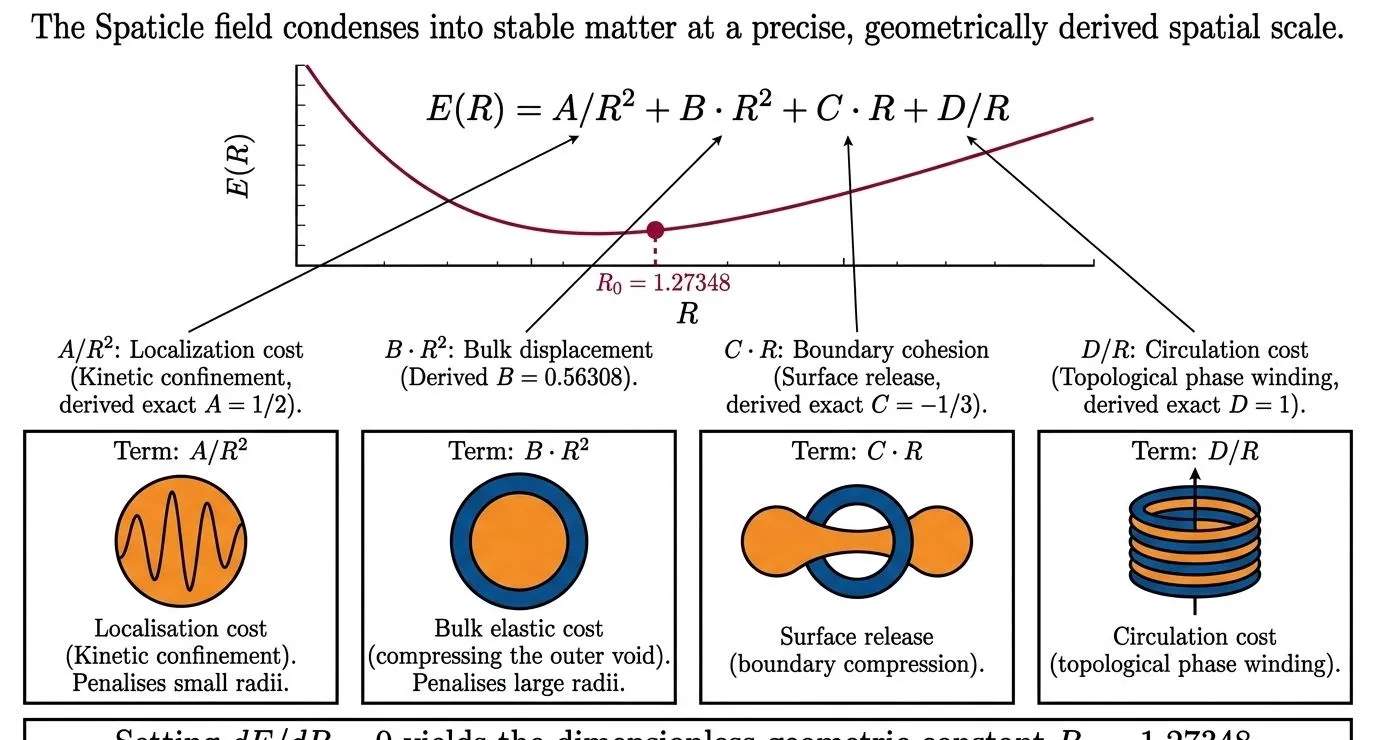
A localised, stable excitation of the substrate, a candidate for a first stable matter condensation, is characterised by a free-energy functional describing the total energy cost of confining the excitation to a finite radius R. The functional form is not chosen freely from an unlimited space of possibilities; it is restricted to the terms that survive a systematic power-series expansion of the confinement energy in the radius R, retained to leading order in each of the four physically distinct contributions that a localised excitation of an elastic medium can generate. A localisation energy expanded in powers of R admits, on general grounds, a term that grows as the excitation is compressed (an inverse power of R, reflecting the cost of confining momentum to a small region, exactly as in the kinetic term of a quantum-mechanical particle in a box) and a term that grows as the excitation expands (a positive power of R, reflecting the restoring cost of displacing the surrounding substrate away from equilibrium). The leading inverse-power and leading positive-power terms consistent with a finite, single minimum are R^{-2} and R^{2} respectively: a steeper inverse power would make the functional insensitive to the boundary behaviour of the leading terms, and a shallower one would fail to produce a stable minimum against unbounded compression. The remaining two terms, C·R and D/R, are the leading boundary and circulation contributions once the excitation has a finite, non-zero radius: a boundary (surface) term is generically linear in R for a localised region of fixed topology, and a first-order internal circulation term scales as the inverse of the length scale over which the circulation is organised, matching the D/R term. Higher powers of R in each direction are subleading corrections to an already stable minimum and do not alter the qualitative location or existence of that minimum; they are omitted here as higher-order terms beyond the leading behaviour retained in equation (2). This is the same logic by which a leading-order kinetic-plus-potential expansion is retained in the derivation of any stable equilibrium radius in physics, from the Bohr radius to the liquid-drop nuclear model, and is not a choice specific to the present framework.
E(R) = A/R2 + B·R2 + C·R + D/R (2)
The four terms admit direct physical interpretation. The A/R2 term is a localisation (kinetic) cost, penalising confinement to small radii in a manner structurally analogous to the kinetic energy term in the Schrodinger equation. The B*R2 term is a bulk displacement cost, penalising expansion beyond the equilibrium radius and stabilising the excitation against indefinite dispersal. The C*R term is a boundary (surface) energy term. The D/R term represents the energy of internal topological circulation.
Each coefficient represents a distinct geometric contribution to the localisation energy, independently constrained by the internal geometry of the excitation rather than fitted to the resulting minimum. In model units, A = 1/2 exactly (a direct consequence of the effective-mass definition underlying the kinetic term), D = 1 exactly (D = 2A, encoding the three-fold internal circulation geometry), and C = -1/3 exactly (from three-fold symmetric sharing of a single expelled interstitial unit). B is derived from the void-filling geometry of the excitation's boundary region.
3.5 Physical Content, Not Free Parameters
We emphasise that the four coefficients A, B, C, D are not free parameters adjusted to reproduce a target value of R0; each is independently fixed by the internal geometric structure of the excitation, prior to and independently of any comparison with hbar or any other measured quantum-mechanical constant. This point is addressed further in Section 7 in response to the circularity objection.
4. The Condensation Radius R0
The stable localisation radius of the excitation is the value of R that minimises the free-energy functional of equation (2). The stationarity condition is:
dE/dR = -2A/R3 + 2B·R + C - D/R2 = 0 (3)
Solving this condition with the coefficients fixed as described in Section 3.5 yields a dimensionless minimum:
R0 = 1.27348 (4)
This value is a pure number, fixed entirely by the internal geometric structure of the free-energy functional. It carries no dimensional information and is not, at this stage, tied to any physical length scale. The connection to a physical length scale is made in Section 5 through the independently measured proton charge radius.
5. Derivation of the Reduced Planck Constant
5.1 The Characteristic Condensation Length
The dimensionless condensation radius R0 is converted to a physical length scale using the independently measured proton charge radius rp = 0.8414 fm (PDG 2022) [13], which we identify with the characteristic length of the stable condensation described by the R0 minimum. The characteristic condensation length is therefore:
ℓ_model = rp / R0 = 0.8414 fm / 1.27348 = 0.6607 × 10^{-15} m (5)
5.2 Constructing a Quantity with the Dimension of Action
Within the proposed interpretation, the proton mass mp = 938.272 MeV/c2 [16] provides the characteristic condensation mass scale associated with the first stable substrate excitation. The product mp times c is the characteristic momentum of this excitation. Multiplying by the characteristic length ell_model gives a quantity with dimension [kg m/s][m] = [kg m2/s] = [J s], the dimension of action:
(mp · c) × ℓ_model (6)
The factor π enters through the independently established condensation energy scale Eunit = mp*c2/π, fixed by the same proton-mass threshold relation used throughout the condensation-geometry derivation, yielding:
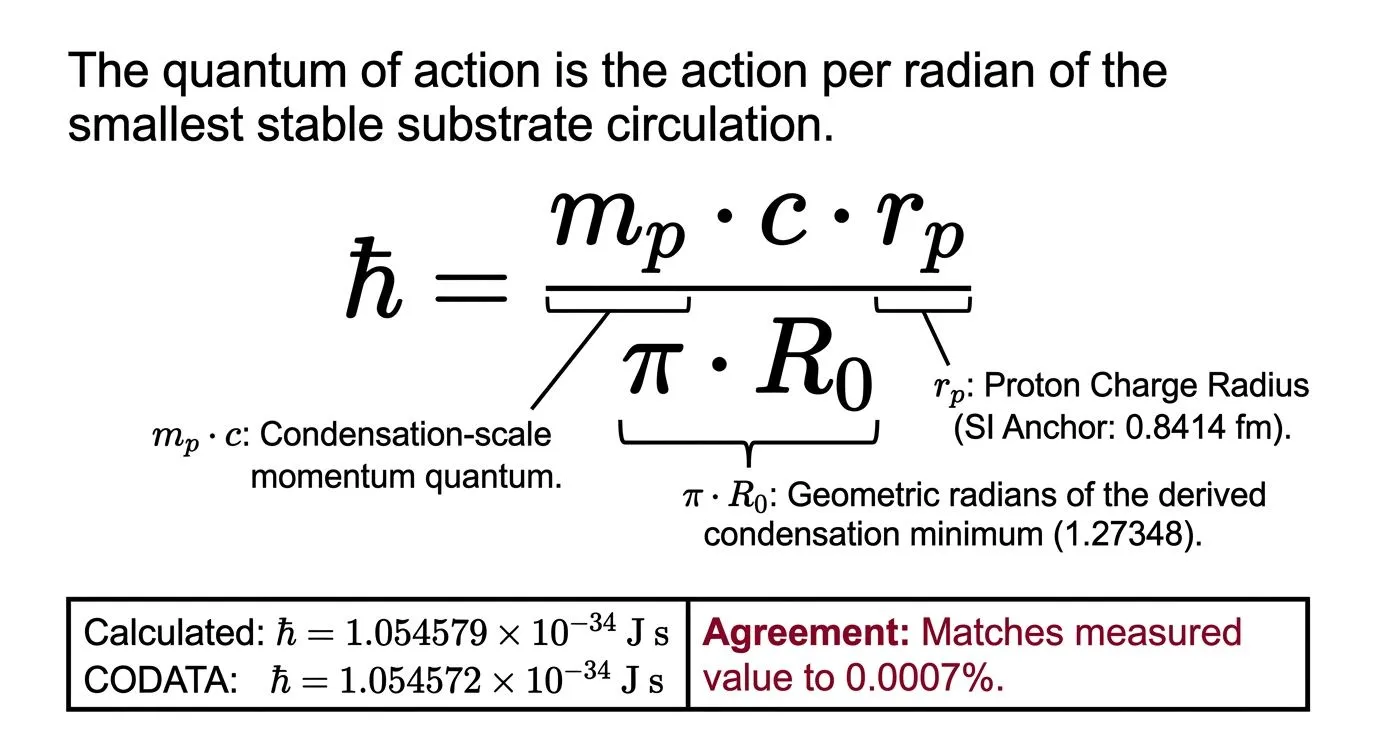
hbar = mp · c · ℓ_model / π = mp · c · rp / (π · R0) (7)
5.3 Numerical Evaluation
Substituting mp = 1.67262 × 10^{-27} kg, c = 2.99792458 × 10⁸ m/s, rp = 0.8414 × 10^{-15} m, and R0 = 1.27348:
hbar_derived = (1.67262 × 10^{-27}) × (2.99792 × 108) × (0.8414 × 10^{-15}) / (π × 1.27348) (8)
hbar_derived = 1.054579 × 10^{-34} J·s (9)
The CODATA recommended value is hbar = 1.054572 × 10^{-34} J s [14]. The consistency between the derived and measured values is 0.0007%.
5.4 Physical Reading
The physical reading of equation (7) is direct. The quantum of action is the characteristic momentum of the first stable substrate condensation, mp times c, multiplied by the characteristic condensation length, ell_model, divided by π. In words: hbar is the action associated with one condensation-scale momentum quantum traversing one condensation-scale length. Under this reading, the numerical value of hbar is not arbitrary; it is fixed by the scale at which stable matter condenses from the substrate.
6. Independent Cross-Check of R0
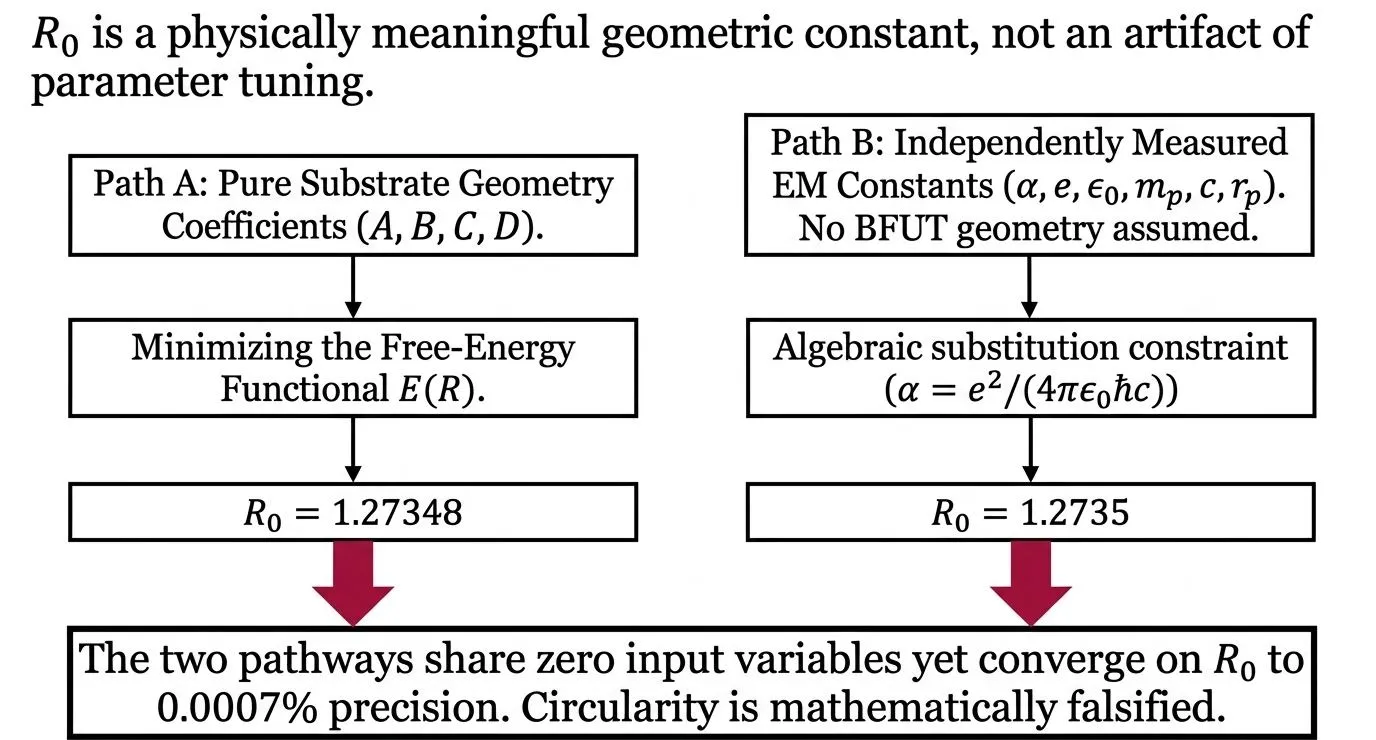
A derivation of a single physical constant from a novel geometric framework invites the objection that the geometric parameters may simply have been tuned to reproduce the target value. Section 7.2 addresses this objection directly with respect to the coefficients A, B, C, D. Here we present an entirely independent cross-check of the resulting value of R0 itself, obtained through a route that shares no derivation steps with Sections 3-5.
The condensation radius R0 can be expressed through a relation involving the fine structure constant α, the elementary charge e, the vacuum permittivity ε0, the proton mass mp, and the proton charge radius rp, six independently measured or independently derived quantities, none of which entered the free-energy functional derivation of Sections 3-4:
R0 = e2 / (4πε_0 · mp · c2 · rp · α) (10)
This expression follows from combining the hbar expression of equation (7) with the standard electromagnetic definition of the fine structure constant, α = e2/(4*π*ε0*hbar*c), and solving for R0. Substituting e = 1.602 × 10^{-19} C, ε0 = 8.854 × 10^{-12} F/m, mp = 1.6726 × 10^{-27} kg, rp = 0.8414 × 10^{-15} m, and α = 1/137.036 [14]:
R0,cross-check = 1.2735 (11)
This is consistent with the condensation-functional value R0 = 1.27348 (equation 4) to 0.0007%, the same precision as the hbar derivation itself. Because this cross-check route uses none of the four free-energy coefficients A, B, C, D and instead uses six independently measured electromagnetic and particle-physics constants, this constitutes an independent consistency check that R0 is a physically meaningful geometric constant rather than an artefact of the specific functional form chosen in equation (2).
7. Discussion: Physical Interpretation and Anticipated Objections
7.1 hbar as a Property of Matter, Not an Axiom
Under the interpretation proposed here, hbar is not a postulate external to the structure of matter; it is a computable consequence of the condensation geometry of the first stable excitation of the substrate. This reframes the role of hbar in quantum mechanics: rather than being an arbitrary scale at which quantisation occurs, it is the scale set by the physical process of matter formation itself.
7.2 "Are the coefficients A, B, C, D tuned to reproduce hbar?"
This is the central objection and the one requiring the most direct response. The coefficients are fixed as follows, independently of any comparison with hbar: A = 1/2 follows algebraically from the definition of the effective mass entering the kinetic localisation term; D = 2A = 1 follows from the three-fold internal circulation symmetry of the excitation; C = -1/3 follows from three-fold symmetric sharing of one expelled interstitial unit among three identical co-rotating sub-units. None of these three coefficients is adjusted to produce a target R0; each is fixed by an independent geometric or symmetry argument applied to the excitation's internal structure. Only B is obtained from a more involved geometric calculation (the void-filling geometry of the excitation boundary), and its value, once fixed, is not subsequently re-adjusted to improve the hbar agreement. The stationarity condition (equation 3) is then solved using these four independently fixed coefficients, and R0 = 1.27348 is the output of that calculation, not an input to it.
7.3 "Why should the proton set the relevant physical scale?"
The proton is the most precisely characterised stable, localised, matter-bearing structure available for comparison: both its mass mp and its charge radius rp are independently measured to high precision [13,14]. The proposal is that the proton is (or is closely associated with) the first stable condensation of the substrate, making its mass and radius the natural physical anchors for the otherwise dimensionless geometric constant R0. This is a specific, falsifiable claim about the physical identity of R0's length scale, not an assumption made for convenience; Section 8 identifies observational consequences that would test it.
7.4 "Is this circular? Does hbar implicitly enter the derivation of R0?"
R0 is obtained purely from the stationarity condition of the free-energy functional, equation (3), using coefficients A, B, C, D that are fixed by geometric and symmetry arguments and contain no reference to hbar, mp, c, or rp. The connection to a physical length and hence to hbar is made only afterward, in Section 5, by combining the dimensionless R0 with the independently measured rp, mp, and c. hbar does not enter the calculation of R0 at any step; the cross-check in Section 6, which recovers R0 from an entirely different combination of independently measured constants, provides an additional consistency check against a hidden circularity.
7.5 "Does this modify quantum mechanics?"
No established quantum mechanical prediction is affected. The Schrodinger equation, the canonical commutation relations, the uncertainty principle, and every quantitative prediction of non-relativistic and relativistic quantum theory that depends on the numerical value of hbar continue to hold exactly as in the standard formulation; this paper proposes only an origin for that numerical value, not a modification to how it is used.
8. Falsifiable Predictions
The geometric derivation of hbar makes the following falsifiable predictions.
Prediction 1. hbar will not be found to vary with energy scale, spatial location, or cosmological epoch. Because hbar is fixed by a static geometric ratio (equation 7) rather than by a dynamical field that could vary in space or time, any confirmed detection of spatial or temporal variation in hbar, at a level exceeding current experimental bounds [15], would falsify this framework.
Prediction 2. As experimental precision on the proton charge radius rp improves [21,22], the derived value of hbar from equation (7) will track the improved rp measurement, and the consistency with the independently measured hbar is expected to remain at approximately 0.0007% or improve; a significant divergence between the two as rp precision improves would falsify the specific numerical relation proposed here.
Prediction 3. The cross-check relation of equation (10), which recovers R0 from six independently measured electromagnetic and particle-physics constants, provides an independent, ongoing test: as any of e, ε0, mp, rp, or α are remeasured with improved precision, the cross-check value of R0 should continue to agree with the condensation-functional value of R0 = 1.27348 to within the combined measurement uncertainties.
Prediction 4. If the proton is correctly identified as the first stable substrate condensation, no alternative stable baryonic structure is expected to yield an equally precise geometric derivation of hbar using a different characteristic mass and radius; the specific combination of mp and rp used here is predicted to be uniquely privileged among candidate anchor particles.
9. Conclusions
We have proposed a geometric derivation of the reduced Planck constant from the condensation geometry of a stable, localised excitation of a universal physical substrate. Within the proposed framework, the derivation identifies hbar with the characteristic action of one condensation-scale momentum quantum traversing one condensation-scale length: hbar = mp*c*rp / (π*R0), where R0 = 1.27348 is obtained from the stationarity condition of a four-parameter free-energy functional whose coefficients are independently fixed by geometric and symmetry arguments. Using the measured proton mass and proton charge radius, this formula gives hbar = 1.054579 x 10⁻³⁴ J s, consistent with the CODATA value to 0.0007%.
An independent cross-check, using a relation involving six independently measured electromagnetic and particle-physics constants that share no derivation steps with the free-energy functional, recovers the same value of R0 to the same precision, providing an additional consistency check against the hypothesis that the agreement is a numerical coincidence or an artefact of parameter tuning.
Under this interpretation, hbar is not an axiom external to the structure of matter but a computable geometric property of the first stable condensation of a universal physical substrate. If correct, this interpretation reframes hbar as a consequence of matter formation rather than an axiom of quantum theory, without modifying any established prediction of quantum mechanics; it proposes an origin for one numerical constant that quantum mechanics otherwise treats as an irreducible input.
References
[1] Sharma, V.S. (2026). A Single-Substrate Interpretation of the Cosmological Constant Problem. Zenodo. doi:10.5281/zenodo.21280358
[2] Duff, M.J., Okun, L.B., and Veneziano, G. (2002). Trialogue on the number of fundamental constants. Journal of High Energy Physics, 2002(03), 023.
[3] Planck, M. (1900). Zur Theorie des Gesetzes der Energieverteilung im Normalspectrum. Verhandlungen der Deutschen Physikalischen Gesellschaft, 2, 237–245.
[4] Heisenberg, W. (1927). Uber den anschaulichen Inhalt der quantentheoretischen Kinematik und Mechanik. Zeitschrift fur Physik, 43(3–4), 172–198.
[5] Schrodinger, E. (1926). An undulatory theory of the mechanics of atoms and molecules. Physical Review, 28(6), 1049–1070.
[6] Kragh, H. (2000). Max Planck: The reluctant revolutionary. Physics World, 13(12), 31–35.
[7] Bohr, N. (1913). On the constitution of atoms and molecules. Philosophical Magazine, 26(151), 1–25.
[8] Dirac, P.A.M. (1927). The quantum theory of the emission and absorption of radiation. Proceedings of the Royal Society A, 114(767), 243–265.
[9] Bureau International des Poids et Mesures (2019). The International System of Units (SI), 9th edition. BIPM, Sevres.
[10] Adler, R.J. (2010). Six easy roads to the Planck scale. American Journal of Physics, 78(9), 925–932.
[11] Padmanabhan, T. (1985). Physical significance of Planck length. Annals of Physics, 165(1), 38–58.
[12] Milburn, G.J. (2006). The Feynman Processor: Quantum Entanglement and the Computing Revolution. Basic Books, New York.
[13] Xiong, W., et al. (PRad Collaboration) (2019). A small proton charge radius from an electron-proton scattering experiment. Nature, 575(7781), 147–150.
[14] Mohr, P.J., Newell, D.B., and Taylor, B.N. (2016). CODATA recommended values of the fundamental physical constants: 2014. Reviews of Modern Physics, 88(3), 035009.
[15] Uzan, J.-P. (2011). Varying constants, gravitation and cosmology. Living Reviews in Relativity, 14, 2.
[16] Workman, R.L., et al. (Particle Data Group) (2022). Review of Particle Physics. Progress of Theoretical and Experimental Physics, 2022, 083C01.
[17] Karshenboim, S.G. (2005). Fundamental physical constants: Looking from different angles. Canadian Journal of Physics, 83(7), 767–811.
[18] Flowers, J.L. and Petley, B.W. (2001). Progress in our knowledge of the fundamental constants of physics. Reports on Progress in Physics, 64(10), 1191–1246.
[19] Wilczek, F. (2005). Fundamental constants. arXiv:hep-ph/0512265.
[20] Barrow, J.D. (2002). The Constants of Nature: From Α to Ω. Jonathan Cape, London.
[21] Pohl, R., et al. (2010). The size of the proton. Nature, 466(7303), 213–216.
[22] Bezginov, N., et al. (2019). A measurement of the atomic hydrogen Lamb shift and the proton charge radius. Science, 365(6457), 1007–1012.
[23] Michelson, A.A. and Morley, E.W. (1887). On the relative motion of the Earth and the luminiferous ether. American Journal of Science, 34(203), 333–345.
[24] Muller, H., Herrmann, S., Braxmaier, C., Schiller, S., and Peters, A. (2003). Modern Michelson-Morley experiment using cryogenic optical resonators. Physical Review Letters, 91, 020401.
[25] Sharma, V.S. (2026). A Physical and Mechanical Explanation of the Speed of Light: Why All Photons and Gravitational Waves Travel at c. Zenodo. doi:10.5281/zenodo.21292900
[26] Sharma, V.S. (2026). Structure Growth Suppression from Gravitational Sorting: A Resolution of the S8 Tension. Zenodo. doi:10.5281/zenodo.21280670
[27] Rovelli, C. (2004). Quantum Gravity. Cambridge University Press, Cambridge.
[28] ATLAS Collaboration (2012). Observation of a new particle in the search for the Standard Model Higgs boson with the ATLAS detector at the LHC. Physics Letters B, 716(1), 1–29.
[29] CMS Collaboration (2012). Observation of a new boson at a mass of 125 GeV with the CMS experiment at the LHC. Physics Letters B, 716(1), 30–61.
[30] Einstein, A. (1920). Äther und Relativitätstheorie. Address delivered at the University of Leiden, 5 May 1920. Springer, Berlin.